







Humanoid robots rather than flesh-and-blood soldiers could one day take on some of the most dangerous jobs in war — and one startup is already testing that idea in Ukraine.
Sankaet Pathak, cofounder and CEO of Foundation, said there’s a “moral imperative” to put humanoid robots on the front lines rather than in people’s kitchens.
“I thought all of this stuff around home use was kind of stupid,” Pathak told Business Insider. “I feel like people can make the coffee and fold their laundry. I was like, ‘We need to do something else.'”
Advancements in drone technology and robotics are now central to the arsenal of modern warfare, enabling precision attacks at scale and at lower cost; however, that capability hasn’t always translated into clean, risk-free operations.
In the age of smart weapons and AI-enabled, autonomous systems, modern warfare still carries a high risk of civilian casualties, especially in dense urban environments.
Pathak said the current approach to war is often “brute force,” either risking soldiers’ lives or destroying a building to eliminate a single target.
He believes that in the future, humanoids could execute “surgical” operations, such as extracting a target. Near-term, they could support military operations such as reconnaissance and logistics.
Foundation said it recently conducted a test that could pave the way for those missions.
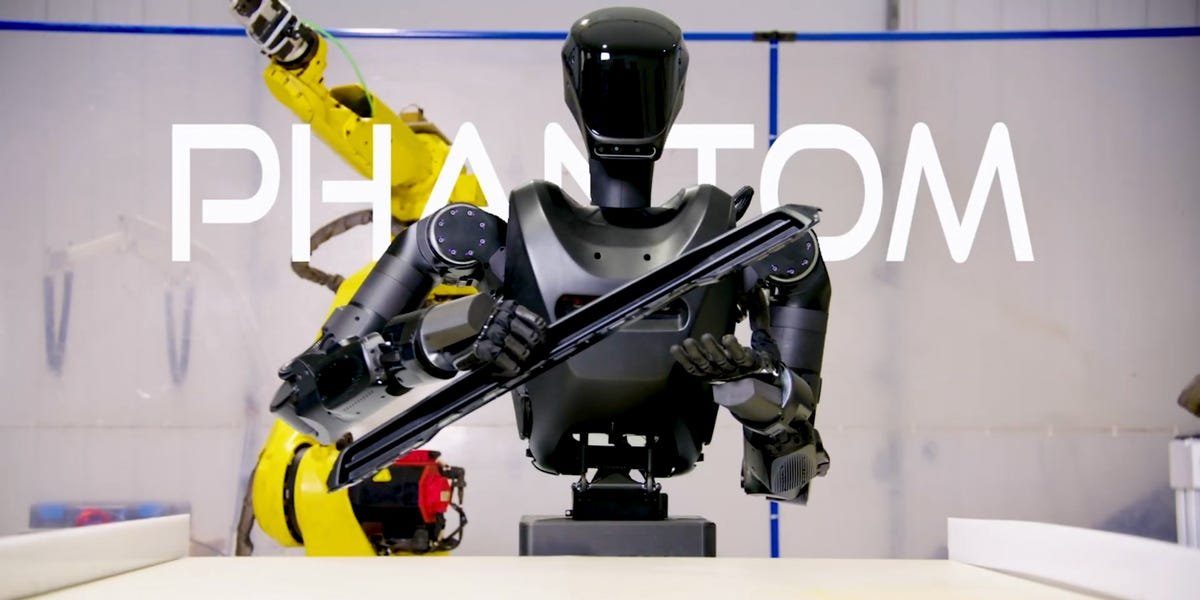
In February, the startup sent two of its Phantom robots to an undisclosed location in Ukraine for a closed pilot demonstration.
“You can hear bombs go off. You can hear electricity get cut. You’re actively in a warzone,” Pathak said of Foundation’s visit to the country, which for years has been fighting off a Russian invasion. “Most of the places are a battlefield as soon as you start going out of Kyiv.”
The CEO said the Phantom test solely focused on “supply pickup” to demonstrate that bipedal robots can effectively “carry supplies from outside to inside and avoid a soldier getting shot at.”
There was “significant interest based on what has been communicated” to the company, Pathak said. A spokesperson for Foundation said the startup has also secured a $24 million contract with the Pentagon. Eric Trump, the president’s son, was appointed chief strategy advisor in March.
Humanoid troops aren’t ready for deployment
Pathak said he didn’t want to “overstate” the Ukraine pilot. A large gap still exists between a humanoid that can slowly clean a test kitchen and one that can use an M4 carbine in a battlefield firefight.
Battery life and durability are among the constraints. Pathak said robot soldiers need longer battery life and must withstand water, dust, and shock.
Reliable manipulation — the ability for a robot to pick up an item and do something with it, like pulling the trigger on a rifle — also remains a major technological bottleneck.
“Right now, the big engineering hurdle is how do you build a highly-dextrous hand that is reliable, easier to manufacture, isn’t too massive, and isn’t too expensive,” Pathak said.
The CEO offered ambitious predictions for overcoming these challenges, saying that key engineering hurdles could be solved within a few years and that humanoid robots could carry out complex missions, such as target extraction, within five to 10 years.
Beyond the technical questions, ethical dilemmas surrounding autonomous weaponry, including concerns of accountability when humans are no longer in the loop, are also a consideration.
Pathak said that while there isn’t a simple line that can be drawn around autonomy, in ordinary circumstances, “you probably want a human in the loop before any kind of kill action is invoked.” Many Western militaries have made that a priority amid rapid technological advances in artificial intelligence and autonomous systems, though the extent remains an active debate.
“So if you actually need to shoot a gun, you need a human to really sign off, which is what happens with drones today as well,” he said. “But then there are exceptions to those cases as well, like an anti-drone gun or the Iron Dome. Those, you cannot wait for human reaction times because the alternative is 100% certainty of fatality.”
The defense industry at large pushes robotics and autonomous weapons as a matter of national security. Anduril cofounder Palmer Luckey has repeatedly said that the United States needs to be ahead of China on AI weapons. The top US admiral in the Pacific said this week that America’s AI technology lead over China is only six months to a year at best.
Unlike many other companies, Foundation has been particularly outspoken on using humanoids on the battlefield.
“Courage comes in limited supply,” Pathak said, while arguing that China is not having the same debate over military humanoids and that the US, Europe, and their allies need to be on alert. “If you build a utopia,” he said, “you have to be able to defend it.”
Read the full article here