







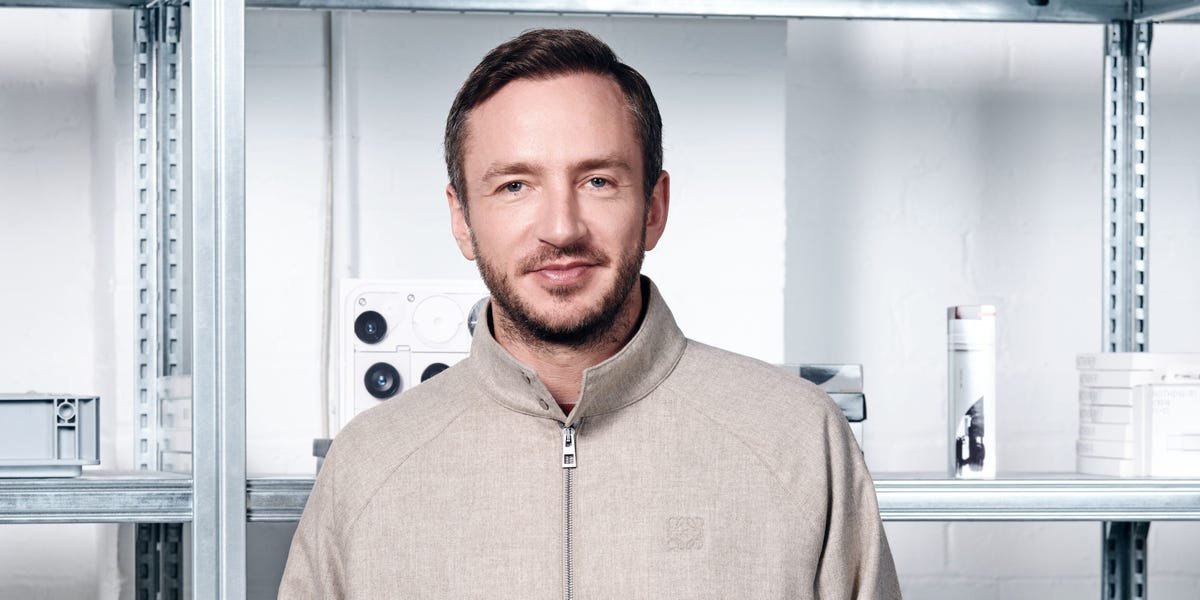


Charlie Smith thinks a lot of the fear around AI is overblown.
“When machines came along, we got new jobs. When computers came along, we got new jobs. And I really believe that we’re going to enter a new era of creativity,” with the help of AI, he said during an interview on Business Insider’s “CMO Insider” podcast.
In particular, Smith, who is the chief brand officer of consumer-tech company Nothing, said his interest in AI accelerated after joining Nothing in January and sitting next to the company’s founder, Carl Pei, whom he described as “a massive vibe coder.”
Likewise, Smith has embraced vibe-coding in his everyday routine and recently designed multiple apps that have reshaped how he organizes his workday, manages travel, and communicates.
“That’s what I find so empowering about AI,” he said. “Now, if you have an idea for an app and it’s literally only relevant to you, it doesn’t matter because you can build it in a few hours and then load it onto your phone.”
In Smith’s view, the most interesting part of AI isn’t hypothetical superintelligence. It’s the fact that people can already use it to automate small frustrations and build tools tailored to their own lives.
Apps he built are changing how he works and thinks
Smith recently vibe-coded several personal apps, including one that combines his emails, appointments, weather updates, and news coverage into a daily dashboard, and another that organizes his flight and boarding information.
“That’s been a game changer for me,” Smith said.
He added that AI-powered voice tools are also changing how he captures ideas throughout the day.
For example, Nothing recently launched a suite of AI-powered tools, including “Essential Voice,” a dictation tool that removes filler words and restructures spoken thoughts into cleaner written text.
“I really have stopped typing since using Essential Voice,” Smith said.
Why Nothing calls its AI products ‘essential’
Nothing’s AI strategy is focused less on futuristic language and more on utility, Smith said. The company intentionally avoids heavily emphasizing the term “AI” in its product positioning, he added.
“We’re calling our AI-powered products essential because it’s more about what they do,” Smith said.
Nothing’s long-term vision is based on the belief that devices will become “AI native” over the next several years, he added.
Smith predicts that computing could gradually shift away from app-based interfaces and toward systems that automatically surface information based on a user’s needs.
“We’re going to move from this kind of app world to a more agentic world,” Smith said.
The fear around AI is a ‘branding problem’
Even as Smith embraces AI tools personally, he acknowledged that the technology faces growing skepticism, particularly among younger consumers.
He believes much of that backlash comes from how AI companies market the technology.
“I really do think it’s a branding problem,” Smith said.
According to Smith, some AI executives have focused heavily on messaging around artificial general intelligence and job displacement.
“I think a lot of these leaders in tech of these AI companies are really talking up AGI and the fact that AI is going to take over our jobs in order to inflate the valuation of the company and get more funding,” he said.
Smith said he does not believe AI will eliminate human creativity or replace all jobs. Instead, he sees AI primarily as a productivity tool that can automate repetitive administrative work.
“We are trying to automate everything that we can so that these business-as-usual tasks of analytics and optimization and data reporting can all basically be done no longer manually,” Smith said of Nothing’s marketing operations.
That, he said, could free workers to spend more time developing ideas and solving problems creatively.
“How much time do we all waste on email and general admin that could be better spent doing other things?” Smith said.
Read the full article here