







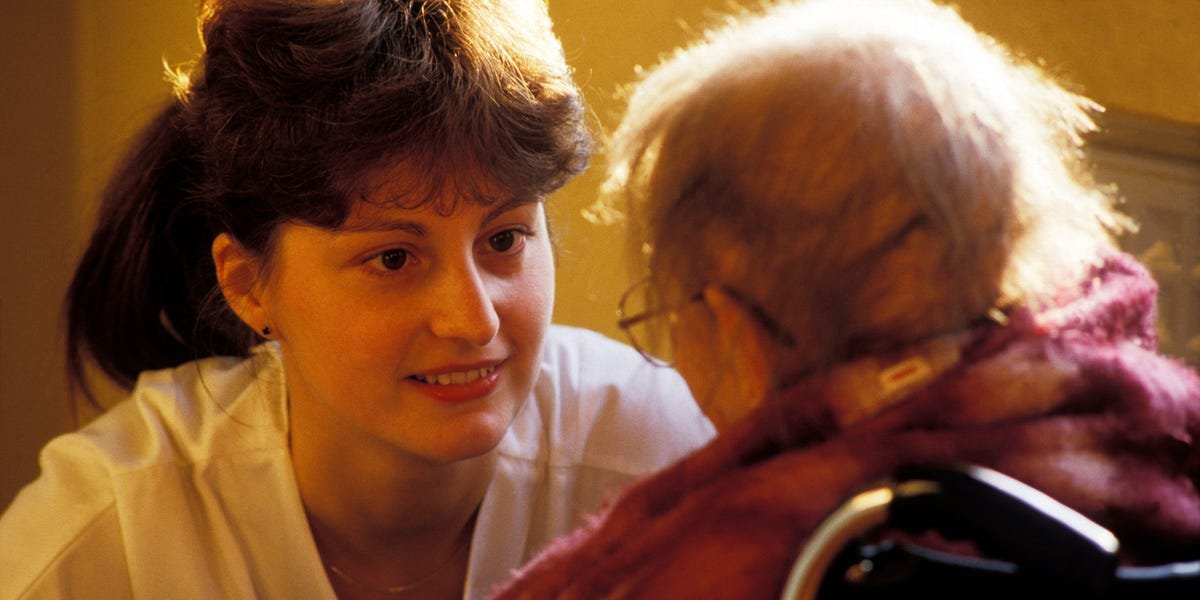


Our story about millennial daughters paying the price to take care of aging parents really struck a nerve.
As a millennial daughter myself, I was interested: A mix of actual costs, lost wages, and missed retirement contributions can cost daughters caring for their parents nearly $300,000.
This was clearly something a lot of our readers are going through. One commenter wrote, “I literally just had to pass up a huge job offer because they could not accommodate the time I needed to visit and attend to my ailing single father. This hits.”
The article’s author, Kelli Mariá Korducki, wrote about how millennials are staring down the barrel of something many Gen Xers have already experienced: the crushing costs of caring for aging parents.
Korducki’s story lays out how that’s falling predominantly on daughters of aging parents, creating an economic hit in the form of lost wages and retirement contributions as those women have to take time off work or pass up career advancement.
Here are just a handful of statistics from the story that made me wince:
- “More than 3 in 5 Americans say that daughters are expected to become primary caregivers over sons, according to a recent BURD Home Health survey.”
- “The US Department of Health and Human Services estimates that 75% to 80% of US eldercare hours are performed by informal caregivers, an army of loved ones deputized into unpaid care roles by sheer necessity.”
- “The majority of those caregivers (61%) are women: the wives, close friends, and, especially, daughters of the nation’s elderly and infirm.”
- “Women account for nearly 70% of caregivers providing constant, round-the-clock care.”
- “A 2021 study of family caregivers participating in the National Family Caregiver Support program found that women are significantly more likely than men to report career impacts including time conflicts, shifting from full-time to part-time work, loss of employment benefits, and missed promotions due to caregiving. They are also more likely to use vacation time, take leaves of absence, and work fewer hours.”
- “Seven in 10 Americans over 65 will one day require long-term care, and at least one in five will need it for five or more years. Yet, according to recent polling, more than 60% of adults over 50 don’t realize that long-term care is not covered by Medicare.”
When I tweeted about the article on X, I was flooded with hundreds of responses and comments from people who basically said, “I’m currently living this, and it sucks.”
Women shared stories of having to stop working to care for a parent, switch to part-time work, pass up job opportunities in other cities, or move back home to care.
Some of them spent their own money, either stopping contributions or even draining their 401(k)s and savings to pay for care. Obviously, this is not recommended financial advice — but faced with impossible decisions about how to provide care for a loved one, what choice does someone feel like they have?
Millennial/Gen X daughters are facing massive economic disadvantages because of the expectation they’ll be responsible for eldercare, even if there’s other siblings or it’s their in-laws. Anecdotally, this feels true and wholly depressing pic.twitter.com/HiR6hD54gN
— Katie Notopoulos (@katienotopoulos) April 30, 2026
Many of the slightly younger women expressed a lot of anxiety about how they see this coming in their future. Some talked about how they planned to refuse to be the sibling who gets stuck with care duties. But life is messy and complicated.
Although the broad strokes of many of these stories were the same — daughters making sacrifices in time and money to provide the necessary level of care — it was clear that it’s all so personal, each case is, in many ways, unique. What happens varies depending on the adult child and their parents’ personal finances, family relationships, geography, and the length of illness or care needed.
Caring for parents reminded me of having children — in some ways
Something that struck me about this was how different this conversation felt from the other thematically similar big conversations about women and childcare.
I’ve seen lots and lots of discussion about falling birth rates, rising childcare costs, why women do or don’t decide to have kids, and the toll that babies can take on careers. These are conversations that millennials (the youngest of whom are 30) and older members of Gen Z are very focused on. I can’t believe I’m ever finding myself saying “having babies” is simple, but the problems and solutions around having children are constrained to a relatively small window of people’s lives and involve pretty universal issues (e.g., paid maternity leave, subsidized childcare).
The eldercare part of the sandwich generation is trickier: Most babies need the same kind of care (albeit exhausting) and only for a few years before they enter school. But an aging parent’s needs can be complex and go on for years and years.
I have a feeling that as millennials and their parents age, and this becomes the reality for more and more of us, it’s going to be something we’re going to hear more and more about. (Which is a bummer, but … we need to talk about it.)
Lots of you had something to say on social media. Leave a comment below to tell us about your experience:
Read the full article here