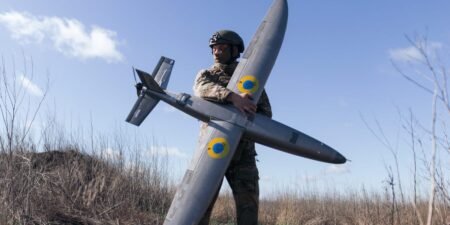







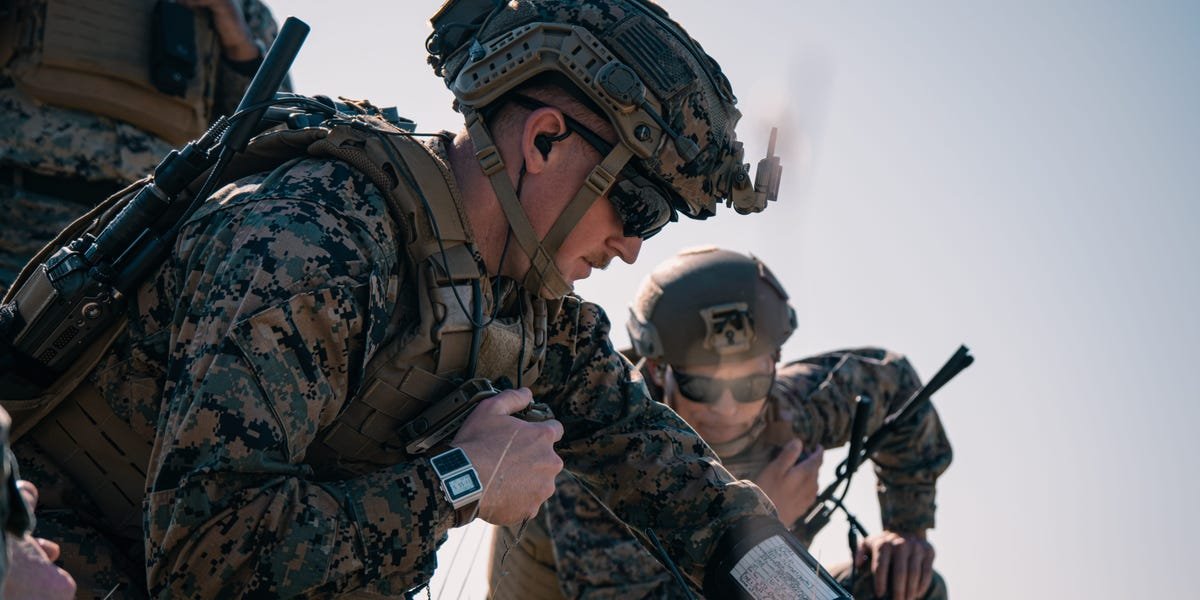


Hostile drones are challenging even highly trained US forces, which have struggled to contend with constant surveillance and attack in realistic combat scenarios. The Marine Corps is scrambling for answers, including standing up a new counter-drone team.
During a recent arduous pre-deployment training exercise, a highly proficient Marine unit ran into trouble as they confronted the drone threat in a rigorous and complex stress test, a Marine general shared during a panel event on Tuesday at Modern Day Marine in Washington, DC.
“It went about as expected,” said Maj. Gen. Mark Clingan, who oversees Marine Air Ground Task Force Training Command, responsible for sharpening combat skills ahead of deployments.
“The Marines had a really difficult time going downrange and dealing with the drones,” he said.
Further complicating the unit’s counter-drone fight was the “double-edged sword” that is jamming and electronic warfare countermeasures, which can interfere with systems on both sides of the fight, Clingan told Business Insider after the panel.
“It confirms that right now, if faced with some of the emerging threats that we see on the battlefield, that we’re going to have to adjust,” he said.
That adjustment is underway, with counter-drone training lanes coming for Marines preparing to deploy later this summer. Likewise, the Corps is also investing more heavily in drone proficiency across the force.
The service expects to have tens of thousands more small drones across the force by the end of the year, which will help Marines more easily train with the technology, said Clingan. But effectively integrating those drones with other assets, like machine guns, aviation, and mortars, a complex battlefield symphony which the military refers to as combined arms, will take time.
A challenge for these efforts is the limited availability of drones and reliable counter-drone systems, both growing areas of defense industry development.
The Pentagon has pushed for greater investment in cheap, attritable drones with plans to field hundreds of thousands of small uncrewed aerial systems, part of its efforts to work toward American drone dominance. The military has also established a counter-drone task force, expanded base defense policies, and begun incorporating low-cost systems proven in Ukraine into its arsenal.
Defensive efforts are aimed at combating a range of threats, from small first-person-view drones to loitering munitions, though tools to effectively combat enemy drones en masse have struggled to keep pace with offensive efforts.
To address the training gap in offensive drone operations, the Marine Corps created its attack drone team last year to serve as a central braintrust for training and policy development.
Now, a similar line of effort is underway for counter-drone operations, Lt. Gen. Benjamin Watson, who oversees the Corps’ Training and Education Command, told Business Insider at Modern Day Marine. The Corps is forming a counter-attack drone team as the service explores the counter-drone solutions available to them now and potential future solutions.
The new team will mirror the offensive attack-drone unit in its approach to adopting the technology to advance tactics, techniques, and tech for defeating enemy drones.
The group will “pressurize the learning and dedicate a small, highly qualified group of individuals to learning just as fast in the counter-drone space as we have been in the drone operation space,” Watson explained.
With its increased focus on fighting with and against drones, the Corps is also beginning to experiment with fiber-optic drones, which are resistant to electronic warfare and being used extensively in Ukraine, where large swaths of the war-torn landscape are blanketed in discarded cables.
That shift is driven in part by some of the training constraints at home, Marine leaders told Business Insider.
Teaching Marines to maneuver within the electromagnetic spectrum — and developing the expertise to operate effectively in it — is difficult because spectrum access and availability in US training areas are federally regulated, restricting how realistically units can train with drones to avoid impacting civilian activities like cell phone usage and aircraft safety.
Fiber-optic drones, which have proven invaluable in Ukraine, could be a workaround.
“It’s a bird on a wire,” Watson said. “It’s a way around a contested spectrum environment that’s tough to train in.”
“We recognize we’re in a time-competitive environment, and that in some areas, we are a little bit behind,” Watson said of the fast-changing tech landscape during the panel. “And so we are trying to make sure that we are learning as fast as we can.”
Read the full article here