







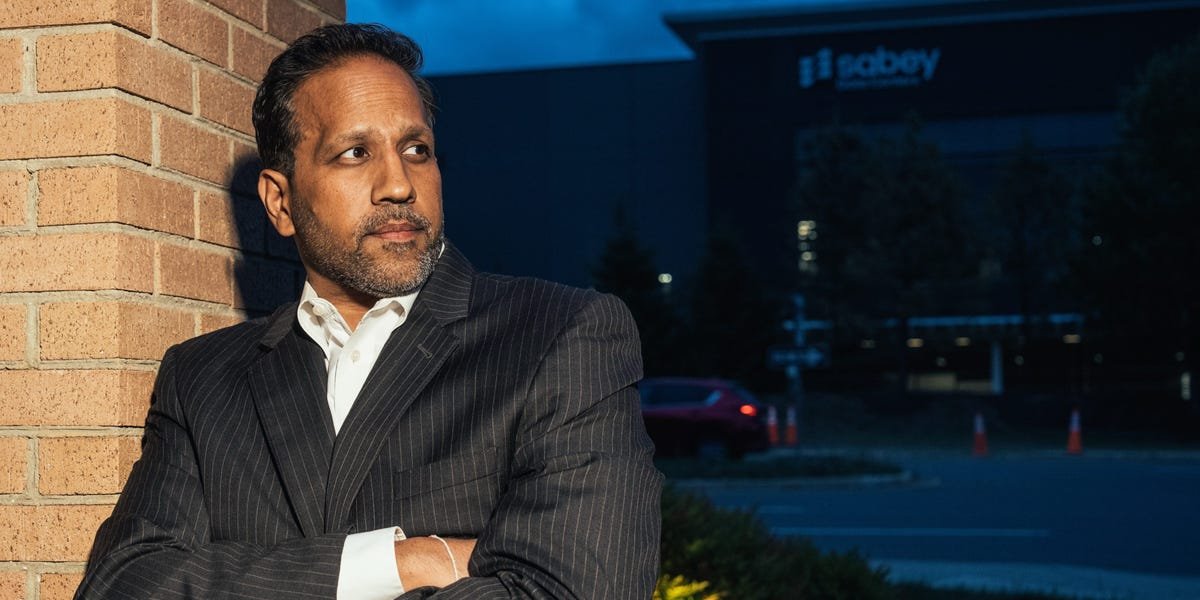


Mital Gandhi remembers watching the 2024 NBA Finals on TV at his home in Ashburn, Virginia, when he realized something wasn’t right.
Instead of hearing the ball bouncing or the intermittent squeaks from shoes on the hardwood, his ears could only focus on a constant hum. That hum, he said, came from one of the four data centers less than 2,000 feet away from his property.
“You can see them from my front porch. You can hear them sometimes from my pool,” Gandhi, 47, told Business Insider. “It’s not appealing to me to hear them or to be surrounded by them.”
To say Gandhi’s development, The Regency, is surrounded by data centers would be an understatement. The 143-home neighborhood in Loudoun County, Virginia, is in the area’s famed “Data Center Alley,” which hosts about 200 data centers — the highest concentration in the world.
Living in a community where your neighbors also include massive servers powering the artificial intelligence boom wasn’t part of the plan when Gandhi moved from Washington, DC, to the suburbs with his wife and son in 2013 after growing tired of pushing a stroller in one of the busiest downtown neighborhoods. As artificial intelligence has taken the world by storm, the country is racing to build infrastructure to keep up — and in places like Northern Virginia, some residents say it’s dramatically encroaching on their lives.
The change in communities like Gandhi’s — not to mention data centers’ impact on the power grids, water supply, and public health — is a stark reminder of how technology is changing our lives in real time. It’s also a deeply unpopular change: A new Gallup survey found that 71% of Americans don’t want a data center built where they live, while 53% of respondents said they would oppose the construction of a nearby nuclear power plant.
After years of constant noise and disappearing greenery, Gandhi had an idea: If the data center invasion is inevitable, why not find a way to capitalize on it?
As the former Regency HOA president and a real estate developer, Gandhi came up with a unique proposal: Get the entire community to agree to sell their properties to a data center developer for $4.4 million per acre — about four times the price of an average property in the development — in a deal worth over $500 million. If they couldn’t beat the data centers, perhaps The Regency could join them.
Convincing 143 families to unanimously agree to sell their homes to a data center company has been an uphill battle since Gandhi first pitched the deal in 2024. Regardless of the outcome, Gandhi sees his efforts as heroic.
“This is the best possible scenario for our lives at this point,” he said. “To give 143 families an opportunity — potentially a once-in-a-lifetime opportunity — is probably one of the best things I’ve ever done in my life.”
‘Either you’re going to love me, or you’re not’
Gandhi is no stranger to making big bets under pressure.
Before he turned 30, Gandhi faced adversity that changed his philosophy on life: He had kidney failure.
He recalled sitting in the dialysis chair, realizing how short his life could have been.
“I could die without this dialysis machine,” he said. “It gave me a real sense of purpose for living.”
It also gave him a business idea. “When I was in that dialysis chair, I told my nephrologist, I said, ‘Hey doc, I’m going to make you a million dollars.'” One day, Gandhi said, he’d open a dialysis center to help save the lives of more patients like him.
A self-described “corporate guy,” Gandhi had worked in fundraising as a major gifts officer for his alma mater, American University, and for Live Nation Entertainment as a national sales manager. He was ready to take the leap into real estate; he just needed more time — something his doctor granted him when he successfully underwent kidney transplant surgery in 2009 at age 30.
“At the end of the day, one thing I learned from having a kidney transplant is that I don’t like the bullshit,” Gandhi said. “I’m very direct. Either you’re going to love me, or you’re not, and that’s OK.”
Inspired by his father, who owned properties in his home state of New Jersey, Gandhi shifted his focus to real estate development, becoming managing partner of Merit Development, a firm based in New Jersey and Washington, in 2012. By the end of 2013, he’d bought a dialysis center with his doctor for $1.9 million in Millburn, New Jersey.
“There are a lot of people who talk a big game, and there are very few who deliver it,” Gandhi said. “When I tell you I’m going to do something, you have nothing else to worry about.”
A not-so-simple plan
When Walt Purnell first heard about Gandhi’s plan, he wasn’t convinced. Purnell, a Regency resident since 1999 and former HOA president himself, lives across the street from Gandhi.
“He calls me one day, he says, ‘My wife thinks I’m crazy, but instead of putting up with all these complaints from all the neighbors incessantly, why don’t we sell the whole development?'” Purnell, 80, told Business Insider. “And I said, ‘Mital, I agree with your wife. You’re crazy. We’re never going to get 143 homeowners to agree to do that.’ And he says, ‘Well, that may well be, but I’d like to be able to put a deal on the table and let them decide.'”
Using his real-estate connections, Gandhi formulated a ballpark sale price based on other data center deals in the area. In the neighboring county of Prince William, for example, Microsoft purchased 124 acres of vacant land for $465.5 million — or about $3.75 million per acre.
Gandhi figured he could get his neighbors a little more.
“I made sure it was a justified number — it wasn’t out of the air,” he said. “It was more of a, ‘Huh, we could potentially do it.’ The biggest task here is to get 143 people on the same page.”
“Do I think it’s the right thing for the community? Yes. To put all the pieces together as a dealmaker, that’s exciting for me.”Mital Gandhi
Longtime Regency resident Rick Myers, 62, has lived in the neighborhood since 1998 and has seen it transform over the last two decades.
Back in the ’90s, when Ashburn was an up-and-coming city, the area around The Regency was wooded and undeveloped, with a small forest of trees standing no taller than a one-story building.
“You really didn’t see anything but greenery everywhere,” Myers said.
While there are still a few trees on the half-acre lot behind Myers’ home keeping the data centers at bay, during the colder months, the bare trees reveal the windowless data centers looming behind them.
“The trend now is to make them four, five, six stories tall, so that you’re going to see them no matter how tall the trees are,” Myers said.
When Gandhi sent out a mass email to residents outlining the potential deal, Myers was immediately on board. There was not much for him and his wife, who are both retired, to consider. He estimates his home is worth $1.3 million, so the payout would be well worth it in his eyes; it would allow them to sell and move somewhere out of state. He thinks about 60% of his neighbors are in favor of selling.
Purnell, too, was on board. He and his neighbors had grown annoyed over the years as more and more data centers broke ground.
“The construction noise, the construction traffic, the running of their emergency generators in the middle of the night… Some of them didn’t have proper baffling on their air conditioners, so there was this massive humming all the time,” Purnell said. “Everybody was complaining.”
When Gandhi and Purnell polled their neighbors on the initial proposal, 138 out of 143 households said they’d accept the deal if the price was right. Once they saw a detailed offer sheet, however, Purnell said support began to waver.
“Everybody decided there’s something they didn’t like about it, and so we’re sort of stalemated,” he said.
Gandhi said one of the biggest issues Regency residents have with the deal is the timeline. Because the deal would require zoning changes and the addition of electrical infrastructure, he estimates the transaction could take about seven years to complete.
One Regency resident who works in finance and has lived in the neighborhood for a decade said that while the deal looks great if it means he could sell his house tomorrow for more than triple the value, the reality is a bit more complicated.
“The value of a house generally — especially in our market — will appreciate, assuming you keep it maintained, by doing nothing,” the resident told Business Insider.
“How much risk is someone willing to take,” he added, “if the answer is you cannot monetize one of your largest assets for some period of time? Then the compensation to offset that risk needs to be appropriate, and the purchase price needs to be appropriate.”
The complexities of the deal have also left some parents wondering how it would fit into their family’s plans.
“There are people who have kids in the school system, where they want to extend the closing even further because they want little Johnny to graduate from high school or middle school or whatever it may be,” Gandhi said. “The only term that everyone can agree to is money.”
A bittersweet solution
Gandhi wouldn’t be the first Northern Virginia resident to attempt to strike a deal with data center developers.
In 2025, Chuck Kuhn, a businessman in Leesburg, Virginia, a town 15 minutes away from Ashburn, sold 97 parcels of land to a global data center investor for $615 million. According to the Washington Business Journal, the property is approved for five new data centers.
In Prince William County, one county south of Loudoun, landowner Mary Ann Ghadban and her neighbors agreed to sell an assemblage of land to data center developer QTS in 2021 — although the deal is still mired in legal troubles.
The potential buyer of The Regency is a data center developer who would lease the property to a cloud provider like Amazon Web Services or Google. The identities of both parties are being kept under wraps via NDAs, but the data center publication Data Center Dynamics reported that both are already major players in Loudoun County.
That doesn’t narrow it down much: About 6 miles up the road from The Regency, Amazon Data Services paid $427 million for George Washington University’s Virginia Science and Technology Campus. Aligned Data Centers is directly east of The Regency, Digital Realty is already the southern neighbor of The Regency, and DataBank and Sabey — both located on Red Rum Drive — are the data centers Gandhi can see from his front porch.
Local officials are aware of Gandhi’s bid and, in some cases, want to stop the construction of more data centers. Sylvia Glass, district supervisor of Broad Run, where The Regency is located, said in a statement that Loudoun County would prefer the land be used for “housing, commercial, and civic uses.”
“I am aware that The Regency has received outreach from data center developers and I have spoken several times with residents,” Glass said. “However, I am not involved in any negotiations the community may be having and no rezoning application has been submitted to Loudoun County.”
While Gandhi and current Regency HOA President Kevin McCaughey said the deal is still on the table, other residents aren’t optimistic.
Ashburn resident Karen Nilsen Brown, a local real estate agent who lives about 3 miles from The Regency, hopes it doesn’t go through for the community’s sake.
“We’re losing beautiful trees and greenery,” Brown, 54, told Business Insider. “The landscape that was once allowed in the county is now being replaced by, basically, these cement panels.”
Gandhi believes it’s already too late. He never imagined he’d be surrounded by data centers when he moved to Ashburn, and neither did most of his neighbors. The best option now, he said, is to help them find greener, less concrete-filled pastures.
“Do I think it’s the right thing for the community? Do I think it’s the right thing for the region? Yes,” he said. “To put all the pieces together as a dealmaker, that’s exciting for me.”
“I do believe AI is the future, and I do believe AI is going to take jobs,” Gandhi added. “It’s nice to be a part of the boom instead of being left behind.”
Still, the idea of ceding the neighborhood to data centers is bittersweet. Gandhi fell in love with his neighbors and with Ashburn when he moved from the city to the suburbs over a decade ago. He’s been an active member of the community, becoming the HOA president and the PTO president at his sons’ elementary school. He never thought he’d be willing to sell the home that his two sons can always come back to, and now he’s leading the charge to flee.
“We love Ashburn, it’s a fantastic area,” Gandhi said. “Unfortunately, we didn’t know 13 years ago that it was going to be Data Center Alley.”
Read the full article here