






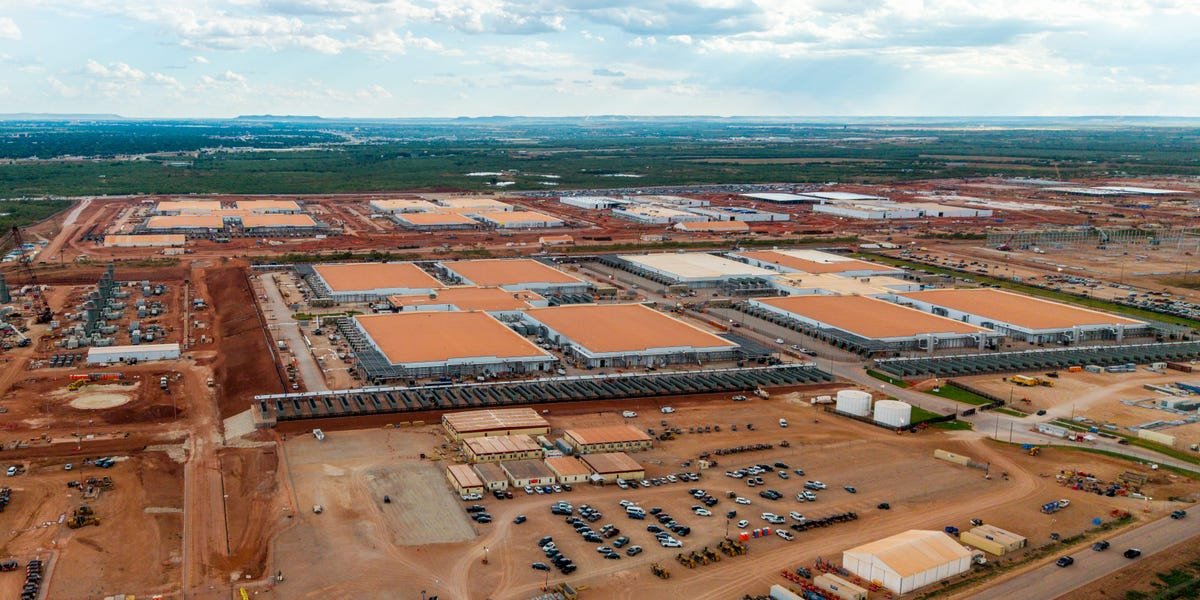


Texas has become a hot spot for jumbo-sized data centers in far-flung locations that provide the heavy computing for artificial intelligence training.
The next phase of the AI boom is taking shape closer to where people live.
DataBank, a Dallas-based data center developer and operator, is capitalizing on growing demand for facilities built closer to population hubs, where they can deliver AI models to users more quickly.
The company said it has secured $2 billion in construction financing from a group of banks led by Mitsubishi UFJ Financial Group to construct three data center buildings in Red Oak, a suburb 20 miles outside Dallas. DataBank did not disclose the other banks involved in extending the loan.
MUFG is also leading a separate, ongoing effort to raise roughly another $600 million loan for a fourth building that will be part of the Red Oak campus. That debt will be sourced from the private placement market, tapping capital from Wall Street investors, according to the company.
The four-building cluster, which together will total 240 megawatts of computing capacity, has been leased by a hyperscaler, according to Raul Martynek, the CEO of DataBank, who declined to name the tenant, saying only that it was one of the major hyperscalers, listing Amazon, Google, Microsoft, Oracle, or Meta.
Major technology companies have focused on building immense facilities with the computing power to develop advanced AI models. Martynek said the success of DataBank’s Red Oak project reflects the increasing demand for so-called inference facilities that offer the physical proximity and networking speeds to allow customers to use and interact with AI seamlessly.
“Why do data center users want to be close to metro markets? Because that’s where most of the fiber is and that’s where people are,” Martynek said. “Who consumes these products? People.”
Inference computing, which handles the work of processing a prompt when it is entered into an AI model, is a fast-growing segment of the data center market. In 2025, 9% of data center workloads were for inference computing versus 14% for training, according to global data from JLL. The remaining 77% was used for traditional data center cloud computing. By 2030, JLL predicts that 37% of the data center industry’s workloads will be for inference computing and 13% will be for training.
“It’s on the forefront of a lot of minds,” Carl Beardsley, head of data centers for JLL Capital Markets, said. “The next phase is once your models have learned, and they’ve trained up, to convert that over to inference and be closer to the population center.”
Lenders are wary despite surging AI demand
Despite surging demand for AI computing, lenders have also grown wary in recent months about accruing enormous debts tied to a handful of major AI and data center players. In January, Business Insider reported that JPMorgan Chase and MUFG encountered headwinds as they sought to sell off pieces of $38 billion in debt tied to two large data center campuses that will be occupied by Oracle. The two banks had extended loans to the projects with a group of other lenders in a process known as syndication, which allows lenders to share risks and the immense costs of large-scale financing packages by pooling together.
Martynek acknowledged that the syndication market had slowed as DataBank sought financing for its Red Oak project. Martynek said that was why the loan for the fourth data center building was ultimately broken off from the syndication effort and will be sourced through a private placement instead.
“It took us longer than we originally anticipated because obviously we’re part of the market,” Martynek said. “If a major money center bank says, ‘Hey, you know what? We’re going to slow down the amount of credit that we’re going to provide to this sector just because there’s so much of it,’ we’re going to be impacted by that.”
The four buildings comprise half of the 8-building, 480-megawatt data center campus that DataBank plans to eventually erect in Red Oak.
Martynek said that DataBank expects to deliver the first of the four initial buildings in the third quarter of 2026 and the last by the end of 2027.
Read the full article here