






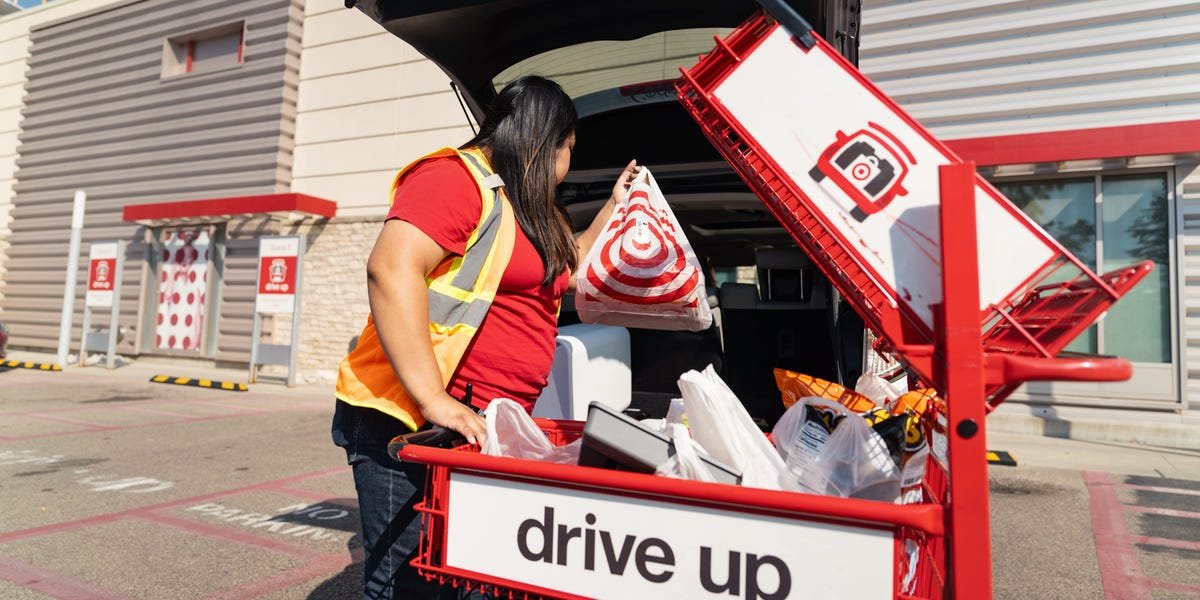


Target’s drive-up operation is big, busy, and growing — and every second counts.
Roughly 20% of the company’s sales occur via its web or app, and a significant share of those digital orders are placed right into customers’ cars waiting in the parking lot.
The strategy is so important to Target that its recent (and future) store renovations devote more space to preparing online orders and often include newly installed drive-up doors for workers to use instead of the front entrance.
Those doors are locked to prevent unauthorized access. To get back inside, drive-up workers would use a key, tap a fob, or call a coworker.
“We’ve all stood at home digging for our keys. Now imagine you know you’ve got a cart in front of you,” said Ashley Daniels, who joined Target last year as head of product management for the chain’s internal software. “We saw this was a frequent, very real pain point for our stores.”
Daniels told Business Insider that one of her first moves on the job was to send teams out to stores and distribution centers to get an on-the-ground perspective on how Target’s tech tools fit into daily operations.
A few seconds sounds small until you consider the bigger picture
Her team found drive-up workers were delayed by an average of 32 seconds each time they needed to get back into the store after completing an order. That might seem small, but multiplied throughout the day across 2,000 stores, the time adds up.
Every time Dominick publishes a story, you’ll get an alert straight to your inbox!
Stay connected to Dominick and get more of their work as it publishes.
The tech team quickly wrote a feature into the app that drive-up workers use on their handheld devices, allowing them to unlock the door with a tap via the store’s secure WiFi network. Rather than fumble for a key, they simply tap on the screen that is always in their hand.
After testing in one location last summer, the feature rolled out to additional stores ahead of the holiday shopping season, and Daniels said the update is now live in almost every store in the US.
Target estimates that the 30 seconds saved by these few lines of code will ultimately save the company more than 350,000 labor hours a year.
“There are stores that are using this over 500 times a day,” Daniels said. “That’s a good leading indicator that we’re adding value.”
Getting out of the office and into the field
The path to this solution is also consistent with CEO Michael Fiddelke’s approach to leading the company: Get out of the office and into the field to see what’s working — and what isn’t.
“If you were sitting at headquarters and somebody put this on their road map, it probably would raise some eyebrows,” Daniels said, “But it has been some of the most meaningful work for our team members, to the extent that when we bring it up on a call, we are getting a round of applause.”
Daniels said her team is carrying this experience forward as they visit stores and warehouses and get user feedback from frontline workers.
“You can’t judge from a conference room what is going to be the most critical or the most impactful for the teams,” she said. “You’ve got to be out there with them.”
Read the full article here