






TAIPEI — Phone in hand, the middle-aged woman gestured to the Taipei intersection, where an infantry platoon unloaded sandbags on the pedestrian crossings.
“My Uber is waiting for me just there,” she said in Mandarin, pointing behind them. The bespectacled military policeman blocking her path with a T112 assault rifle apologized: She’d have to find another way around.
Soon after, Clouded Leopard infantry fighting vehicles emerged between the shophouses, opening fire with blanks into a killbox the Taiwanese formed with barricades. Military police covered the roads with smoke grenades, several leapfrogging through the streets under covering fire to regroup with the main force.
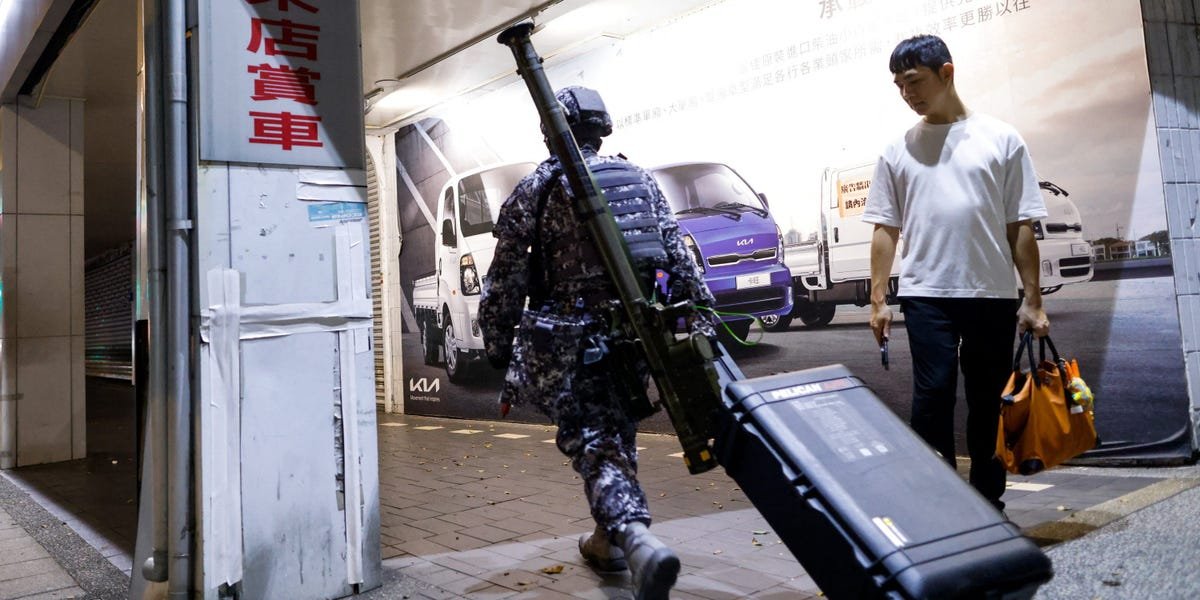
The drill, a simulation of a bridge defense against Chinese forces, was held after midnight to minimize disruption to the capital’s Wanhua cultural district. But with much of Taiwan’s Han Kuang exercise conducted in the bustle of its cities and neighborhoods, it’s clear the military wants to train its troops on the very streets they’re assigned to defend — while still letting the rest of the island go about its business.
The practice adds an element of realism to the live drills, giving way to odd scenes where infantry and armored brigades engaged in mock skirmishes or counter-sabotage operations right next to people walking their dogs, going out for a party, or simply living at home.
Troops in urban areas used blanks instead of live ammunition, which was fired only on Taiwan’s outlying islands.
In a residential area south of the Songshan airport, diners sidled out from a barbecue restaurant to gawk at troops firing blanks from alleys and rooftops. Halfway through the drill, a police cruiser showed up, apparently investigating a noise complaint.
And in the southern city of Kaohsiung, a delivery worker on a scooter sped past a guard to drop off the mail at an auto shop, as reservists lined the main road with busted cars, barbed wire, and fortifications.
Several dozen yards away, a softball team practiced in the late morning heat.
Past Han Kuang exercises often featured simulated force-on-force battles, meant to show the public — and China — that Taiwan has the resolve and weapons to defend itself from an invasion. But Taipei said last year that it’s reforming the Han Kuang to instead focus on unscripted exercises, hoping they would serve as better stress tests for its military and society.
“This year’s Han Kuang exercise gradually shifted away from ‘staged performances’ designed for senior officials and the public, moving toward genuine operational verification,” said Lin Ping-yu, a former Taiwanese special forces paratrooper who is now a city councilor for New Taipei City.
The result this year was dozens of logistics and combat drills peppered across the island of 23 million people.
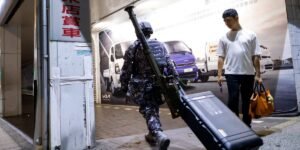
As Typhoon Dolphin brushed past Taipei, driving rainstorms into the capital on the fourth day of the exercises, military police special forces with machine guns and antitank launchers watched the late-night streets from park treelines near the Nangang Exhibition Center, Taiwan’s largest trade-show complex.
The scenario assumed their command in central Taipei had suffered heavy casualties, and the survivors were retreating across the city by subway to Nangang, where the visitor center was being set up as a makeshift headquarters.
Roping in civilians
Civilian infrastructure like this featured regularly in the drills, with reservists gathering in schools, privately owned factories converted into backup arms-production facilities, and a culture park used as a vehicle-field repair station.
“If you look at the exercises as a whole, Taiwan is actually training for almost every major contingency it could face,” said Tristan Tang, a Taipei-based nonresident fellow at the US think tank National Bureau of Asian Research.
Folding civilians into the war effort can get messy. On August 9, for example, a civilian truck ferrying 155mm howitzer shells spilled its contents along a highway in Miaoli while navigating a bend.
The rounds were inert, and the military said the fastening straps on the eight-inch shells had come loose, calling it evidence that the transport operation had room for improvement.
The Han Kuang also conducted limited, citywide drills to train the public for war. For the first time, city governments throttled mobile internet for 30-minute periods during the exercise, hoping to get people thinking about how an attack would affect communications.
On a Thursday afternoon, air-raid alerts buzzed on mobile phones in Taipei, ordering people to head indoors for shelter. The streets emptied, turning the capital into a ghost city for 30 minutes as people abandoned buses, cars, and motorbikes on the roads.
Lin said Taiwan previously conducted its civil and military exercises separately, and combining them was one of the most significant changes the island made this year.
“This shift helps the public grow more accustomed to the presence of military units in their daily lives,” he said.
The New Taipei City Councilor, an advocate for arms innovation and bolstering Taiwanese defense, raised concerns that years of relaxed relations with China had caused its military to “forget how to operate as a truly effective fighting force.”
Cross-strait tensions have worsened, especially with the rise of the Democratic Progressive Party, the party of the current president, which rejects Beijing’s territorial claim. China, meanwhile, has been growing increasingly hostile toward Taiwan, with the country’s leader, Xi Jinping, refusing to rule out taking the island by force.
With changes to drills such as the Han Kuang, Taiwan’s military is in a “critical transition” phase in its warfighting capabilities, Lin said.
“We are now at a pivotal moment to reclaim these core military capabilities, and conducting more rigorous exercises will help the military rebuild its operational edge,” Lin said.
Read the full article here