







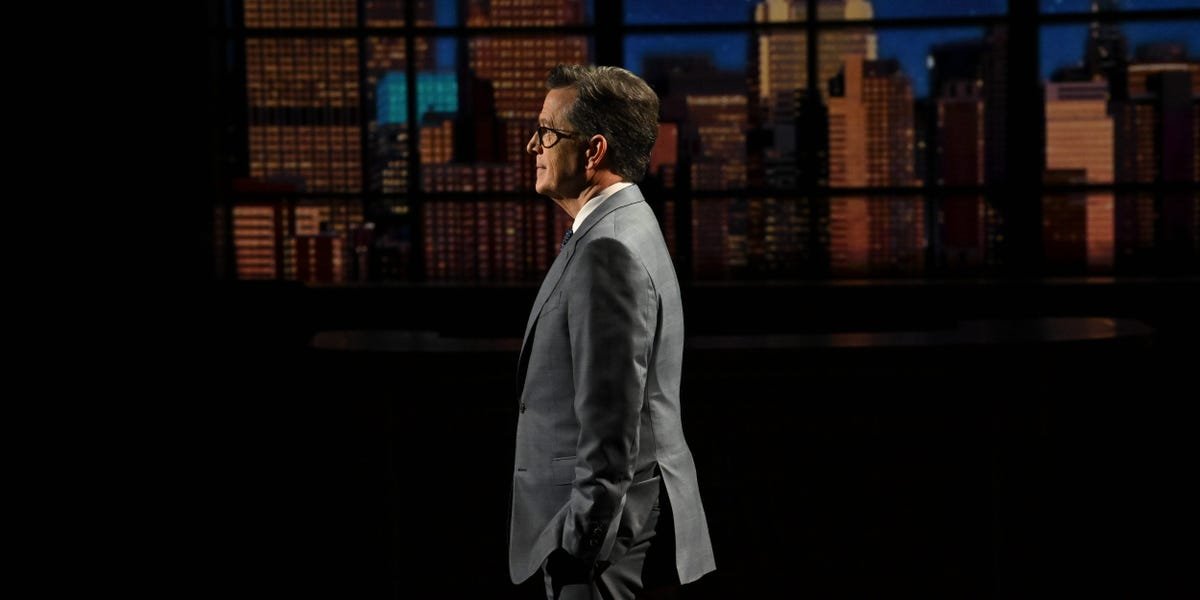


Andrew Garfield was trying to promote his new movie when Stephen Colbert made him cry on national television.
Garfield had ostensibly joined “The Late Show with Stephen Colbert” in 2021 to discuss his Netflix musical, “Tick, Tick… Boom!” He began by hitting all the usual talking points: his preparation for the role, his dynamic with the film’s director, Lin-Manuel Miranda, and the tunes he was tasked with singing onscreen.
Colbert gamely bantered with the actor, drawing out goofy anecdotes, an impromptu a capella performance, and, of course, plenty of laughs from the audience.
Then, as their conversation neared its scheduled close, Colbert changed tack. Rather than pushing for a punchline, the host asked Garfield to reflect on his mother’s recent death from pancreatic cancer.
Garfield was visibly moved by the question, delivering a tender and, crucially, uninterrupted monologue on his mother’s life as an “unfinished song.”
Every time Callie publishes a story, you’ll get an alert straight to your inbox!
Stay connected to Callie and get more of their work as it publishes.
“I hope this grief stays with me,” he told Colbert, tears pooling in his eyes, “because it’s all the unexpressed love that I didn’t get to tell her.”
Nearly five years later, watching that now viral clip still chokes me up. It’s moments like these, steeped in sincerity and pathos, that set Colbert’s show apart in the late-night TV ecosystem. They’ll be sorely missed after Colbert takes his final bow on “The Late Show” Thursday night.
Colbert is a skilled interviewer — an increasingly rare quality in late night
Colbert was hired by CBS in 2015 to fill the shoes of legendary comedian David Letterman, who retired after hosting “The Late Show” for more than two decades.
Though Colbert’s most recent role had been a satirical news anchor — a self-described “poorly informed, high-status idiot” — on Comedy Central’s “The Colbert Report,” he quickly established himself as a worthy successor, blending humor and charm with thoughtful, studied lines of inquiry that coaxed his famous guests to open up.
It’s not just that Colbert’s still-standing peers, including Jimmy Fallon, Jimmy Kimmel, and Seth Meyers, lack those skills. It’s that even if they could conduct a Colbert-esque interview, there’s little incentive to do so.
CBS said yanking its most-watched talk show was “purely a financial decision.” Many of Colbert’s defenders point instead to political motivations, describing the move as a poorly disguised capitulation to President Donald Trump, who has publicly celebrated that “Colbert got fired.”
For his part, Colbert has given credence to both sides. “It’s possible that two things can be true,” he told The New York Times. “Broadcast can be in trouble. They cannot monetize because of things like YouTube, because of the competition of streaming. They’ve got the books, and I do not have any desire to debate them over what they say their business model is and how it does not work for them anymore.”
Whatever the motivation, it’s clear that Colbert’s exit from late night is a symptom of our increasingly clip-driven, increasingly sycophantic celebrity culture.
Talk-show hosts like Fallon, who got his start on NBC’s “Saturday Night Live,” have long leaned into gimmicks, skits, and goofy bits to keep their drowsy viewers tuned in — and to keep the A-listers coming back to his couch, swaddled in his benign giggle fits. But the decline of substantive celebrity interviews can now be felt far beyond the walls of 30 Rock.
Influencers are now hired en masse as red-carpet correspondents, and interviews with content creators from Jake Shane’s “Therapuss” podcast and Alex Cooper’s “Call Her Daddy” to the fried-chicken-themed double whammy of “Hot Ones” and “Chicken Shop Date” now dominate the media circuit. Soothed by the promise of frictionless self-promo, celebrities are flocking to these friendlier environments, while fans are served shallow soundbites on TikTok and Instagram Reels.
Shane — who was criticized for asking reductive questions at Vanity Fair’s Oscars after-party and, more recently, for asking Kacey Musgraves to explain a straightforward lyric about time zones — is particularly shameless about giving celebrities full editorial control over their appearances on “Therapuss.”
Asked if he would cut a quote or a segment at the behest of his guest, Shane told Rolling Stone, “Always, always.”
“I think it’s really selfish to not honor someone’s discomfort with something that they’ve said,” he explained. “I want to create a comfortable, friendly environment for my guests.”
Shane has been clear that he does not consider himself a journalist, but that doesn’t mean he and his contemporaries are not affecting the media landscape. Shane’s laudatory approach to interviews is undoubtedly appealing to public figures — the very people who help shape public opinion, cultural tastes, and beauty standards, and should be subject to scrutiny in exchange.
As Shane himself admitted, celebrities “probably” opt for podcasts like his to avoid being vulnerable with skilled interviewers, while still fulfilling promotional responsibilities. “I don’t care,” Shane said. “I’m just happy to have them.”
Colbert, meanwhile, proved that it’s possible to be welcoming, funny, and probing all at once, whether he was creating space for Garfield’s grief, discussing faith and death with Dua Lipa, or gently plumbing the depths of John Mulaney’s anxiety. Colbert’s approach, though hardly perfect, valued conversation over comfort. His departure may mark the triumph of the latter.
Read the full article here