







For more than a century, Hotel Du Pont in Wilmington, Delaware, has served as a hub for business leaders, an opulent event venue, and a luxury hotel that stands as a destination in its own right.
Built in 1913 as part of the Du Pont Company‘s headquarters, the hotel was designed to impress executives and industrialists flocking to Delaware as the state’s corporate influence grew. In true Gilded Age fashion, artisans flown in from Europe helped outfit the rooms with Italian Renaissance Revival craftsmanship rivaling royal palaces.
Their work remains well-preserved. Today, guests at Hotel Du Pont can walk across its original marble mosaic floors, dine at its historic French brasserie, and view pieces of the hotel’s 113-year history on display in its grand lobby.
Tom Santora, Hotel Du Pont’s historian-in-residence who has been with the hotel for 45 years, showed Business Insider around its opulent spaces in May.
Take a look inside.
Built in the Italian Renaissance Revival style, Hotel Du Pont has remained a fixture of downtown Wilmington for more than a century.
Hotel Du Pont opened in 1913 in the same complex as the Du Pont Company’s headquarters in Wilmington, Delaware.
The Du Pont Company, dating back to the 1700s and incorporated in 1802, made its fortune as America’s leading producer of smokeless gunpowder, then transitioned into the chemical business.
Delaware has long been known as a haven for corporations thanks to its favorable state laws and tax advantages. As more and more companies established operations there during the Gilded Age, Du Pont Company executive and heir Pierre S. du Pont recognized the need for a luxury hotel in Wilmington befitting the caliber of clientele he sought to entertain.
Hotel Du Pont stretches 12 stories high and spans a full city block, making it an unmissable landmark.
Hotel Du Pont cost $1 million to build when it was completed in 1913, equivalent to around $33.6 million in 2026.
“Nobody ever spent that kind of money in 1913 to build a hotel,” Santora told Business Insider.
Due to immediate high demand upon opening, the hotel also added an expansion in a 1918 renovation.
Famous guests have included actors, athletes, royals, musicians, and 13 US presidents.
Former President Joe Biden, a Wilmington local, announced his 1972 Senate bid at Hotel Du Pont and held numerous campaign events and meetings there throughout his political career, including as president.
Hotel Du Pont is also believed to be the site where Prince Rainier III of Monaco and Grace Kelly’s engagement was finalized in 1955.
Hotel Du Pont is now owned by the Buccini/Pollin Group and operated by PM Hotel Group.
The hotel offers four room tiers: classic, heritage, luxury, and suites. Starting rates for a classic room are $599, and one-bedroom suites start at $1,913.
My hotel tour began in the lobby, which used to be a French salon-style ladies’ sitting room called the Rose Room.
In 1918, the hotel expanded, adding 118 guest rooms. The Rose Room was transformed into the main lobby with new marble floors and an ornate ceiling inspired by the Ducal Palace in Venice.
The area rug in the lobby features a rose petal design in homage to the space’s original name and function.
This walnut grandfather clock has remained in the lobby since Hotel Du Pont opened in 1913.
The clock was made in England in 1910 and shipped to Wilmington to furnish the hotel. The best part? It still works over a century later.
The hallway just off the lobby features exhibits about the hotel’s history with accompanying artifacts from its early days.
The displays included pieces of china dinnerware and a cigarette box from 1912 that was discovered in a wall during a 1992 renovation.
Sections of the original marble mosaic floors can be seen at several locations throughout the hotel, including the entrance to the Green Room.
Each small tile was laid by hand to create the mosaic design.
The architecture of the Green Room, the hotel’s dining room with an in-house French restaurant, has also largely remained the same.
The Green Room houses Le Cavalier, a French brasserie. Le Cavalier means “the horseman,” a nod to the Du Pont family’s enthusiasm for equestrian sports.
Walnut paneling lines the walls, but the Green Room’s coffered ceilings are actually made from plaster painted to look like wood.
Hand-painted plaster made to look like wood or marble was considered a status symbol during the Gilded Age, since it was more expensive and required a higher level of craftsmanship than using the real materials.
The room features a balcony where musicians would play for the hotel’s patrons during dinner.
The featured performers were usually harpists or a trio of musicians.
The bar is a more modern addition, added after the hotel was sold in 2017.
The bar offers the signature Hotel Du Pont cocktail with VSOP Guillon Painturaud cognac, Alvear fino sherry, and Angostura bitters.
Santora pointed out a corner table in the Green Room that was once favored by wealthy tycoons and power brokers.
“Every decision about the state of Delaware was probably made over at that table by a lawyer, judge, or governor who sat there,” he said. “They weren’t done in the courthouse, which is directly across the street. The decisions were made, and the agreements were made, by handshake right here.”
Next, we visited the Brandywine Room, where men would smoke cigars, drink brandy, and play cards after evening meals.
The Brandywine Room was formerly known as Peacock Alley, a place to see and be seen.
The Christina Room, a lounge formerly known as the Club Room, still has its original wood paneling from 1913.
The Christina Room still functions as an event space.
The woodwork features hand-carved designs.
The carvings depict fish, pelicans, beavers, and other creatures symbolizing Wilmington’s status as a port city.
Hidden in the room’s ornate carved paneling is a secret passageway leading to The Playhouse, which Santora described as the longest-running theater in the US.
Like the doors in the Oval Office, the Christina Room’s secret door lacks handles, allowing it to blend into the wall.
“At night, you could come in, have dinner in here, and then you could sneak right through to the theater,” Santora said.
In its early days, when it was known as the Club Room, the lounge featured three Tiffany glass domes in the ceiling.
The domes are still there, but were enclosed in the ceiling when the hotel installed air conditioning, so they’re no longer visible.
A large walnut door in the lobby leads to additional Italian Renaissance Revival-style rooms added to the hotel in 1918.
The detailed artwork on the door, hand-carved into a slab of wood cut from a single tree, is characteristic of the hotel’s Italian Renaissance Revival architecture — a resurgence of the detailed craftsmanship displayed by Italian artists such as Michelangelo.
An engraving above the door depicts a horn of plenty, symbolizing celebration and leisure.
Both the door and the rose-marble carvings above it were created by artisans brought over from Italy.
The door opens into a foyer with a grand staircase and a coffered, hand-painted gold ceiling.
The du Barry Room is located on the upper level, and the Gold Ballroom is downstairs. The du Barry Room used to have a balcony overlooking the Gold Ballroom below, but the hotel enclosed and soundproofed the two spaces so they could host two separate events at once.
The du Barry Room is a Federal-style ballroom with French touches that also pays homage to American history.
A French crystal chandelier serves as the centerpiece of the gilded ceiling.
Engravings on the walls depict lobsters, crabs, and other sea creatures found in the Delaware Bay area.
The ceilings also feature engravings of turkeys, owls, pheasants, and other local animals.
Eagles adorn the federalistic columns.
“If you go back and look 100 years ago, you’ll notice that the American eagle was more of a scrawnier-looking eagle compared to what you see today,” Santora said.
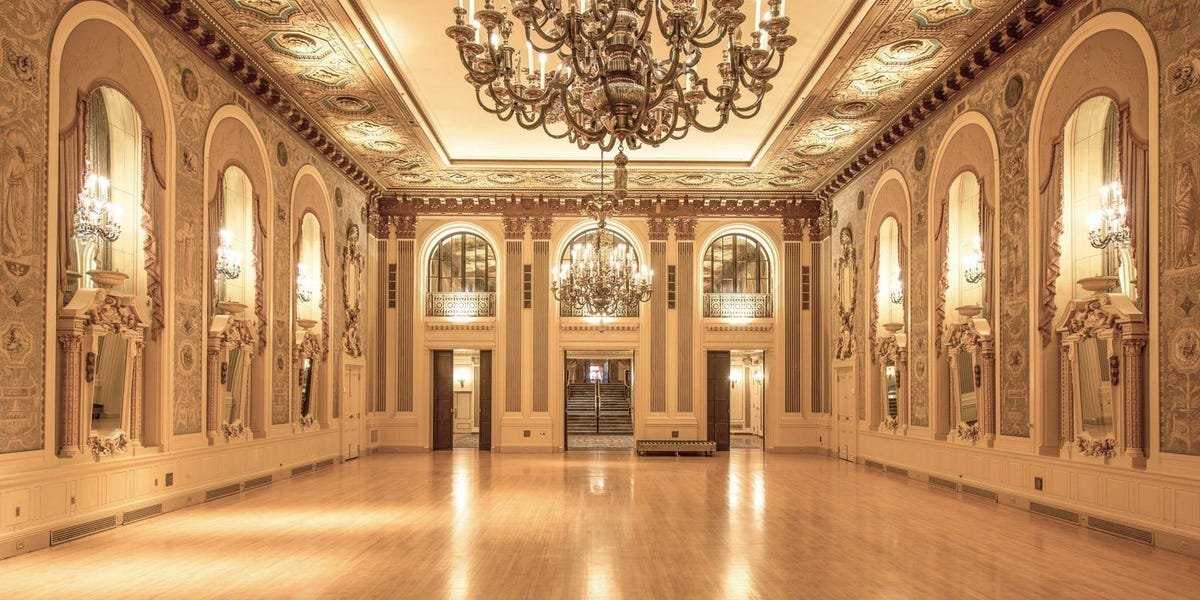
Walking into the Gold Ballroom was absolutely breathtaking.
The ceilings measure 2 ½ stories high.
The walls are decorated with an Italian Renaissance method of etching designs into layers of plaster called sgraffito.
The artwork shows women playing instruments and dancing, indicating the room’s purpose as a jovial space for celebration.
A closer look at the walls reveals the individual scratches that make up the larger designs.
The hotel brought in 30 Italian artisans, who worked on the sgraffito for an entire year.
Chandeliers commissioned for the Gold Ballroom were brought over from Europe in the 1920s.
The chandeliers contain five precious metals.
The ballroom walls also feature 20 medallions depicting famous women.
The medallions pay tribute to Pocahontas, the Queen of Sheba, Catherine the Great, and other notable women throughout history.
The mirrors throughout the room include an adorable decorative touch: a tribute to the Du Pont family’s beloved pet.
The Du Pont family had a pet ram named Don Pedro, whose likeness appears throughout the room.
The other side of the walnut door leading back to the lobby features engravings of squirrels, a symbol of getting back to business.
“Squirrels are working animals,” Santora said. “When you go through that doorway, you’re going back to work.”
More than a century after it opened, the hotel remains faithful to Pierre S. du Pont’s original vision: a place where business and leisure meet beneath gilded ceilings.
While many lavish Gilded Age-style properties have been renovated beyond recognition or demolished completely, Hotel Du Pont endures as a monument to the wealth and innovation that helped establish Wilmington as a center of American business — and looked good doing it.
Read the full article here