







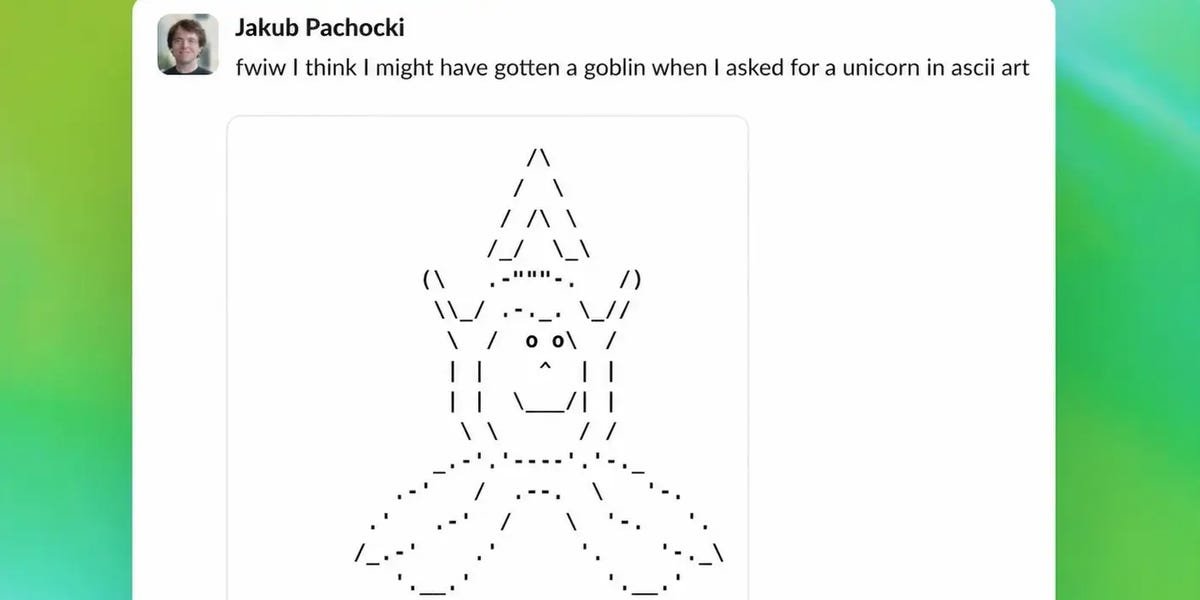


OpenAI has been in “goblin mode” for months.
On Monday, one X user pointed out an unusual line in Codex’s personality guide. The instructions tell Codex to have a “vivid inner life,” a “good ear” — and to get out of fairytale land.
“Never talk about goblins, gremlins, raccoons, trolls, ogres, pigeons, or other animals or creatures unless it is absolutely and unambiguously relevant to the user’s query,” the source code reads.
The sentence appears four times in the code.
Two days later, OpenAI posted a blog post titled: “Where the goblins came from.” The mythical creatures had been growing in prominence since the November launch of GPT 5.1, the company wrote.
The culprit seems to be the “Nerdy” personality option for ChatGPT. The personality’s training incentivized references to mythical creatures, OpenAI wrote.
OpenAI retired the “Nerdy” personality in March, but GPT-5.5 was trained before it noticed the issue. The company noticed it especially in its AI coding agent. “Codex is, after all, quite nerdy,” it wrote.
The goblin moment is a “powerful example of how reward signals can shape model behavior in unexpected ways,” it wrote.
How OpenAI’s goblin code turned into a meme
In the prior days before the line of code was spotted, some users posted screenshots of their conversations with GPT 5.5, including references to these mythical creatures.
“Why is gpt5.5 so obsessed with goblins,” asked one user on X, who posted screenshots showing the AI recommending a particular type of camera equipment “if you want filthy neon sparkle goblin mode.” Another example showed the AI referencing “goblin bandwidth” or giving “an even shorter goblin version” of its answer.
Repo Prompt founder Eric Provencher posted on X that GPT 5.5 said, “I’ll keep babysitting it rather than leave a little perf gremlin running unattended.” An OpenAI engineer responded: “I thought we fixed this sorry.”
The AI evaluation website Arena.ai also found an increase in GPT 5.5’s usage of the words goblin, gremlin, and troll. The increase was especially noticeable when not using high-thinking mode, Arena found.
Since the line was spotted, OpenAI’s goblin instruction has spun out into a meme. X users posted screenshots of their conversations, prompting about goblins and gremlins.
Many users online referenced the term “goblin mode.” Defined as “a type of behaviour which is unapologetically self-indulgent, lazy, slovenly, or greedy,” the term was Oxford English Dictionary’s word of the year in 2022.
OpenAI also got in on the jokes. ChatGPT included the line in its bio on X. Codex engineering lead Thibault Sottiaux posted the line with the shortening “If you know, you know.”
Citrini Research shook the market in February with a Substack post about the future of the economy with AI. The research outfit had a more negative outlook on the goblin saga, calling OpenAI’s response “insane.”
OpenAI CEO Sam Altman chimed in, first with a meme about asking for “extra goblins” in GPT-6. Then he wrote that Codex was having a ChatGPT moment, before correcting himself.
“I meant a goblin moment, sorry,” Altman wrote.
Read the full article here