







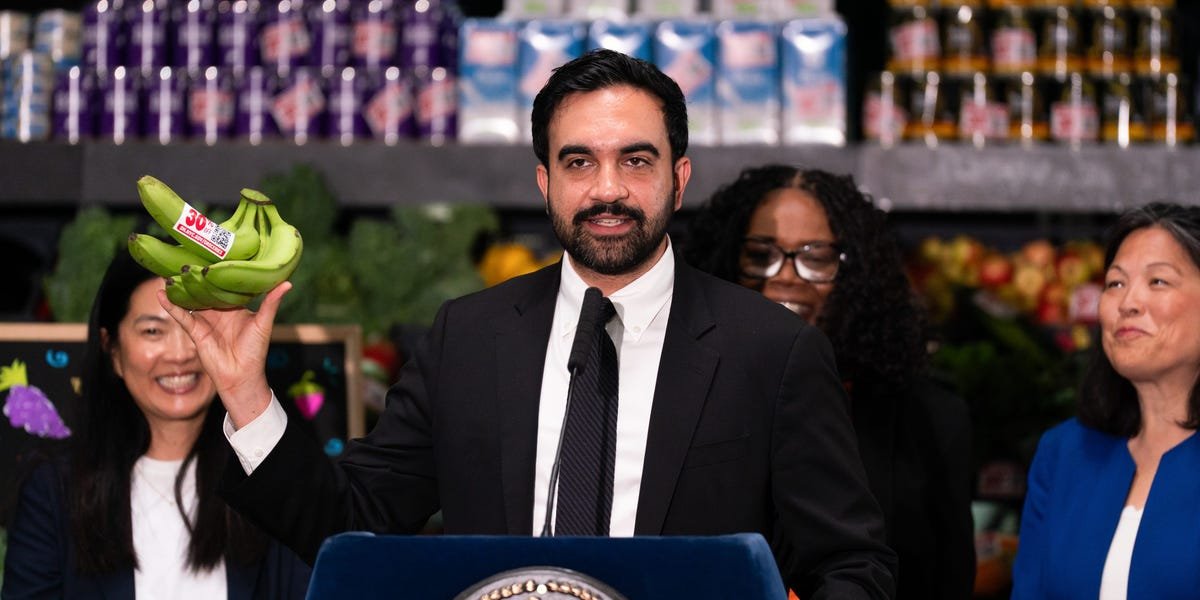


Mayor Zohran Mamdani is rolling out his city-run grocery stores — and New York City has a lot to learn from metros that have done the same thing.
The five NYC stores, which the city says will open by 2029, plan to offer shoppers a 30% discount on core goods like meat, dairy, and fresh produce through government subsidies offered to private operators that will run the stores.
In other cities, lawmakers have opened city-run stores through a series of grants and loans. Some, such as a public-private partnership-run supermarket in Atlanta that closely resembles Mamdani’s proposal, are financially viable. Other experiments in places like Kansas City, Missouri, failed and closed because of high overhead costs, dwindling city support, and theft.
While other cities have focused on rectifying food deserts, the five boroughs’ promise of lower prices is distinct.
“Basically, every other example is almost entirely about food access,” said Jamie Horton, executive vice president for strategic initiative and business operations at NYC’s Economic Development Corporation — a quasi-public nonprofit partnering with Mamdani on the stores. “They don’t have that mandated affordability. That’s what really separates our program. We’re both.”
The city recently filed a request for proposals seeking experienced grocers to partner on the stores’ operations. Horton said the EDC is looking for businesses that already have the expertise and licensing needed to buy food at wholesale and manage inventory. He pointed toward the private-public Atlanta store specifically as a source of inspiration.
Atlanta and St. Paul, Kansas, have opened city-run stores
Opened in 2025, Azalea Fresh Market in Atlanta is the most comparable to NYC’s program because it serves a large population.
Atlanta’s government acted “like a bank,” securing roughly $8 million in grants and no-interest loans to open two stores, said Paul Nair, CEO of Savi Provisions, the store’s operator. He said local leaders play no part in staffing, stocking, or day-to-day logistics, and that the store’s second location, set to open this fall, will be financed through another multimillion-dollar grant. Nair is considering adding in-store coffee shops because drinks are more profitable than groceries. He said that partnering with the trade group Independent Grocers of America allows him to buy wholesale items more cheaply and offer core products at competitive prices.
His goal is for the stores to fund themselves through daily revenue after three to five years. As of June, Azalea reported serving more than 150,000 customers.
Nair said his experience running private stores informs how he operates Azaela. He said he has consulted with EDC leaders on Mamdani’s stores, and hopes the city is able to pick a strong operator that they trust. “I, as a business businessman, am making the decisions” about day-to-day operations and finances, he said.
The key to some other city-run stores’ success is that residents have no other options. The last remaining private grocery store in St. Paul, Kansas — a town with just over 600 residents — closed in the 1980s.
To make up for the lack of nearby supermarkets, St. Paul’s municipal government opened a city-run store in 2008 through a public-private partnership, using local economic development funds and a zero-interest loan from the US Department of Agriculture. It transitioned to full city operation and ownership in 2013. The building itself is owned by the city, eliminating the cost of rent, and a store representative said it has enough daily revenue from shoppers to cover overhead.
Other stores have closed
Government-run supermarkets in Baldwin, Florida; Kansas City, Missouri; and Erie, Kansas have all shut their doors.
For smaller areas like Baldwin, revenue wasn’t sufficient to cover the store’s costs, especially given nearby private options. In metros like Kansas City, the local government spent a total of $29 million in taxpayer funds to open its store in 2022, but the operation lost money and closed in 2025.
Local NYC businesses worry about their bottom line
Mamdani has allocated $70 million to launch the New York stores, and Horton said the EDC will subsidize food and operating costs each year. The EDC owns and invests in property on behalf of the city and will offer each location rent-free.
“One of the main tools that the city and specifically EDC has is to essentially shoulder real estate costs,” Horton said, adding. “We want this to be as cost-effective and efficient as possible.”
Advocates for the grocery industry, however, told Business Insider that they would rather the city provide subsidies directly to small bodegas and grocers, or widen the social safety net programs like SNAP for New Yorkers experiencing food insecurity.
Laura Strange, chief public affairs officer for the National Grocers Association — a trade group that represents small and independently-run grocers — said profit margins for grocery stores are low. After accounting for food, staff, equipment, real estate, and other costs, most stores net between 1% and 3%.
For local businesses, it can be more difficult to see returns, and Strange said some won’t be able to keep up with stores backed by NYC’s bank account.
“Subsidizing government-run stores to undercut market prices by 30% doesn’t fix what’s broken in food retail; it distorts it further,” she said. “Rather than expanding government-run retail operations, policymakers should focus on addressing the underlying costs that make groceries more expensive in the first place.”
She added that making the wholesale buying process easier for grocers “will do far more to lower food costs over the long term” than a chain of city-run stores.
Scott Moses, head of grocery, pharmacy, and restaurants investment banking at Solomon Partners, said “adding a Soviet-style, state-run grocery store will only make these competitive dynamics more difficult — if not prohibitive — for smaller, often family-owned grocers around the city.”
Mark Jaffe, a founder of the Multicultural Business Coalition — which represents local grocery chains, bodegas, and other vendors — said directly supporting small businesses would be a more impactful use of the money.
“Hardworking New Yorkers just can’t put enough healthy food on their table because it’s so darn expensive to live here,” Jaffe said. He appreciates that the city is looking for solutions, “but there are better ways to do it.”
Read the full article here