






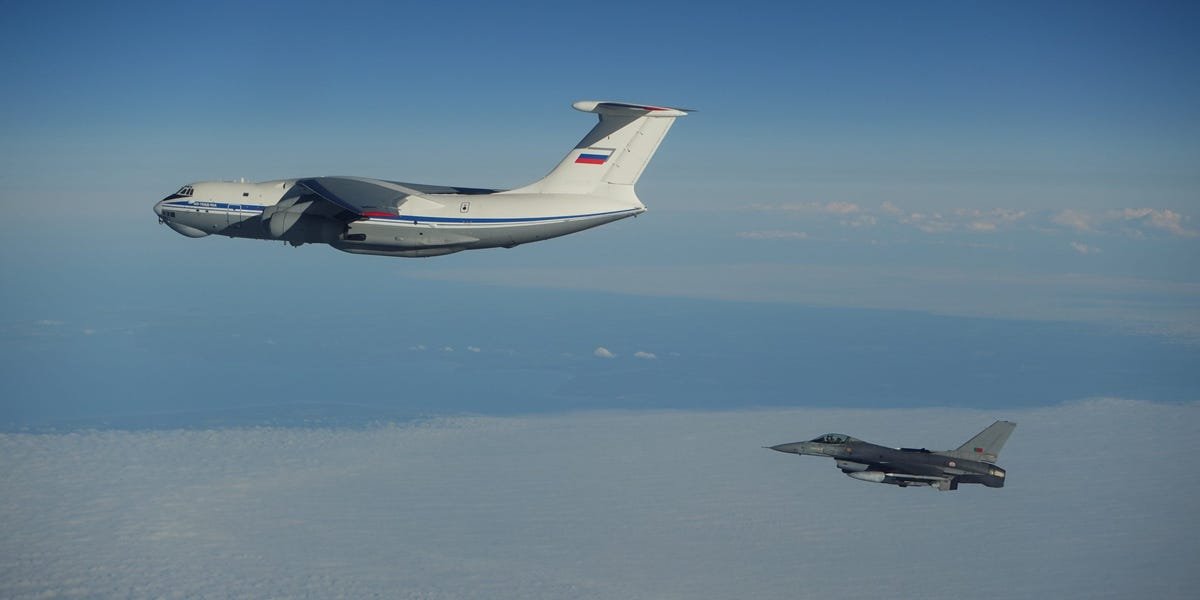


NATO is pursuing a new approach to its air defense operations across Europe, shifting focus away from traditional air policing missions and toward a 360-degree strategy, an alliance official said.
The transition to a more comprehensive approach comes amid a rise in Russian drone incursions into NATO airspace this year. Allied militaries have repeatedly scrambled fighter jets to track and sometimes shoot them down.
A NATO official told Business Insider that NATO’s integrated air and missile defense strategy is changing from a framework focused on air policing to a “multi-layered, 360-degree approach” designed to address a range of threats.
The air policing missions involve keeping NATO fighter jets and crews at a high state of readiness so they can launch within minutes to protect allied airspace against potentially hostile crewed aircraft and drones.
The revised air defense framework is intended to protect NATO from “threats across all domains,” including crewed aircraft, drones, and cruise and ballistic missiles, the official said this week. They spoke on the condition of anonymity to discuss the sensitive strategic developments.
The new framework goes beyond scrambling fighter jets, missions that are more formally known as Quick Reaction Alert; it incorporates “assets and capabilities available across all operational domains,” they said.
The revised framework includes QRA fighter jets, surface-based air defense systems, counter-drone equipment such as mobile firing teams and helicopters, and next-generation sensors that individual allies are contributing for placement under NATO command.
Airspace under greater threat
NATO established its air policing operations in the 1960s during the Cold War. In the decades since, these missions have expanded across Europe, including around the strategic Baltic region.
The transition to a new air defense approach began roughly a year ago after nearly two dozen Russian drones crossed into Polish airspace, marking the largest spillover from the war in Ukraine into NATO.
Want more Business Insider in your news feed?
Add BI in Google so our reporting is easier to find when you’re searching for what matters.
The alliance quickly launched its “Eastern Sentry” operation and surged air defense assets — including fighter jets, warships, and counter-drone systems — to allies along the shared borders with Russia and Belarus.
Eastern Sentry, which was designed to deter against future airspace violations, “laid the foundation” for the new air defense framework, the NATO official said, adding that allies “are now implementing the required capabilities to support this updated approach.”
There has been a sharp uptick in unauthorized drone incursions into NATO airspace this year, with a number of violations over the past few months in the Baltic states, as well as Finland and Romania.
The incidents have prompted NATO to scramble its fighter jets across the alliance. Earlier this week, for instance, allied aircraft shot down a drone above Lithuania. Authorities said that the drone likely crossed over from Belarus.
European officials have said many of these incursions involved Russian drones. Some of the drones have been Ukrainian; Kyiv says they were pushed off course and into NATO airspace by Moscow’s electronic warfare.
“Russia has grown increasingly reckless,” NATO Secretary General Mark Rutte said earlier this month. “As they continue their terrible war against Ukraine, we have seen more drones and missiles crossing into our airspace, along our eastern flank, creating increased risk.”
He said that NATO has also seen a significant rise in “malign activities targeting our territory directly,” including recent sabotage incidents or so-called hybrid attacks attributed to Russia. Moscow has repeatedly denied involvement.
Some Western officials and experts are pushing for a more aggressive response to the rise in hybrid activity and airspace incursions.
Conflict analysts at the Institute for the Study of War, a US think tank, suggested on September 13 that NATO should “reassess” its policy of intercepting Russian targets only after they cross Ukraine’s borders.
Read the full article here