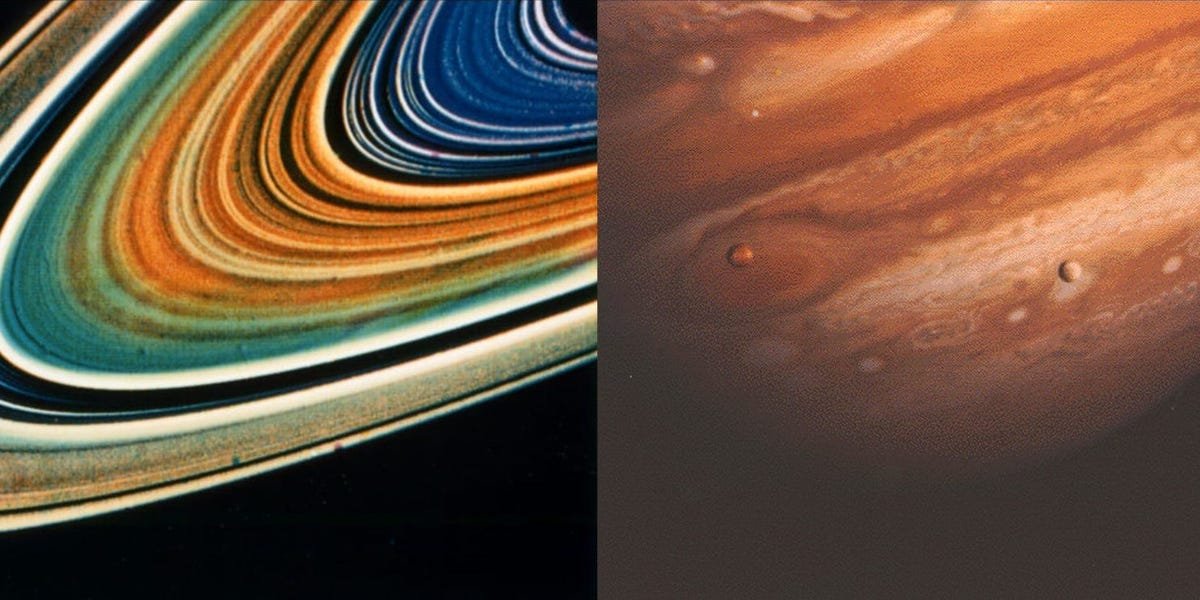
Voyager 2, a pioneer in outer solar system exploration, left Earth for interstellar space 49 years ago, on August 20, 1977.
The twin of Voyager 1, which left Earth only a few weeks after, is the only spacecraft to visit all four of the solar system’s outer gas giants — Jupiter, Saturn, Uranus, and Neptune.
The Voyager probes were originally sent on a four-year mission to tour the solar system, but they exceeded expectations and are still going nearly half a century later. That makes them NASA’s longest-lived mission, costing the agency more than $865 million.
The two probes have had their fair share of interstellar road bumps, which have only been exacerbated as the probes age. In 2022, Voyager 1 started sending garbled data from outside the solar system. NASA ultimately figured out that one of its computers had gone dead years earlier.
Voyager 2 fell into limbo in 2023, losing contact with NASA after someone sent a wrong command. The agency detected a faint signal from Voyager days later after blasting a “shout” across the cosmos to get the probe to point its antennae back to Earth and resume communication.
Come November 2026, Voyager 1 will be 16 billion miles — or one light-day — away from Earth. Voyager 2, meanwhile, will be more than 13.2 billion miles from Earth, traveling through interstellar space — the space between stars — at 34,000 mph relative to the Sun.
While both probes are losing about 4 watts of power each year, NASA continues to make efforts to keep them exploring.
In August, the agency announced it substituted some devices on Voyager 2 with “lower-power alternatives while ensuring the spacecraft remains warm enough to operate.” This, it said, should keep the probe’s instruments running for at least another year. NASA plans to make the same change for Voyager 1.
To celebrate Voyager 2’s 49th birthday, here are 23 photos that show its history and what both probes have seen among the cosmos.
Voyager 2 launched from Cape Canaveral Air Force Station in Florida in August 1977.
The Voyager mission included two probes — Voyager 1 and Voyager 2 — which NASA launched in 1977 within a few weeks of each other. Voyager 1 launched on September 5, 1977.
NASA took advantage of a rare planet alignment to turbocharge the journeys into space. Voyager 1 overtook its twin shortly after launch, thanks to a faster flight path.
The Voyager probes carry 11 different scientific instruments to study planetary bodies, magnetic fields, and particles.
This annotated image shows the various parts and instruments of NASA’s Voyager space probe.
The Voyager probes were designed to visit Jupiter and Saturn.
Voyager 2’s mission saw all four gas giants.
This is what Voyager 1 saw on its approach to Jupiter.
Voyager 1 and Voyager 2 reached Jupiter in 1979.
As they flew by the planet, they took about 50,000 pictures of Jupiter. These blew away scientists, as the quality of the pictures was much better than those taken from Earth, according to NASA.
These snaps taught scientists important facts about the planet’s atmosphere, magnetic forces, and geology that would have been difficult to decipher otherwise.
The probes discovered two new moons orbiting Jupiter: Thebe and Metis.
Jupiter has over 100 known moons; its main four are Ganymede, Io, Europa, and Callisto.
They also spotted a thin ring around Jupiter.
The probe captured this picture as it was looking back at the planet, backlit by the Sun.
Voyager 1 discovered volcanoes at the surface of Io, one of Jupiter’s moons.
Io is the most volcanically active body in the solar system.
Next stop: Saturn.
In 1980 and 1981, the probes reached Saturn. The flyby gave scientists unprecedented insight into the planet’s ring structure, atmosphere, and moons.
Voyager snapped Saturn’s rings in more detail than ever before.
Photos showed secrets that Enceladus, the sixth-biggest of Saturn’s nearly 300 moons, had to offer.
Saturn, snapped as the probe flew away, was shown in a new light.
By 1986, Voyager 2 had made it to Uranus.
By 1986, Voyager 1 had finished its grand tour of the solar system and flew out toward interstellar space. But Voyager 2 kept on exploring our nearest planets, passing 50,600 miles away from Uranus in January 1986.
Voyager 2 discovered two extra rings around Uranus, revealing the planet had at least 11, not 9.
Voyager 2 also spotted 10 previously unseen moons around Uranus.
Voyager 2 was the first spacecraft to observe Neptune from a close distance.
In 1989, 12 years after its launch, Voyager 2 passed within 3,000 miles of Neptune.
Voyager 2 was the first spacecraft to pass by Neptune.
Voyager 2 took this picture of Triton’s rough face.
It captured Triton, Neptune’s largest moon, in unprecedented detail.
It also snapped Triton’s southern hemisphere.
As it flew by, Voyager 2 discovered 4 of Neptune’s rings.
As its parting gift, Voyager 2 took this beautiful picture of light grazing Neptune’s south pole.
Since it wouldn’t come across another planet on its ongoing journey, NASA switched off its cameras after its flyby of Neptune to conserve energy for other instruments.
Voyager 1 had one last trick up its sleeve.
As its last photographic hurrah in 1990, Voyager 1 took 60 images of the solar system from 4 billion miles away.
It gave us the Earth’s furthest selfie, dubbed the “pale blue dot.”
This remains the longest-range selfie: a portrait of the Earth taken by a human-made probe from 4 billion miles away.
After this picture, NASA switched off Voyager 1’s cameras to save energy. NASA could switch the probes’ cameras back on, but it is not a priority for the mission.
Beyond the solar system
Though the probes are no longer sending pictures, they continue to send crucial information about space.
In 2012, Voyager 1 became the first human-made instrument to cross into interstellar space by crossing the boundary between our solar system and the rest of the universe, called the heliopause.
Voyager 2 was second, crossing that threshold in 2018. The probe revealed that there was yet another layer outside our heliosphere.
The probes keep sending back measurements from interstellar space, like weird hums likely coming from vibrations in the electrically charged gas between stars.
Even after their instruments are switched off, the probes’ mission continues.
Even after all their instruments become quiet, their mission will carry on.
As they drift off, they will still be carrying a golden record that carries crucial information about humanity. If intelligent extraterrestrial life exists, they could use that information to reach out to us.
This article was originally published on June 6, 2022, and is being updated with the latest developments about Voyager 1 and 2. It was last updated in August 2026.