








Nearly every parent knows you can be literally anywhere with the kids — out to dinner, at the park, sitting around the living room, or packed in the car — and they’ll come up with questions you can’t answer.
Until recently, my parental refrain was, “Let’s Google it.”
Growing up with Google as a fact of life, my son never had any objections. Now that AI has hit the scene in full force, he’s not as comfortable with my new response: “Let’s ask AI.”
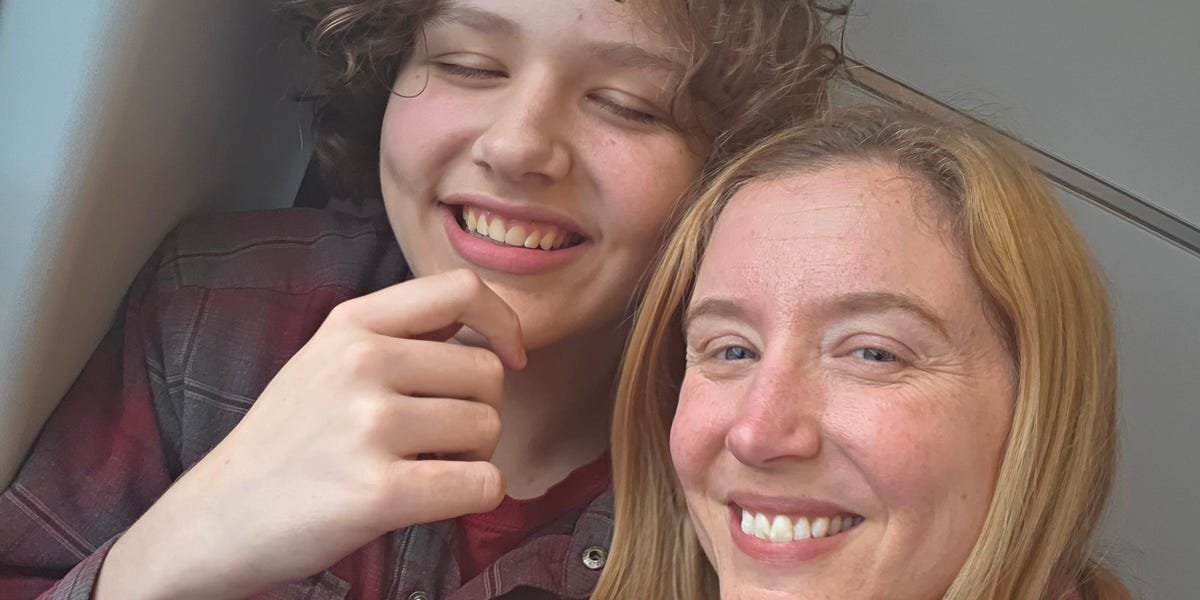
My son, Noah, has gleaned very clear anti-AI sentiments from YouTube, his peers, and likely ambient cultural unease. In many ways, I get it. He sees AI as an existential threat to humanity, the environment, and to creativity — very real and very mature concerns for a teen just entering high school.
But while Noah is forming his worldview, learning to think critically, and determining his inner compass, I’m living in a world where AI is already embedded in how I work.
I use AI as part of my daily workflow in corporate leadership
At work, I’m often the one leading the charge of incorporating AI into the workflow. It’s been a game-changer for team productivity, and I could argue that it’s reduced work stress and the ennui of repetitive tasks.
This isn’t the life I imagined I’d be living. As a former philosophy major, questions of ethics, consciousness, and what it means to be human were part of my career path. In fact, my graduate continental philosophy program was replaced only a few years ago by ethics and artificial intelligence (if only I’d had the foresight to change my major).
At my son’s age, I would likely have had reservations and even deep convictions about the limitations of AI. Frankly, I’m proud of him.
Yet at the same time, I’m drafting strategy docs and analytics decks daily, potentially draining rivers in the process. It’s a contradiction that’s hard to reconcile.
My son and I are having difficult conversations
While my son tends to see things as black and white, I see an opportunity to gently challenge that kind of thinking. It’s not only a developmental phase — it’s a very human impulse to simplify things that feel big and overwhelming.
I’m not sure there’s been a better example than AI since the advent of the atomic bomb.
I tell my son that tools are just tools, and it’s how they’re wielded that matters. A hammer can build a house or destroy one, but that doesn’t make a hammer bad. Most tools reflect the intentions of those behind them.
That said, hammers can’t build themselves, nor did the creator of the hammer put out a call for a coordinated slowdown across the industry because of the potential safety concerns.
As such, I’m far from an AI cheerleader in the home, but I’m no doomsayer either.
I’m not trying to raise a child who blindly accepts technology (or anything), but someone who can think critically inside complexity, to hold the tension of opposites without rushing to resolve it. If nothing else, this is what his future will demand of him.
I want to help him understand that pragmatic adoption isn’t blindly condoning AI and that wholesale rejection isn’t going to stop AI from taking the world by storm. To face the reality of AI, we have to situate ourselves somewhere in the messy middle.
We start at home with simple boundaries
I’m not toggling between conversations with my son and a chatbot. I don’t use AI to outsource meaningful creation. When I log off for the day, I focus on getting my hands messy in my garden and in making pottery, or getting sore thumbs mashing buttons with my son on his favorite video games.
I don’t know where Noah will ultimately land on AI. He may remain a skeptic, become an outspoken critic, or he may embrace it when he enters the workforce.
What matters more to me is that we keep the dialogue going: that he continues to question the world around him, that he learns not just what to think, but how. Above all, I want him to know it’s possible to engage meaningfully with something imperfect without surrendering your values to it.
We’re both figuring it out in real time: him as a teen stepping into a rapidly changing world, and me as a parent trying to model what it means to live thoughtfully inside it.
For now, that feels like enough.
Read the full article here