







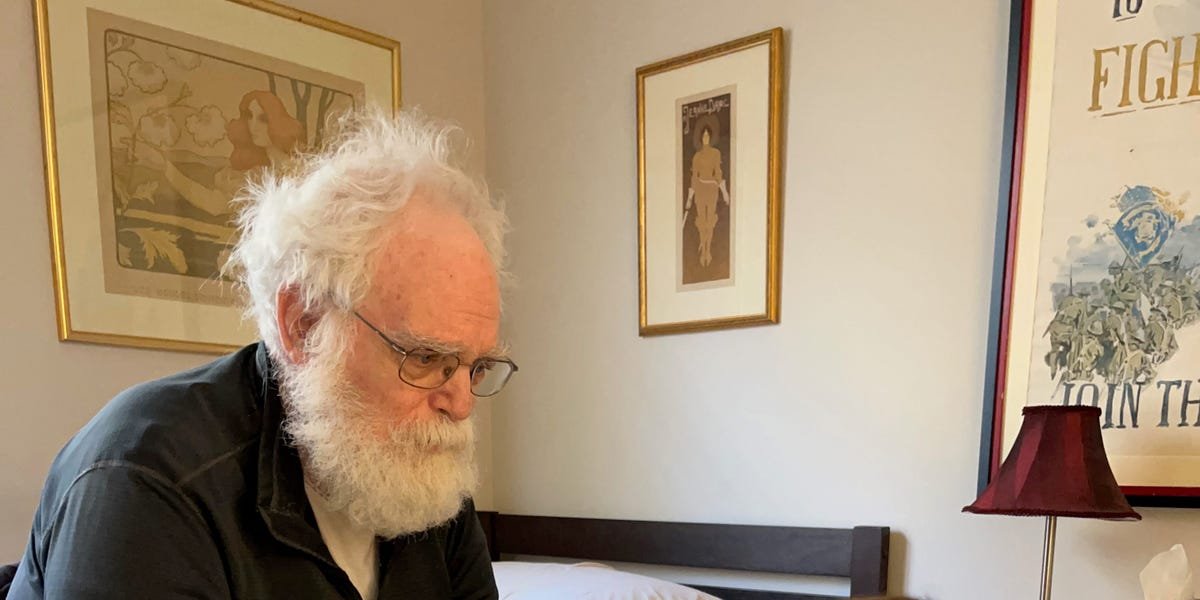


My father, a decorated veteran of the Marine Corps who served during the Vietnam War, struggled with dementia for over a decade.
By the age of 70, both his first and second wives had died from cancer, leaving him alone and attempting to live by himself while dealing with his dementia diagnosis.
His dementia left him unable to sign up for veterans benefits, manage his finances, consistently take prescription medicine, or handle such basic tasks as managing the refrigerator, charging a cellphone (leading to a landline), hanging up the handset for the landline (leading to a corded phone), or putting in hearing aids (such that all phone calls were missed).
This all occurred during the peak years of my career, and during the fledgling years of my own family.
We decided to move him close to us
When my son was a newborn, I would regularly drive four hours to pay Dad a visit if I couldn’t reach him on the phone. I installed cameras in his apartment and hired twice-daily caregivers to administer his medication and provide meals.
He began to wander and had a few hallucinogenic episodes, so my dad and I decided together that he would no longer live independently, even with the professional in-home care he received. My wife and I decided to move him to Maine to live near us so I could better care for him.
Within steps of exiting my car, he tripped, fell, and hit his head on the granite steps of our house, cutting his forehead. Over the next few weeks, despite my being with him at all hours (I was also a stay-at-home dad for three toddlers at the time), we could see that round-the-clock professional care would be necessary. While we looked for options, he lived in our guest room.
When he moved in with us, we were able to sell his apartment, which left him with about $300,000 in the bank, now the entirety of his life savings. Combined with his Social Security and the veteran’s pension I’d been able to secure for him, we hoped it would last him for the rest of his years.
He paid $17,000 a month for a memory care unit
I began researching assisted living facilities in our area, and after a few consultations, I was advised that he should be in what they call a 24-hour lockdown memory care unit. There were three potential options nearby, one of which was actually in a Veteran’s Home. Unfortunately, the waitlists were all rather long, and the Veteran’s Home was said to be well over a year.
Although the Veteran’s Home would have been the most affordable option of the three, and favorable because of the veteran community, waiting a year or more to get him in didn’t work for our timeline. So, after a few months’ wait, he was admitted to a memory care unit in a private facility about 10 miles from my home. The care he received was outstanding, he was happy and safe, and he spent his days kindly flirting with nurses when he wasn’t being visited by my family.
A tiny studio apartment in the memory care unit ran a shocking $17,000 a month. We also had to pay for incidentals, physical therapy, and haircuts, all of which were not included in the monthly rate. He lived there for just under a year and a half and died with only a few thousand dollars to his name. This would have been a disappointment had he known of it, but his dementia left him blissfully unaware.
I don’t know what we would’ve done had he lived another year, or even several more months.
There’s emotional and financial stress for families like mine
Everyone knows that the cost of elder care is outrageous, but for families dealing with dementia, it can become impossible.
Surely, plenty of homes cost much less than $17,000 a month, but the cost and scarcity of round-the-clock care make the equation very complicated for families like mine. The complexities of Medicaid and Medicare, red tape, and the high cost of long-term care insurance only make things worse. Beyond the emotional strain of handling dementia, many families are now faced with a choice between financial ruin or taking on care for which they may not be qualified, often dedicating a family member as a full-time caregiver and sacrificing their career in the process. In total, we spent over $270,000 over the last few months of his life.
I sometimes wonder if Dad actually knew all about this somehow, and if he chose to depart just before the bricks came tumbling down, before his family had to take on added stress and financial hardship.
I’m extremely grateful for the care he received, and that he was able to peacefully depart this life holding his granddaughter’s tiny hand while I sat by his side. The time he got to spend with his grandkids and the memories they made with their grandfather are something I consider to be priceless. In reality, though, I know what that eye-watering price happens to be.
Read the full article here