







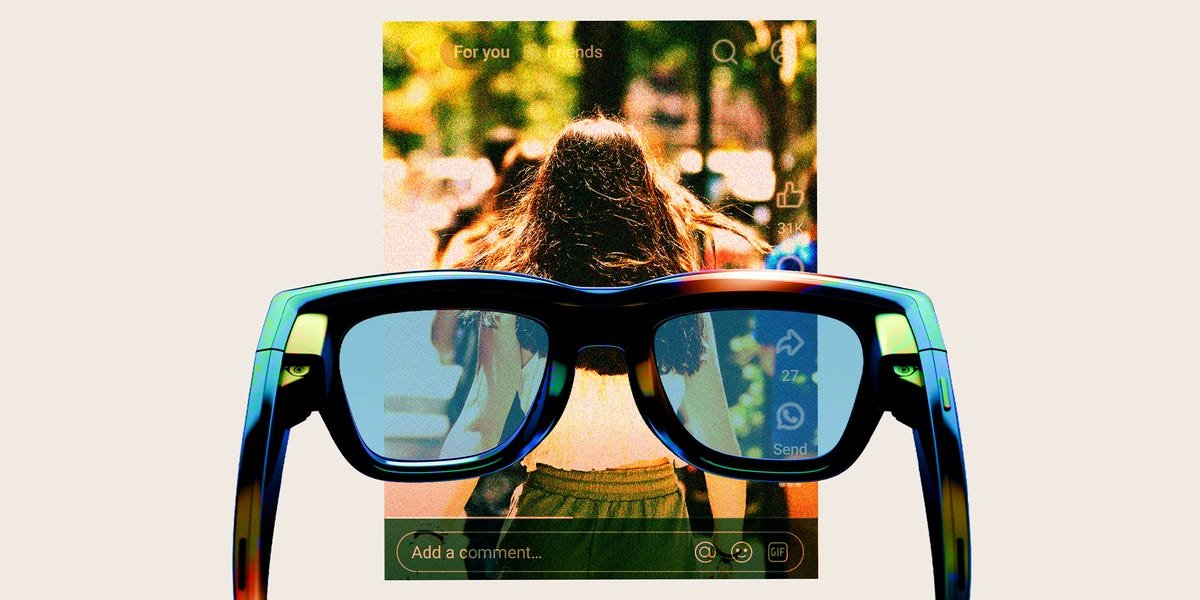


“Are you a secret code?” a young man in Meta glasses asks a woman in a tank top on the sidewalk. “What do you mean, ‘a secret code?'” she responds, seemingly confused as the man’s glasses record her. “Because I’m trying to crack you,” he says.
The interaction, filmed by content creator Colin Allen for his Instagram account @thatiscolin, is one of dozens of similar videos that I found from popular and verified accounts on the platform in the month after Instagram boss Adam Mosseri said Meta would remove “harassing” pickup line videos filmed with Meta glasses.
After I sent Meta a link to 20-plus pickup and other harassing “prank” videos from different accounts, the company removed the “secret code” video and eight others. Allen, who describes himself as a “lifestyle and comedy creator” and not a pickup artist, had used the same line to different women in several other videos, which remain up.
Videos from pickup artists using Meta glasses to approach women in public have emerged as a genre on Instagram’s Reels and TikTok, with some of the popular videos racking up millions of views. These videos of men trying pickup lines on women on the street, along with pranks on cashiers or service workers, are tagged on Instagram as being shot on “Meta glasses.”
Being associated with that kind of icky content can’t be good for the reputation of the devices, which some people are already referring to as “creep glasses.”
Tracy Clayton, a spokesperson for Meta, told me that thousands of pieces of content have already been removed, and several large accounts have been taken down. The recent enforcement action falls under Meta’s existing Community Standards on bullying and harassment, which broadly forbid content that sexualizes other adults or sexually harasses people. Additionally, search terms for “rizz” or “cold approach,” common pickup slang, are now blocked in search.
My last month spent in pickup-line video land has shown me that Meta’s enforcement has been uneven in the weeks since Mosseri’s remarks. “We don’t want people to be surreptitiously taking videos of other people and harassing them and then posting them on our platform. So we’re trying to fight that every way we can,” Mosseri said in mid-July.
When initially reporting on Mosseri’s comments, I found two large pickup artist accounts that had been deactivated as part of the recent enforcement wave. A few days after my article was published last month, one of those accounts was reactivated (a Meta spokesperson said this was by error, and the account was re-banned after I brought it to their attention).
Carolina Are, a digital criminologist based at the London School of Economics and Political Science, said that Meta and Mosseri’s response to the harassing AI glasses videos highlights isn’t enough.
“There is a backlash, and then Meta tends to minimize its own responsibility for it. They talk about how this is user-generated behavior or an error in enforcement,” Are said. “But they don’t recognize the systemic issues that are causing that to happen, and they take no accountability for what their policies or infrastructure have done to enable that behavior,” Are said.
These pickup and prank videos made with Meta glasses aren’t exclusive to Instagram; they also exist on YouTube and TikTok.
A spokesperson for TikTok told me that it has policies against harassing content. After I sent a list of four videos of pickup artists who also posted on Instagram, TikTok took down two of them, citing its policy on bullying and sexual harassment.
Boot Bullwinkle, a representative for YouTube, told me it has policies against certain kinds of harassment and dangerous prank videos. YouTube has been dealing with moderation issues around street pranks and pickup artists for years. After I sent four examples of channels that posted Meta glasses pickup content, YouTube said it took down “several” of the videos and removed one of the channels from its monetization program.
A headache of its own making
Mosseri personally delivering the message that Instagram will take down this specific kind of content is unique among video platforms. That may be because of Instagram’s unique relationship with the Meta glasses: Not only are these unsavory videos a headache of its own making, but they also risk harming the public perception of a product that Meta invested big bucks in building and marketing.
Plenty of people are buying up Meta’s AI glasses. Sales have grown since their launch in 2021, topping 7 million units in 2025, more than triple the previous year. Meta is the early leader in the smart glasses race.
They’ve been a bright spot for Meta’s money-losing Reality Labs department, which faced layoffs this year. They’re also key to CEO Mark Zuckerberg’s AI bet.
“I think in the future, if you don’t have glasses that have AI or some way to interact with AI, I think you’re kind of similarly, probably [going to] be at a pretty significant cognitive disadvantage compared to other people and who you’re working with, or competing against,” Zuckerberg said in a 2025 earnings call.
The recent backlash — remember when Kylie Jenner’s Instagram comments were flooded with people calling her signature Meta glasses “pervert glasses”? — presents a thorn in Meta’s side.
“In many cases, the public-facing rules that users see are vague enough to be open to the discretion of the platform to make those kinds of shifts and changes at any time,” said Sarah T. Roberts, faculty director and cofounder of the UCLA Center for Critical Internet Inquiry.
Meta is betting AI could supercharge its moderation efforts. Zuckerberg and other execs have long said the old way of doing things, leaning heavily on third-party human contractors, doesn’t scale. The theory goes that AI can be trained to autonomously flag violating content. In June, Meta told the Financial Times that initial tests showed that its AI systems made fewer mistakes than human moderators and flagged more violating content. The jury’s still out on whether that will prove to be the case long term.
Deactivated one day, reactivated the next
After seeking out and interacting with some of these pickup line videos in Reels, I started getting served more and more of them. I no longer needed search terms to find them; my Reels feed was filled nearly entirely with that genre of content.
One creator whose account was active weeks after Mosseri’s remarks is Caren Babaknia. He has 174,000 followers and posts videos of himself driving up to women he identifies in the caption as escorts and talking to them while wearing Meta glasses.
In one video captioned “Wasting ESCORTS time by making them watch brainrot” he offers a woman who approached his car $50 in exchange for watching a video on his laptop of brainrot memes. The woman agrees, and he plays the video, which includes an ad for a gambling app. He hands her the cash.
I spoke with Babaknia on the phone to get his perspective on videos made with Meta glasses. He told me he believes the women in his videos are aware that he was filming them because his content is so viral that they knew him.
He voiced disdain for pickup artists with Meta glasses, however.
“I think the rizz content is very cringe,” he told me. “I think those are normal girls and they don’t deserve to be videoed without their consent.”
After including one of Babaknia’s videos in the list I recently sent to Meta, his account was deactivated the following morning. Babaknia told me that he was going to appeal. A day later, his account was back up with the videos restored.
It’s not unusual for changes to enforcement in content moderation to take time to implement at scale. But as Meta glasses get increasingly popular, it seems likely that Instagram will face pressure to deal with this — and potentially new forms of bad behavior — more and more.
“It’s not like they just started those platforms yesterday,” said Roberts from UCLA. “It’s not like they don’t have 20 years now of understanding how people will behave at the most depraved levels if given a chance.”
Read the full article here