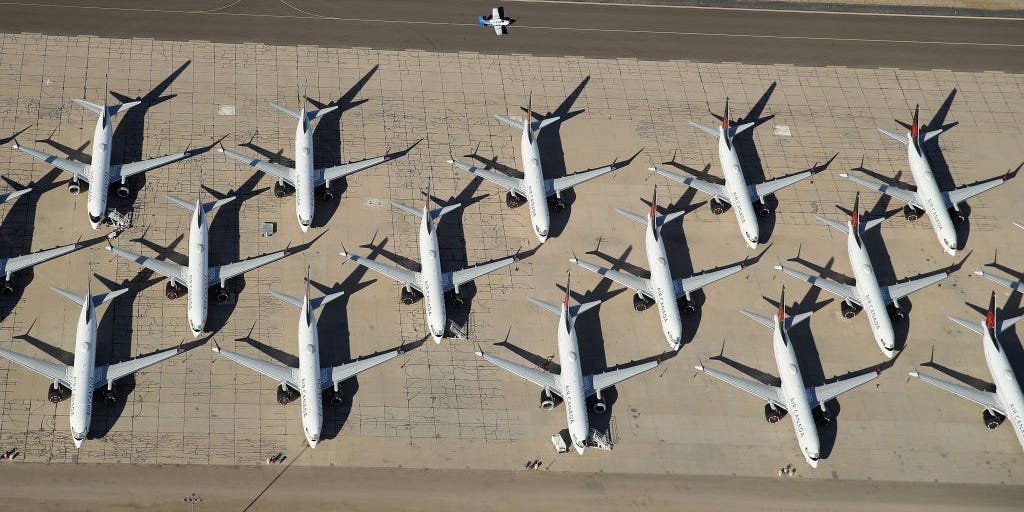
There are approximately 8,000 “end-of-life retired aircraft” sitting in deserts, jungles, and storage yards across the globe. Another 11,000 planes are expected to join them over the next 10 years.
These “graveyards” started filling up during the COVID-19 pandemic when airlines had to make drastic cost-cutting changes, including furloughing pilots, cutting routes, and indefinitely storing hundreds of planes in the desert.
Some Spirit Airlines aircraft could end up at facilities like this for reconfiguration or disassembly after the budget carrier ceased operations on Saturday.
One of these plane “graveyards” is Pinal Air Park in Marana, Arizona, which Business Insider visited in April 2023. Take a look inside.
Pinal Air Park in Marana, Arizona, is located about 90 miles southeast of Phoenix.
The dry climate is favorable for preventing corrosion.
As airlines started to shrink in 2020, hundreds of planes from all over the world flew to the 2,080-acre airpark.
With the influx, Pinal had to take special precautions to ensure the aircraft was ready to fly once travel eventually rebounded.
Because of this, Ascent Aviation Services — the largest aircraft service provider on the airfield — had to beef up its staff to maintain the constant arrivals.
Additional parking lots were built to handle the hundreds of planes, with jets coming from places like the US, South Korea, the UK, Australia, and Canada.
Leasing companies were also filling the airfield after buying up inexpensive planes sold during COVID and storing them at Pinal.
However, when travel roared back, with demand surpassing 2019 levels, AAS returned to its roots: maintenance, repair, and overhaul (MRO).
Basic offerings include simple maintenance checks and on-demand repairs, like fixing the landing gear or inspecting the flight controls.
Heavy maintenance is the most costly for airlines. A full assessment of the aircraft can take up to 60 days for widebody jets, Butler explained.
“A narrowbody will cost around $2 million,” he told Business Insider in May 2023. “With widebodies, you’re easily looking at $3 million.”
These projects take a lot of manpower. Butler said the company targets 400-500 hours per day for widebodies and 300 per day for narrowbodies.
Because checks are so expensive, many carriers opt to sell the aircraft when it reaches that stage in its lifecycle, typically every six to 10 years.
Or, the operator will allow an aircraft lease to expire. This means if the lessor finds a new home for the plane, it will need to be fitted for its next contract.
For these conversions, AAS offers additional services, such as repainting liveries, switching out flight systems, and installing new cabins.
Sometimes, aircraft transition from passenger jets to cargo planes, a service that saw increased popularity during the pandemic, especially with older jets.
For flight tests and deliveries, the operator will arrange pilots, who land and depart on the designated runway stretching across Pinal’s airfield.
Overall, Butler said AAS can do nearly anything an airline would need from an MRO standpoint.
The main service it can’t provide is engine overhauls, which are outsourced to other shops.
“A lot of our current projects are just waiting on engines,” Butler said in 2023. “There’s a backlog because no one did engine maintenance during COVID because of the expenses.”
He explained this was adding to the already strained supply chain, which had caused a slowdown in returning aircraft to service.
While AAS does a lot of work keeping airplanes flying, it also offers aircraft reclamation and end-of-life services, which the Aviation Circularity Consortium wants to capitalize on.
This involves disassembling and disposing of unwanted parts, which make up about 10% of the airplane.
According to Butler, the other 90% is recyclable. These include items such as engines and galley carts.
Avionics and landing gear can also be recycled.
However, he said custom interiors do not have much value except to the original operator.
A plane can spend months being salvaged, with hundreds of collected parts being resold or repaired for future use.
The re-certified pieces can be sent back to airlines who keep them in their inventory as spare parts, meaning retired jets can still provide for current ones.
Meanwhile, some carriers will take parts of the metal to create memorabilia, like cutting the logo or airline name from the fuselage and using it as wall art.
In addition to the strong MRO and reclamation divisions, storage and parking are still strong revenue sources for AAS.
“80% of all the stored aircraft worldwide are stored in the Southwest,” Butler told Business Insider in 2021.
During an April 2023 tour of the airpark, Business Insider found the main lot full of planes, including two rare Boeing 747SPs.
Mechanics spend up to two weeks getting a plane ready for storage. Important components like the engines, pitot tubes, systems, and landing gear are sealed and protected.
This is especially important to prevent critters and other wildlife from taking up residence in the airplane’s openings and small crevices.
Butler said that the stored aircraft also get regular maintenance checks to keep them airworthy.
Parked planes, on the other hand, do not get this service and can be left to collect dust, giving Pinal its “boneyard” nickname.