







One of the greatest ironies in personal finance is that the people with the most money sometimes live the most uncomfortably. After spending another summer in Honolulu with my parents, I’ve been thinking hard about why.
This post is a love letter to frugal parents everywhere. It’s also a nudge for all of us adult children to check in on our parents more often. Because sometimes, a $400 fix is the difference between suffering and living well. And in extreme cases, it may be the difference between life and death.
The $400 Comfort Upgrade
When we started spending summers in Honolulu, one bedroom in the two-bedroom in-law unit I remodeled, had a toxic 42-year-old through-the-wall AC unit that no longer worked. Summers here run 83 to 90 degrees, and when the Tradewinds disappear, the humidity turns every room into a sauna.
So I bought a new AC unit at Home Depot for $250 and had my handyman slot it through the wall where the ancient one had been rusting away.
Once I saw how easy the swap was, I asked him whether we could install a unit in the second bedroom, which had no AC at all. He said, “why not?” He took out some slat windows, built a frame, caulked the gaps, and installed the same $250 unit.
Total labor for the project was about three hours, which included his trip to buy the unit. Given how cost effective it was, I had him install a third new unit in the living room too. Hooray for comfort!
I know $250 for the unit plus $150 for labor isn’t chump change. But wouldn’t you spend $400 to sleep comfortably all summer and lower your risk of heat stroke? I sure would.
Which brings me to the puzzle I couldn’t stop thinking about.
Why The Elderly Suffer The Most From Heat
Here’s a stat that shocked me: every summer, more than 60,000 Europeans die from the heat. Not over a decade. Every summer. And according to the World Health Organization, heat now claims more than 175,000 lives every year across the broader WHO European Region, making heat stress the leading cause of climate-related death there. Even more die from heat in Asia every year.
Roughly 85% to 90% of these heat-related deaths are people over 65. Older adults are uniquely vulnerable because aging reduces the body’s ability to thermoregulate. Sweating and cooling down simply don’t work as well anymore. Pre-existing cardiovascular and respiratory conditions also get aggravated by severe heat stress.
Intuitively, that makes sense. But here’s what doesn’t: the elderly are also the wealthiest demographic in the country. If anybody can afford $400 to install an AC unit, it’s a retiree with decades of savings, not some 30-year-old still living at home with his parents.
So why all the unnecessary suffering? I finally got my answer driving in my dad’s car one sweltering hot afternoon.
The Hot Box Car
My dad own a 28-year-old Toyota Avalon that is breaking down. I’ve offered to buy him a new car for better comfort and safety. He declines every time given he wants to save money and likes its familiarity.
However, when he learned I was doing a 55-minute supercommute one way last summer to school, he scolded me for not just staying with them for a 12-minute commute instead. But we needed to give my mom her space, so we stayed at my aunt’s house far away for a week.
Then, after we left Honolulu, he replaced the old axles and tie rods for over $2,000, which was a huge surprise. When I visited this spring break, and the driver’s side window didn’t work, he also decided to fix it for $750 before we came back to visit this summer. I told him not being able to wind down the window was unbearable.
In other words, his desire for us to be safer spurred him into action. And I appreciate it because I don’t want to get into an unnecessary accident.
The Broken AC They Did Not Realize Was Broken
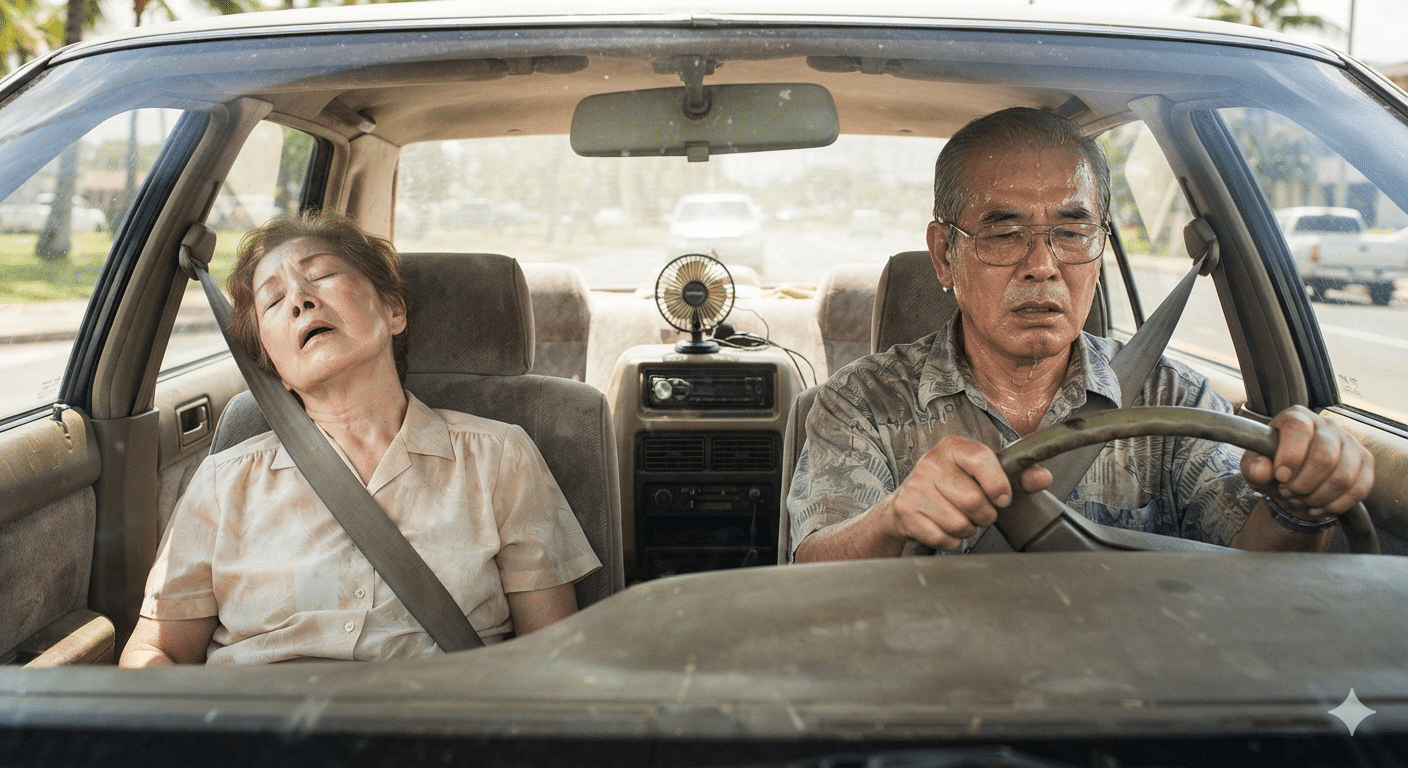
But the one thing that never got fixed was the AC. When it’s 88 degrees outside, the vents blow 80 to 88-degree air, while the cabin heats up to over 100 after sitting in a parking lot.
After lunch at Sing Sing, a great Thai restaurant in Chinatown, I went ahead to air out the car while my wife, mom, and dad looked for some durian. On the 14-minute drive home, my mom asked me to roll up the windows after five minutes. Like a good son, I obliged as I drove everyone home.
The cabin climbed past 90 degrees and I immediately felt my chest get heavy and my breath shorten. The fan blew warm air in my face like a hair dryer set to medium. Thirty minutes more of this, and I could see myself passing out and crashing with all of us inside. There’s precedent too. As a kid, I once passed out face forward and cracked my head in the heat when my mom took me to a Buddhist temple in Malaysia.
But I told myself, if my parents can withstand the sauna, so can I. Worst case, only nine minutes to freedom.
Then I asked my parents whether they felt hotter with the windows up. They said no. I was perplexed, because both my wife and I could feel the oven temperature rising.
The Real Reason: Inertia, Not Money
Here’s my realization. Perhaps it was never about the money.
My parents have no debt, government pensions after decades of working in the U.S. foreign service, and the cash flow to fix the AC or buy a new car no problem. The reason they don’t isn’t poverty. It’s inertia.
After 20+ years of retirement in Hawaii, they’ve adapted to the heat. They’ve adapted to the car. They’ve adapted to the leaking kitchen pipe that ran for three years until I finally fixed it. And when the television I bought them started looking blurry, they adapted and thought nothing was wrong for a year until I got it fixed.
When you’re used to something, the discomfort fades into background noise, even when the danger doesn’t.
So when my father tells me “I just don’t want to” when I ask why he won’t buy a new car, I take him at his word. There’s something admirable in that contentment. He’s not chasing more. He’s satisfied with what he has.
Mind / Body Incongruency As You Get Older
My only fear is that one day they’ll get stuck in midday traffic for an hour, and the heat will overwhelm bodies that can no longer cool themselves like they did at 35. It seems as if we get older, our senses either fade, or our minds think our bodies are more resilient than they really are.
Because once again, why are over 60,000 elderly people dying in Europe every summer when they can easily prepare for the heatwave ahead of time? They’ve been through enough summers already.
This incongruence between mind and body is something we all need to be vigilant about, especially if we have people depending on us. We adult children can provide a different perspective to break up what our parents find normal, but wrong.
The Activation Energy Problem
Think about what fixing a car AC actually requires. You have to research a trustworthy mechanic. Call and get quotes. Drive the car in. Arrange a ride home. Wait days for parts. Drive back to pick it up. Dispute the bill when it comes in 40% over the estimate.
For me at 49, that’s an annoying afternoon of phone calls. For someone at 81, each step is a boulder to push uphill.
The same math applies to everything. Hiring a cleaner means letting a stranger into your home, explaining what you want, and supervising the work. Fixing a leak means finding a plumber, scheduling around your nap, and enduring the noise.
Meanwhile, doing nothing costs zero energy today. The discomfort gets paid in small installments you barely notice, while the fix demands a lump sum of effort up front. Of course doing nothing wins. It wins every single day, for years, until the leak rots the ceiling or the heat wins the war.
So when the elderly won’t spend money to live better, we’re diagnosing the wrong problem. They’re not short on dollars. They’re short on activation energy. And no amount of money in a bank account fixes that on its own, which is why checking in on elderly parents is important.
Why I Appreciate The Suffering
Part of me loves that my childhood home is stuck 42 years in the past.
Same old oven that is now rusted. Same old dirty carpet with stains everywhere. And same walls with smudge prints from when my hands were half the size. It’s a time machine back to when I was a kid with no money and plenty of happiness.
It’s also one of the best antidotes to lifestyle inflation.
After a month of driving a 28-year-old car with no Bluetooth, no backup camera, no leather seats, and no working AC in the summer heat, my 2015 car back in San Francisco feels like the most luxurious automobile ever. My desire to buy a new car evaporates.
My urge to keep climbing the housing ladder disappears too, because our gut-remodeled 2023 home is pristine by comparison.
And getting fried in Honolulu heat makes me appreciate San Francisco’s 62-degree average all over again. The city makes you soft after a while.
The occasional suffering makes everything you have feel more valuable.
But Don’t Let Frugality Shorten Your Life
Appreciating what you have is one of the great keys to happiness. Gratitude beats back greed and dissatisfaction better than any raise ever will.
But there’s a line where admirable frugality becomes dangerous neglect. The saddest recent example is Gene Hackman.
In 2025, Hackman and his wife Betsy Arakawa were found dead in their Santa Fe home, undiscovered for more than a week. Investigators found rodent nests and dead rodents across the outbuildings and vehicles on their property.
His wife died of hantavirus pulmonary syndrome, a rare disease spread by rodent droppings. Hackman, 95 and suffering from advanced Alzheimer’s, lived alone with her body for about a week before his heart gave out.
I wonder where were his three children? Did Gene and his wife think their house was clean enough when it was not?
Here was a man worth a reported $80 million. He could have hired pest control, cleaners, groundskeepers, and a full-time caretaker without noticing the expense. The money was never the obstacle. The energy to arrange it all was.
Money is a tool. If it can’t buy you a cool room in a heatwave, a safe car, or someone checking in on you several times a week, what exactly are we saving it for?
What Adult Children Can Do
As the eventual caretakers of our parents, the best thing we can do is spend time with them and observe. A fresh set of eyes catches blind spots that a simple fix could solve. Here’s my playbook:
1) Visit long enough to notice. A three-day visit shows you the highlight reel. A four-week stay shows you the broken AC, the expired food, the fuzzy TV, and the leaking kitchen ceiling that all should be attended to.
2) Fix small things without a committee meeting. I didn’t ask permission to fix the leaking pipe in the kitchen ceiling. I just fixed it. They were grateful, kind of. For three years, they had gotten used to simply putting a rag on the floor to catch the drip.
2.5) Be the activation energy. Don’t hand your parents a to-do list. Do the doing. Research the mechanic, schedule the appointment, be there to let the handyman in. Your parents don’t need advice. They need someone to absorb the logistics they no longer have the energy for.
3) Don’t force wholesale change. You don’t want to be the overbearing child who bulldozes their independence. Respect that their habits got them to a comfortable retirement in the first place.
4) Introduce convenience gradually. Set up Uber Eats or grocery delivery on their phone. Save them a trip or two per week and let the convenience sell itself. Teach them new features on their phones. Hire a gardener or house cleaner.
5) Establish a check-in rhythm. A weekly call minimum. A daily text. It takes 30 seconds and it’s the cheapest insurance you’ll ever buy.
And maybe, when they aren’t looking, take the car to the mechanic and pay to fix the AC yourself. It’s still cheaper than a new car, and your parents might finally remember how things are supposed to feel.
The Joy Of Having A Mobile Fridge Once More
True to my word, I hunted around online for someone who could fix car ACs. I found a fellow named Dan who drove to our house the next day to check out the car.
He diagnosed a freon leak and gave me two options: top it off with one pound of refrigerant for $80, or replace the AC condenser for about $600. Given the car is 28 years old and the AC stopped feeling cold three years ago, I told him to go the easy route first and reassess later.

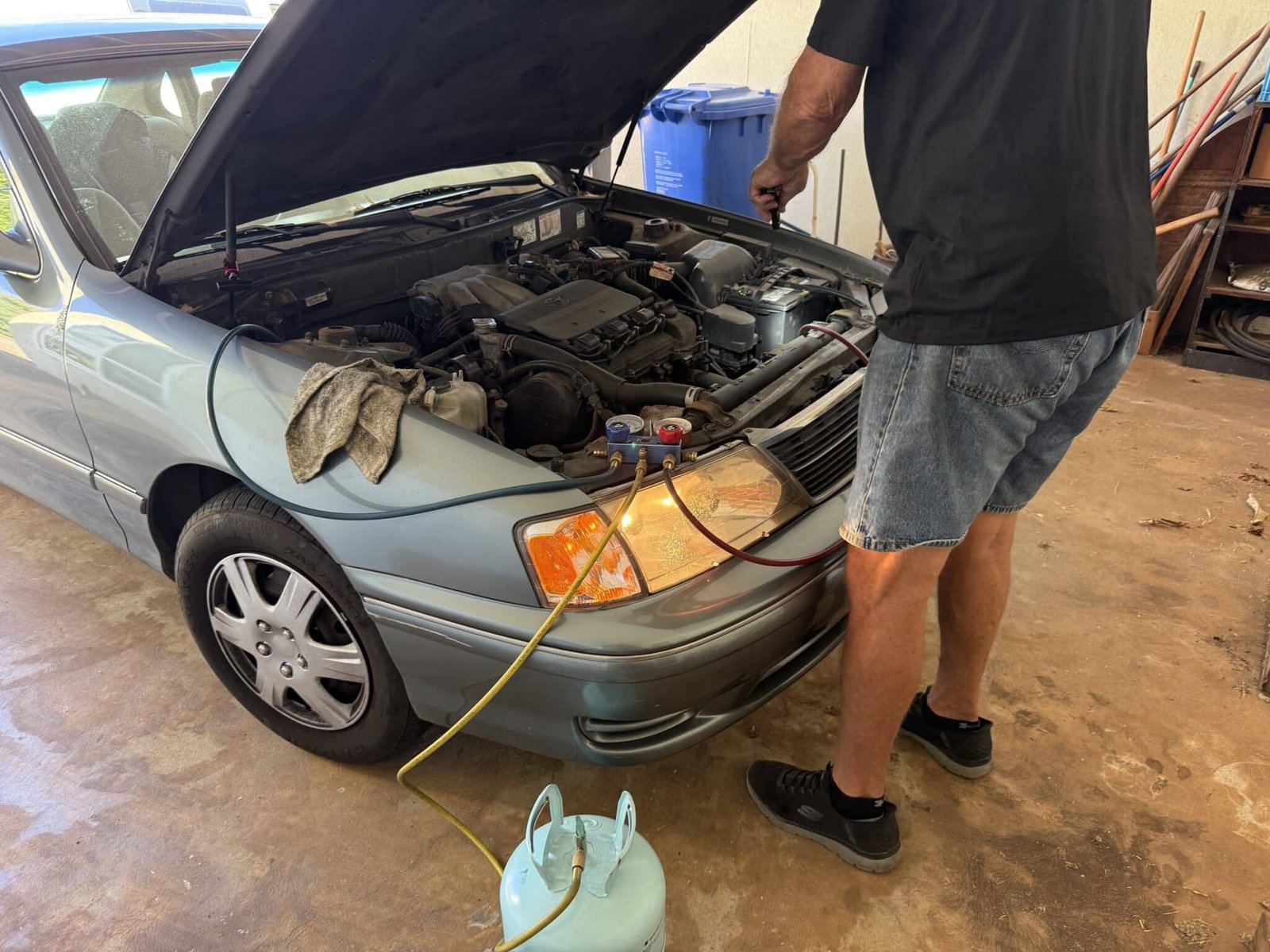
And just like that, the 1998 Toyota Avalon blows ice cold air again. Ah, it feels so satisfying to get things fixed. No more fearing anyone will pass out from the heat while I drive my kids around.
Add it up. Three years of unnecessary suffering, eliminated in 24 hours for $80 and one phone call. If that’s not proof the obstacle was never money, I don’t know what is. The obstacle was simply nobody willing to be the activation energy, including myself last year.
Small Costs, Catastrophic Risks
The whole experience crystallized something for me. Most of protecting a family comes down to paying small, almost boring costs to remove catastrophic risks. Eighty dollars of freon removes heat stroke and a potential accident or worse. A $400 wall unit removes a sweltering bedroom. A weekly phone call removes the possibility of a parent lying undiscovered for a week.
The biggest catastrophic risk of all is a family losing its income earner. That one costs a little more than $80 to remove, but not much more. When our first child was born, my wife and I got matching 20-year term life insurance policies, and the relief was immediate. It’s the same feeling as cold air finally blowing from those vents, except it covers your family for two decades instead of one drive home.
If you have anyone depending on your income and haven’t checked rates, Policygenius lets you compare real quotes from top carriers in minutes, all in one place, for free. Like my dad’s AC, the hard part was never the cost. It was making the one phone call.
Reader Questions
Readers, why do you think the wealthiest generation is often the least willing to spend money on comfort and safety? Is it Depression-era conditioning, inertia, or a contentment the rest of us have lost? Have you noticed the activation energy required to get anything fixed rising as you age?
Join 60,000+ readers and subscribe to my free weekly newsletter here. If you want new posts in your inbox as soon as they’re published. Money is too important to be left up to pontification.
Read the full article here