







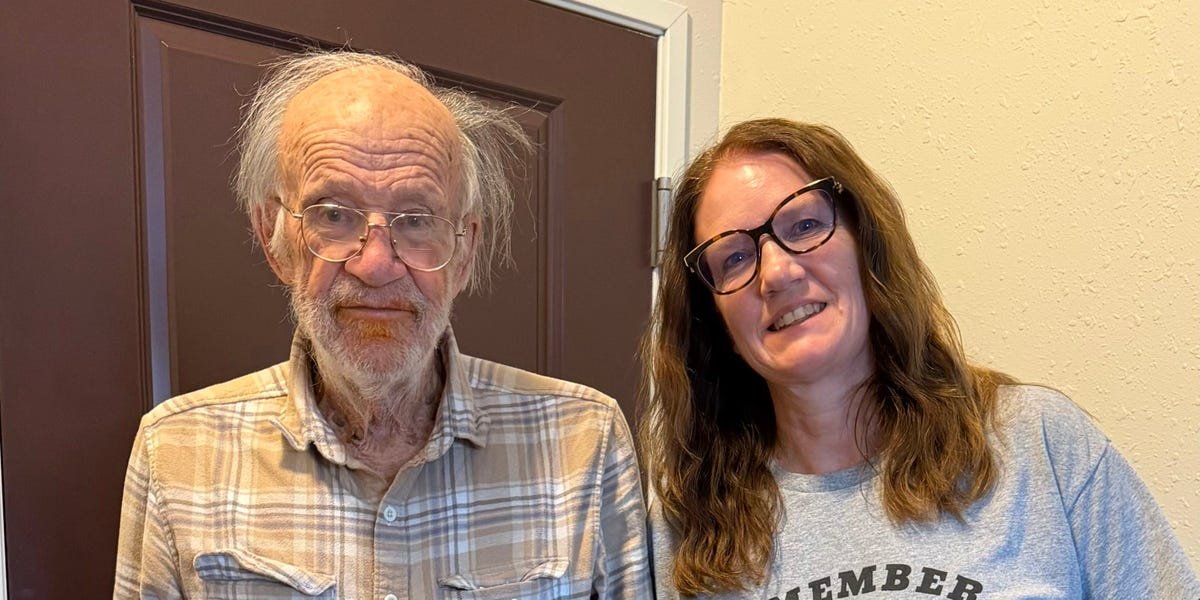


This as-told-to essay is based on a conversation with Tasha Crouse, 55, who is caring for her father with dementia. She lives in Wisconsin but frequently visits her father, who is in a memory care facility in Colorado. Crouse became his conservator as his condition worsened. Crouse’s lawyer and fiduciary confirmed details of the conservatorship agreement. This interview has been edited for length and clarity.
Both of my parents are from the UK. They got married and moved to Fort Wayne, Indiana, where I grew up. My mom taught French, and my dad was a trust officer administering estates at a bank.
After college, I taught for two years before getting married and having kids. I stayed home with them, and when they got to high school, I went back to nursing school and became a practicing nurse in long-term care. I became familiar with dementia, and I recognized all the signs when my dad started experiencing some symptoms.
My dad started acting differently after my mom died
My mom’s decline was relatively quick. One day in 2015, she couldn’t stand up, so my dad took her to the hospital. She had a huge ovarian tumor, and she died two months later. She was in the hospital that entire time.
After she died, I noticed that my dad would talk in circles. He would ask the same question that he had asked a minute earlier. One time, we were kayaking, and we told him to pick us up at 11 a.m. at the drop-off spot. When we were done, we went there, but he wasn’t there, and we couldn’t contact him. We borrowed somebody’s phone, and he said he went but didn’t see us, so he left. He didn’t look at the time.
We initially doubted that anything was wrong, and he was just forgetful. We noticed he would hold on to his receipts and write them down to keep track of his finances. One time, I noticed he wasn’t turning on the heat in his house during the winter because, according to him, he didn’t have the money to pay for it. He didn’t have the executive skills to look up a phone number and call someone to deliver him wood, so he went into the woods to scavenge. He didn’t remember that he already had piles and piles alongside the house.
We hired a caregiver
I realized that I had to call social services and make a doctor’s appointment for him. I wasn’t sure whether we should hire somebody or put him into a facility. At the doctor’s office, he revealed he had a huge wound on his arm that turned out to be skin cancer. I kept calling and trying to get help, but he wouldn’t qualify for Medicaid, despite everyone at the social services office trying to get him to apply.
I came across an in-home caregiving service called Home Instead, so I got signed up with them. The caregiver was horrified when she saw his living conditions and how he wouldn’t turn the heat on. We paid $50 an hour for three hours a day, three days a week. It came out to $4,100 total. He wouldn’t pay for it because he felt he didn’t need it, so I paid. He would refuse to let his caregiver in, and I’d have to call his neighbors to try to convince him.
At the end of April this year, I got a phone call from Home Instead saying that he had suddenly keeled over and had a seizure that lasted for more than a minute. He was rushed to the hospital and kept having seizures. I got there as soon as I could. He was in a coma for a week.
Want more Business Insider in your news feed?
Add BI in Google so our reporting is easier to find when you’re searching for what matters.
He came back little by little, and I was there with him as he improved. He was able to breathe and eat on his own, but doctors decided that it would be best to put him in a rehab nursing home so he could get physical and occupational therapy again. I had earlier put down a deposit for a memory care facility in Colorado so that when he needed it, there would be a space available.
My dad’s memory care is almost $8,000 a month
We got a neurology assessment for him that said he had advanced dementia and shouldn’t be driving or making important decisions on his own, like managing his finances. He’s still mobile and motivated to get out, though he likely won’t.
I’ve been trying to do long weekends once a month, flying out on a Thursday and coming back on Sunday. During emergencies, I’m there for as long as needed. I’ve spent about $6,000 in travel costs between Wisconsin and Colorado.
His memory care is about $7,700 a month. I was able to go to court and get conservatorship of him. He had a financial advisor, and they’re liquidating his investments little by little. I got the court’s permission to reimburse myself for Home Instead and travel costs. He’s got about two years’ worth of savings left, and he does have a house, which we’ll probably have to sell.
It took me a while to go through the conservatorship process. I didn’t know what form to fill out, and nobody responded when I had questions. I finally found a lawyer who helped me. He charged $400 an hour. Eventually, I brought my dad and my sister to court for the special conservatorship, and I had to return 30 days later for permanent conservatorship. I had to swear that I would use his finances for his benefit and keep a record of everything.
When you present yourself as a conservator at the bank or investment advisor, the customer service representatives don’t know what to do or how to handle your situation. Every customer service representative treats me with suspicion even when I have the letters and orders in place that identify me as a conservator. All I want to do is pay the assisted living bill and keep my dad safe.
I’m thinking about my own long-term care
Watching his decline has helped me out a lot with my own long-term care planning. I’ve thought about buying long-term care insurance for a few years. My dad did not have any advance directives, so we’re making sure they’re in place so our wishes are followed. He’s been resuscitated multiple times, and it’s starting to come down to a quality-of-life thing with our own decision-making.
I’m hoping I’ll have just the bare minimum I need in retirement. My dad had boxes and boxes of mail that never got thrown away, and I don’t want my kids to have to deal with that for me. They’ll know where to look for our valuables, and everything will be addressed and ready for them.
Read the full article here