







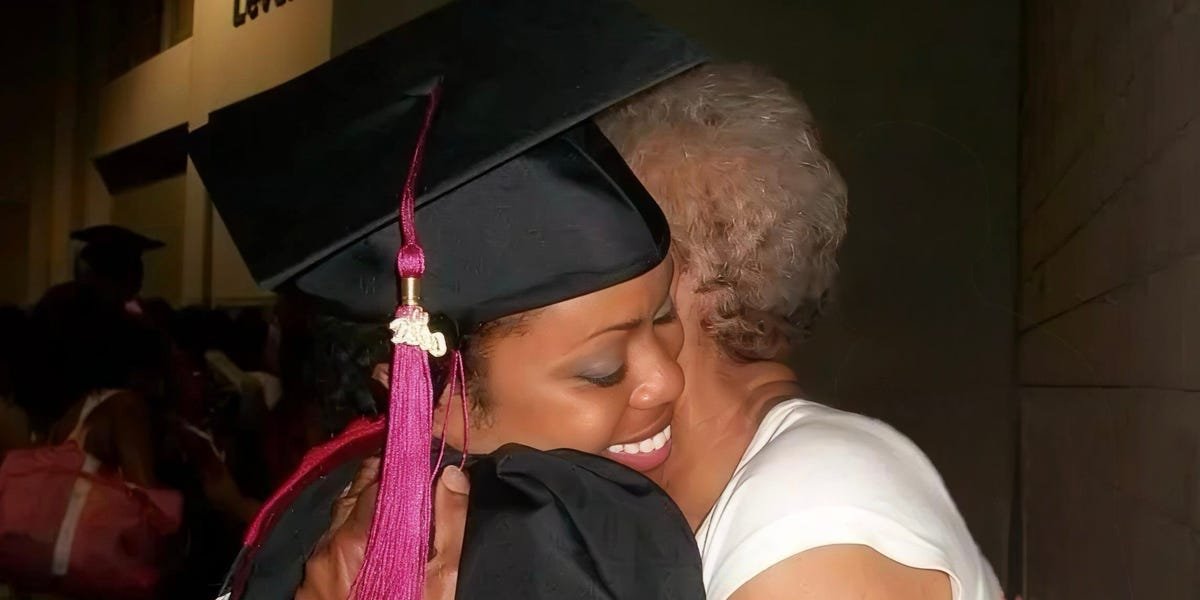


Since I was 11, I dreamed of attending a historically Black college or university.
That dream started at Morgan State University in Baltimore, where I spent two weeks each summer in a program focused on leadership and academics.
For a preteen growing up in Baltimore City, Morgan felt like another world. I had seen drug deals outside my front door and heard gunshots while playing hide and seek with friends. My mother refused to let our neighborhood define what I thought was possible for my life.
At Morgan, I saw Black students carrying backpacks and briefcases, preparing for careers and building futures. They looked like the life my mother kept telling me I could have.
But it’s not the life I think my kids need.
I applied to one college
When college application season came, I applied to one school: Clark Atlanta University.
My guidance counselor warned me to give myself more options. I had a high GPA and felt certain I would get in.
Then summer 2006 came, and my friends started receiving acceptance letters. Finally, I checked my mail and saw the message I had been waiting for. I had been accepted.
My excitement faded when I saw the cost.
Want more Business Insider in your news feed?
Add BI in Google so our reporting is easier to find when you’re searching for what matters.
Tuition, room and board, books, and fees added up quickly. It was around $25,000 altogether. I had scholarships, but they did not come close to covering the bill. The university told me its grant money had already been used and encouraged me to apply again the next semester.
My mother agreed to cosign a loan. At 18, I signed paperwork for debt that would follow me for the next 20 years.
I spent 4 years finding a way
Clark Atlanta’s motto is “Find a way or make one.”
I lived up to that motto. I stood in financial aid lines that wrapped around corners. My classes in the mass media arts major were sometimes dropped because my account was not updated in time.
I looked at the technology available at nearby universities and wondered why my department had so much less. I even attended career fairs at other schools because I wanted access to more employers.
My family had taken on significant debt with private loans. I did not expect luxury, but I expected functioning facilities, reliable administration, current technology, and strong career opportunities. Unfortunately, I felt Clark Atlanta struggled in most of these areas when I attended from 2006 to 2010.
In my department, the School of Mass Media Arts, there was only one small radio station and one television studio. I wanted to volunteer so I could get hands-on experience with the equipment, but there were far more students interested than there were available spots.
That was frustrating, especially when I visited friends at nearby Georgia State University. As a large public university, they had multiple studios and state-of-the-art equipment. The difference in access and resources was hard to ignore.
Still, Clark Atlanta gave me something important: I found belonging. I studied under Black professors. I watched students who came from backgrounds like mine become leaders, entrepreneurs, and graduate students.
I gained confidence in who I was, and that mattered, but it does not erase what the experience cost.
I see college differently as a parent
At 18, I chose college partly with my heart. I wanted Black excellence and a place where I felt understood.
Now I am a parent, and my priorities have changed. Even though not all HBCUs are created equal, I would not encourage my children to choose one simply for the experience, especially if it means taking on more debt for fewer resources.
My kids, who are now 7 and 9, do not need college to introduce them to Black excellence. They can experience that through the people around them, books, museums, travel, history, and everyday life.
When they choose a university, I want the decision to be centered on what will best prepare them for their desired careers. I want them to look at academic programs, costs, scholarships, internships, and facilities.
If that school is an HBCU, I will support them, but the HBCU experience alone will not be enough for me.
I loved Clark Atlanta. It helped shape me into the strategic communication consultant I am today. I can value what it gave me and still question what I had to pay to get it.
Editor’s Note: Clark Atlanta Univeristy did not respond to Business Insider’s request for comment.
Read the full article here