









Building a website has never been easier thanks to AI. But how much easier?
Vibe-coding tools like Lovable and Anthopic’s Claude Code can take a rough prompt and build a website with little to no human intervention.
Established players like Wix let individuals create websites without coding knowledge, but require a human user to decide on design elements and layout.
Wix has embraced AI and vibe coding to keep pace with emerging rivals like Lovable. In June last year, it announced that it had acquired Base44, a vibe-coding startup, for $80 million. In January, it announced the launch of Wix Harmony, an “AI website builder that merges human and artificial intelligence.”
This comes as the industry is warning of a “SaaSpocalypse,” in which AI threatens the business models of companies like Workday, Salesforce, and Asana. Wix’s share price is down about 23% since the start of the year, partly on these fears.
Wix’s head of product, Yaara Asaf, told Business Insider that Wix Harmony is for “anyone who wants to create a web presence; no website-building experience, technical or design background required.”
Lovable’s design head, Nad Chishtie, told Business Insider that Lovable “empowers the 99% of people with no technical skills to build whatever idea they have in their head, just by talking to AI.”
I tested Wix Harmony to see whether Wix’s two decades of website-building expertise gave it an edge over Lovable, a 2023-founded startup.
Lovable
I’ve used Lovable before to create a virtual newsroom photo coach, so I already knew this would be a simple process.
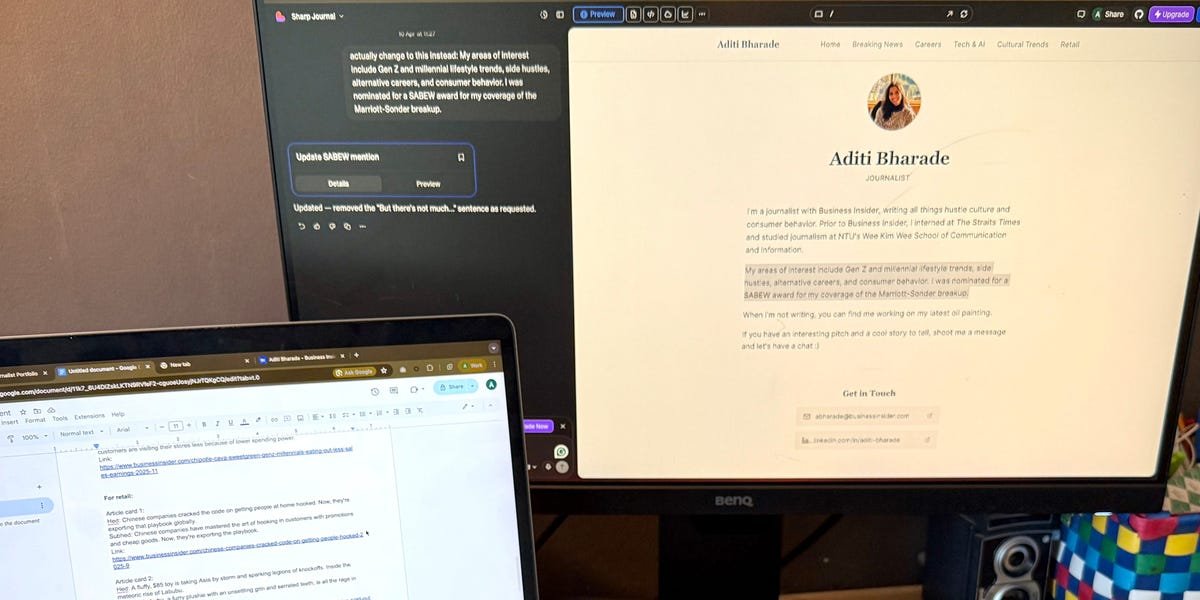
I threw in my first prompt, asking the platform to generate a clean, no-frills website with my headshot and bio on the homepage, and five sections — breaking news, careers, tech and AI, cultural trends, and retail — where I could post my choice of stories.
It nailed the brief, giving me almost exactly what I needed. The homepage features only a simple headshot, the title “Jane Doe: Journalist, Reporter, Writer,” and a placeholder bio. The website was split into five sections, each with three article cards populated with dummy stories.
Here’s where I ran into my first issue — how do I edit the text? I expected a Canva-like interface where I could double-click the text box to enter my content, but Lovable didn’t work that way.
When I asked the chatbot what to do, it told me to either edit the code or paste all the edits into the chat, and it would make the changes for me.
I don’t have coding expertise, so I fed it a massive 700-word prompt, instructing it on all the headlines, subheads, and article links to the 15 stories I wished to spotlight in my portfolio. It processed the request seamlessly.
Then I realized the article cards were missing thumbnails. I asked if it could pull the thumbnails from my Business Insider articles in the correct dimensions. No problemo.
Then all that was left was plonking my LinkedIn bio into the homepage, asking it to pull my headshot from my author page, and updating my contact info.
Just as I processed the final tweak, my daily free credits ran out. I cut it a bit close, but at the end of the roughly 20 minutes it took to make the website, I had a very usable digital portfolio.
Needless to say, I was impressed.
Wix Harmony
I had high hopes for Wix Harmony. The first website I ever built, way back when I was in my high school’s photography club, was a digital photo repository on Wix.
But when I put the same prompt into Wix Harmony and saw the website it created on the first try, I sighed.
It looked like all the elements were pulled from a basic PowerPoint template, with no consideration given to text alignment.
It auto-generated an image of a quill as the website’s logo, which I can’t fault, but it felt slightly on the nose. The headshot was an AI-generated image of a South Asian woman.
But the worst part was that Wix didn’t create five distinct sections for my story types. Instead, it lumped all the story cards into the homepage and hallucinated two unnecessary sections called “Blog” and “Portfolio page.”
When I prompted it to correct that mistake, it gave me a list of five steps to fix the problem myself: “Follow these steps to restructure your website and align the content properly.”
“Can’t you do it?” I asked Wix. It then gave me another set of options, including one to contact Wix support.
As a last-ditch attempt, I asked Wix to regenerate the site, thinking it might be easier to start afresh than fix all the issues myself. This helped — the redesign was way better.
The five sections were correctly segregated, and the text was aligned. But unlike Lovable, it couldn’t correctly populate the story cards with information from the 15 stories I fed it; instead, it populated them with placeholder stories.
For example, I’ve never written a story titled, “The Rise of the Fractional Leader.”
What I liked about Wix was that it could do what Lovable could not: let me edit the text on the preview instead of putting my edits into the chat. That feature felt a lot more intuitive than Lovable.
Perhaps if I’d worked with Wix’s existing design templates instead of asking it to generate a website from scratch, it would’ve yielded better results. It certainly required much more of the human touch than Lovable.
Final thoughts
For impulsive people like myself who thrive on random brainwaves but don’t have the patience to refine websites, Lovable might be a better option, as it allows you to draft up a quick idea and see it come to life immediately.
Chishtie from Lovable said that traditional website builders “constrain people’s visions, even when they appear to offer a lot of choice.”
“They tend to drive users towards templates and ask them to use pre-made blocks to create a site,” he said. “This also means that customization comes with a high learning slope, as making more precise changes actually requires a lot of technical knowledge.”
On the other hand, I got the sense that Wix is for someone more dedicated to the craft, who cares about how each element looks and wants more control over the flow of the website. It wasn’t purely vibe coding: it was AI-assisted website building, with the user very much holding the steering wheel.
Asaf from Wix told Business Insider that Wix Harmony allows users to seamlessly switch between AI and manual editing.
“This makes vibe coding not just a way to build websites quickly, but a complete, professional-grade method for creating real, live business websites,” she said.
She added that all actions by the AI tools were fully reversible and could be easily tweaked, giving users “complete control over the outcome at every stage.”
Overall, the experience gave me some insight into the fears behind the SaaSpocalypse.
If Wix’s AI capabilities fail to keep pace with others like Lovable or Claude, it risks losing users like me who are not too fussed about design and want a usable website in minutes.
Read the full article here