







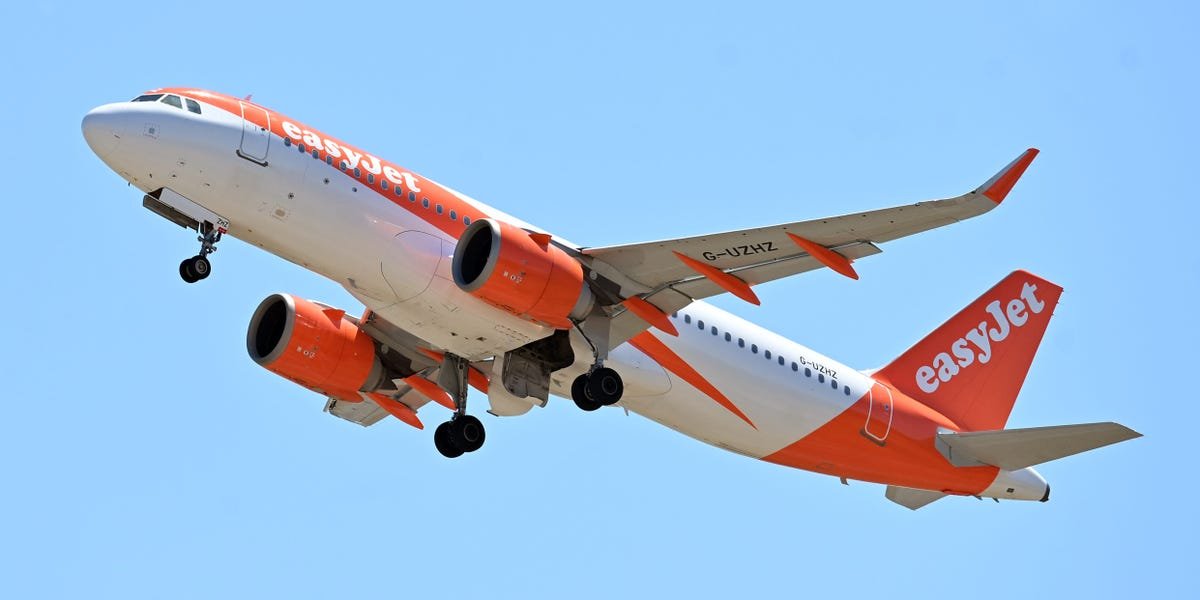


One passenger’s mistake while packing their luggage forced their flight to be diverted.
It was the latest case of a power bank upending travelers’ plans, as aviation regulators call for increased awareness of the devices’ potential hazards.
Last week, a passenger on an easyJet flight told the crew during the flight that a power bank was charging a device in their checked bag.
The flight from Hurghada, Egypt, to London diverted to Rome because regulations state that power banks are not allowed in the airplane’s cargo hold.
Passengers then had to wait overnight to continue their journey after the Airbus A320 landed in the Italian capital around 10:30 p.m. on Tuesday.
“The aircraft landed safely and passengers disembarked routinely,” an easyJet spokesperson said in a statement shared with Business Insider. “We provided hotel accommodation and meals where available and provided customers who stayed in the airport with refreshments.”
The flight reached London Luton Airport around 4 p.m. the next day, nearly 16 hours later than it was originally scheduled to arrive.
“We are sorry for any inconvenience caused by the diversion and subsequent delay,” the easyJet spokesperson said.
Power banks can only be carried in an airplane’s cabin because they pose a fire risk.
Like laptops and phones, they are generally powered by lithium-ion batteries, which are susceptible to thermal runaway: If the battery is damaged or overcharged, it can spark a chain reaction and a rapid rise in temperature.
Following the easyJet incident, the UK’s Civil Aviation Authority told the BBC that “more awareness” was needed as portable chargers carry “serious risks” of overheating or catching fire.
“It is absolutely a rule that can make a difference,” the CAA’s Jonathan Nicholson told the outlet.
“I wouldn’t want to be the passenger who packed it in the wrong place and ended up with all the other passengers in the wrong city because the flight was diverted,” he added.
Airlines are particularly concerned about power banks since the growing market for the devices means that many are cheaply made and not properly certified. They may also lack the advanced circuitry that helps stop laptops and phones from overcharging.
Many airlines also say that power banks cannot be used on board. It is safest to ensure devices are kept visible and accessible. This means that smoke or a fire can be spotted more quickly than if the device were in an overhead bin. Airline crews are well-trained in dealing with electrical fires, so they can react promptly if anything goes wrong.
Several carriers introduced stricter rules last year.
After a fire broke out in an overhead bin in Busan, South Korea, in January 2025, the country’s transport ministry announced a ban on storing power banks and e-cigarettes in the overhead bins.
Emirates prohibited passengers from charging devices with power banks, and Southwest Airlines mandated that they cannot be stored in a bag or overhead bin while in use.
Read the full article here