









No one wants to deal with the stench of rotten eggs. Or exorbitant utility bills. Or having to shell out thousands to replace a major home appliance on a whim.
And by performing routine maintenance on your home’s water heater — specifically by flushing its tank — you won’t have to.
While it’s not the most glamorous part of homeownership, daily tasks like showering, washing laundry and doing dishes rely on the hot water produced by water heaters. So it’s important to keep it working properly to avoid any major disruptions to your lifestyle.
Why Should I Flush My Water Heater?
Sediment builds up in your water heater over time. It’s caused by the mineral deposits in hard water, like calcium and magnesium, settling at the bottom of the tank during the heating process.
This buildup acts as an insulating layer, which reduces the appliance’s heating efficiency, causes higher energy bills and can lead to premature tank failure.
“Sediment build-up makes the water heater work harder, and most importantly, sediment build-up can promote the growth of waterborne bacteria. These bacteria can cause illnesses, including Legionnaires’ disease,” reads guidance from the New Jersey Department of Health.
How Often Should I Flush My Water Heater?
Experts typically recommend flushing your water heater once or twice a year, depending on the quality of your water and if you have a water softener. But Anthony Intile of Doctor Water Heater in Denville, New Jersey said you can do it up to four times a year — at the start of every season — if you have particularly bad hard water or a significant amount of water usage.
“If you do this four times a year, it will prolong the life of the water heater,” he said.
What If I’ve Never Flushed My Water Heater Before?
If your water heater is several years old and has never been flushed, Intile said it’s actually recommended that you don’t start flushing it.
“Get it checked by a professional. You don’t want to do it when it’s more than, say, three years old,” he said. “When you get into several years of not doing it, flushing it is the worst thing you can do. Then you’re starting to move the sediment, and that’s when the heater will start leaking.”
How Do I Flush My Water Heater?
If you have a tankless water heater, Intile said you should always contact a professional to flush it for you. This is because the process involves circulating a chemical solution — referred to as a descaling agent — through the unit using a pump, which is then flushed out with fresh water.
But if you have a conventional water heater with a storage tank, you can typically flush it yourself, as it’s a simpler process that only involves water.
To do it, start by turning off the electricity, natural gas or propane that powers the water heater. You should generally do this the night before to give the water in the tank enough time to cool to avoid the risk of burning yourself during the process.
If you can’t leave the water heater off overnight, you can opt to open a nearby faucet to drain the hot water so the tank can be replaced with cold water.
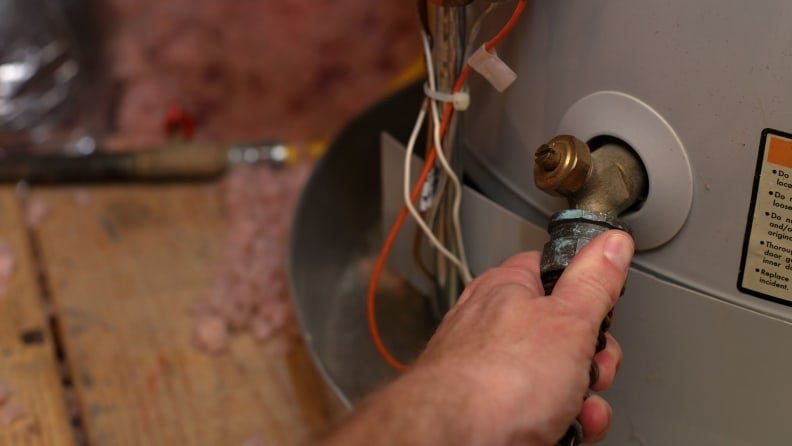
You’ll then turn off the water supply valve, which should be located on the top of the water heater where the cold water pipe enters the tank. After, connect a garden hose to the drain valve at the base of the tank and run the other end of the hose to an area where the tank can safely drain, like your lawn or garden.
“Take a five-gallon bucket, or something similar to that, and put it underneath the drain. You then open it up and fill it up twice, then dump it,” Intile said.
You can do this as many times as needed until the water is clear and sediment-free. Then you can close the drain valve, remove the garden hose, let the water heater fill back up and restore power to the appliance.
There is an array of detailed guidance available online, including from the New Jersey Department of Health and Home Depot. You can also consult a local plumber for further assistance.
“Other than flushing, there’s really no maintenance to a water heater,” Intile said.
Read the full article here