







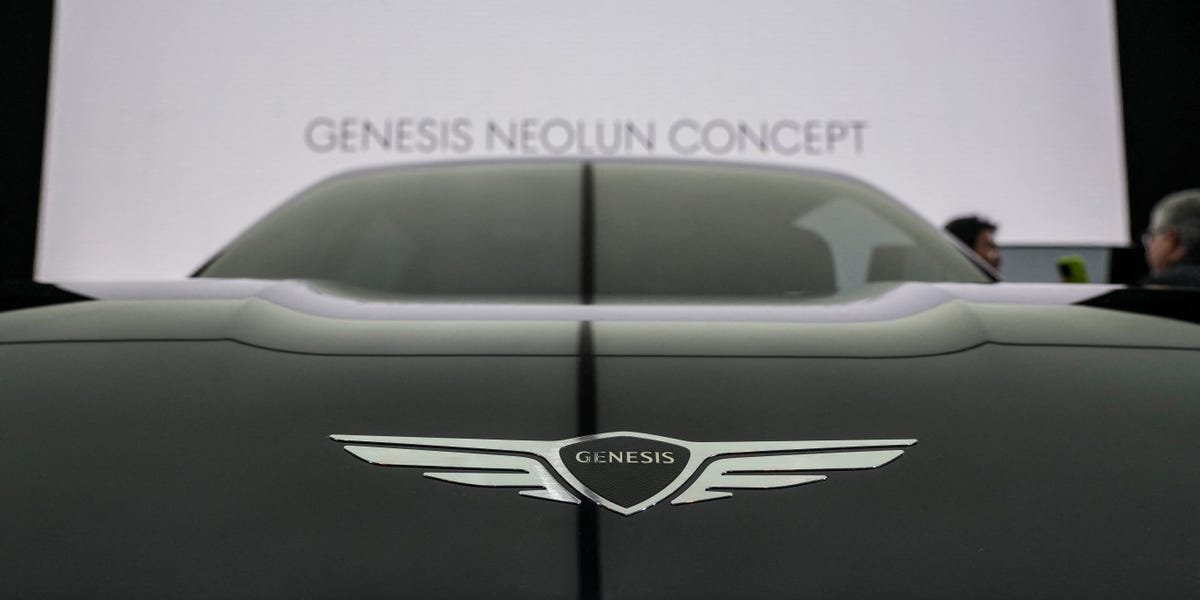


Genesis is, by now, a nearly 20-year-old name.
When Ted Mengiste joined the Hyundai brand five years ago as an executive director of sales operations, he described the internal workings of Genesis as “ground floor.”
His team was about 37 people, Mengiste told Business Insider, and along the way, he had to build the processes, go-to-market strategies, and the reports they’d use to measure how the business was doing.
“That’s tough, but you find some bright minds that are eager to create something new — like a startup,” Mengiste said. “We were really a startup.”
Mengiste now oversees a team of roughly 200 employees.
Of course, Genesis isn’t really a startup. Under the hood, the brand is backed by the multibillion-dollar Hyundai Motor Group — South Korea’s national pride and one of the world’s largest automotive companies.
A decade after Genesis spun out of Hyundai and became a stand-alone luxury brand, its executives say that operating with the mentality of a young company while tapping into the resources of an auto giant has helped Genesis grow quickly.
“When you have that type of, not just economic and investment backing, but the level of talent and experience to draw on, I think it gives you confidence to be bold and daring,” Mengiste said.
A startup backed by a legacy brand
The first Genesis model was introduced in 2008 under the Hyundai name. At the time, the rear-wheel-drive sedan was a major departure for the automaker, which was best known for affordable, mass-market cars.
In 2015, Hyundai spun Genesis out into an independent luxury brand, with ambitions to compete more directly with the BMWs and Mercedes-Benzes of the automotive world. Hyundai later said it established an “autonomous business unit,” with dedicated teams for marketing, product, brand, and sales planning.
Since then, Genesis has expanded its portfolio from sedans into a lineup of SUVs, EVs, and performance cars. On Wednesday, the brand unveiled its first full-size SUV, the GV90.
While Genesis still accounts for a fraction of Hyundai’s overall sales, it’s become an important part of the parent company’s push into more profitable luxury cars.
In 2025, Genesis sold a record 221,482 vehicles, while Hyundai Motor Company sold 4.1 million vehicles.
A company spokesperson said Hyundai has increased support for Genesis as it has grown, citing investments in product development, design, manufacturing, and customer experience. Last year, Genesis opened a dedicated design center in El Segundo, California. It also announced plans for 22 new or “significantly enhanced” vehicles through 2030.
The upside — and limits — of Hyundai’s scale
An automaker startup could only dream of having the kind of backing Genesis has.
Nowhere is that clearer than Hyundai’s massive global manufacturing network, with a total annual production capacity of more than 4 million vehicles — not including Kia Corporation, another car company it owns.
Mengiste, who previously worked at Nissan, Infiniti, and Ford, said Hyundai’s manufacturing prowess allows the brand to move quickly between different models and powertrains.
“It’s an amazing thing to see,” Mengiste said. “I’ve never seen the speed and the flexibility that I have seen at Hyundai Motor Company.”
The COO added that Genesis draws from other critical Hyundai resources, such as its advertising firm, engineering and research, steel production, and shipping.
“When the cars are done, the ship is waiting right there — our ships,” Mengiste said. “We build the ships, and we have the Glovis logistics firm that ships our cars for us.”
At the same time, Genesis doesn’t always get first priority.
Hyundai recently moved production of Genesis’ GV70 SUV — the brand’s most popular car in North America — out of Alabama and back to South Korea. The move came months after Genesis said it was doubling down on US production.
Mengiste said Hyundai’s own growth in the US tightened capacity at the Alabama plant. The decision made more room for Hyundai production, he said.
It’s a clash that’s familiar to many large companies. Uber COO Andrew Macdonald recently called it the “classic innovator’s dilemma” — a massive core business can swallow the resources and management attention that newer ventures need.
Still, Mengiste said Hyundai has been “doubling down on Genesis a lot.” The imperative remains to show results.
“The company will invest and maybe even be patient,” he said of Hyundai. “But at some point, you have to deliver. And if you show signs of delivery and consistency, you get more investment, and you can then increase the speed of your growth.”
Have a tip? Contact this reporter via email at lloydlee@businessinsider.com or Signal at lloydlee.71. Use a personal email address, a nonwork WiFi network, and a nonwork device; here’s our guide to sharing information securely.
Read the full article here