






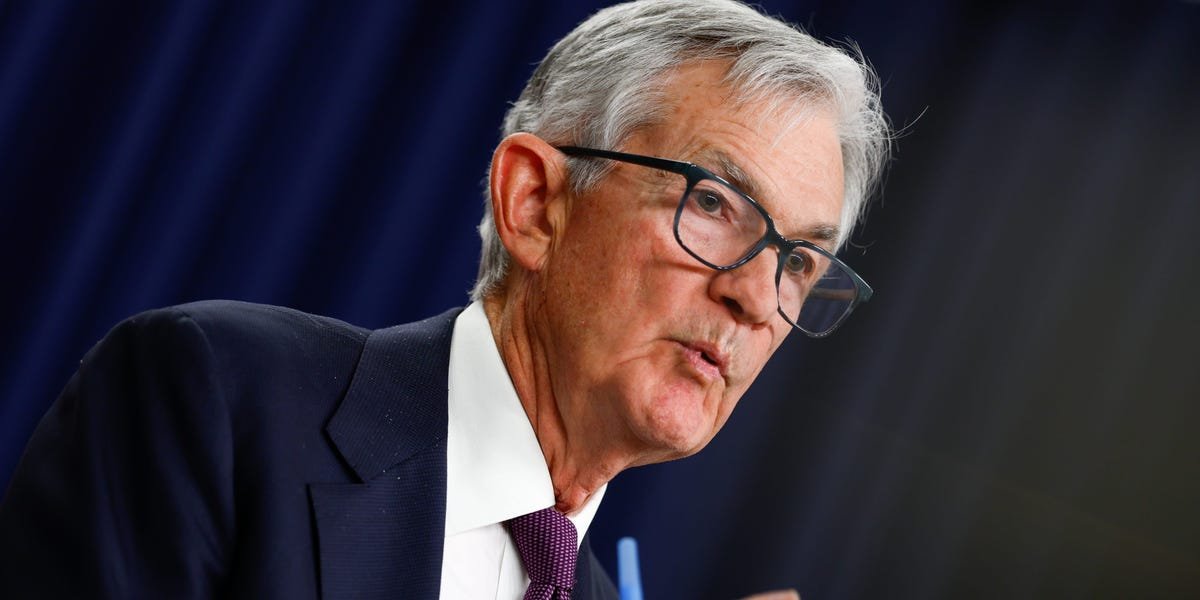


After eight years, Jerome Powell is clocking out.
The Federal Reserve opted to hold rates steady at its third meeting of 2026, which was Powell’s last as head of the central bank. From oil shocks to Fed leadership, here are Business Insider’s biggest takeaways from the decision.
Highest vote split since the 1990s
The Federal Open Market Committee had four dissenting votes in Wednesday’s rate call — the most since October 1992. Governor Stephen Miran hoped for a rate cut, and Governors Beth M. Hammack, Neel Kashkari, and Lorie K. Logan opted for a hold, but “did not support inclusion of an easing bias” in the statement’s language.
The breakdown continues a pattern of division among central bank leaders as they weigh the Fed’s dual mandate for stable prices and maximum employment. Some FOMC members prioritize one side of the mission more than others, Powell said. The committee has disagreed on rate decisions at every meeting since September 2025. Prior to that, decisions were often unanimous.
Powell said the current division is a “function of the extraordinarily challenging set of supply shocks” over the past few years. Everyone on the committee has a different risk tolerance, he said, and “it’s only natural that you would have a range of views on the committee. If everyone agreed, that would be surprising.” He called the 19-person committee “strong-minded.”
One thing is clear: Kevin Warsh will be stepping into an uncharacteristically divided Fed once he’s confirmed.
Powell will stay, but not as ‘a shadow chair’
In a highly anticipated announcement, Powell said he will remain on the Fed as a governor until he thinks it’s “appropriate” to leave. He is eligible to vote until 2028.
It’s rare for a former chair to remain on the FOMC beyond their tenure, but Powell said he would prefer to stay on the Fed until he’s sure the Department of Justice probe is “well and truly over.”
The US Attorney General dropped the criminal investigation into Powell’s alleged mishandling of construction at the bank’s Washington, DC, buildings last week, passing it to the Office of the Inspector General. Jeanine Pirro said she “would not hesitate” to reopen the probe if she felt it necessary.
Since it launched in January, the investigation has been seen as a political attack on Fed independence by lawmakers across the aisle, which Powell said is “battering the institution” and causing
“widespread concern.”
As long as he remains on the committee, Powell said he will keep a “low profile” and won’t interfere as a “shadow chair.” He congratulated Warsh on passing the committee vote on Wednesday, and said he takes him “at his word” that he will stand up to White House pressure.
Powell reaffirmed his belief that the Fed’s independence is key to its management of the economy. “It’s not about the Fed or the institutions, it’s about the benefits of a central bank that makes decisions based on analysis and our best thinking rather than trying to help or hurt politicians,” he said, adding that he will do everything he can to support his successor.
A laundry list of supply shocks
As he exits Fed leadership, Powell acknowledged that inflation remains above the committee’s 2% target. The Iran war, and associated oil price hikes, are a central reason. Gas remains above $4 a gallon, with no clear indication of when the Strait of Hormuz will reopen.
Since becoming chair in 2018, Powell said the US economy has faced four major supply shocks: The pandemic, Russia’s invasion of Ukraine, Trump’s tariffs, and the Iran war. Events like these make it difficult for the Fed to balance both sides of its mandate, Powell said. “This is a very different world, and a much more challenging one” than when he began guiding monetary policy.
He added that the Fed is “not in a rush” to raise or lower rates and broadly feels that a neutral stance is the best position for monitoring the Iran war. This attitude could change once Warsh takes the helm.
Powell left the podium to applause, saying that he’s proud of his work at the central bank.
“I won’t see you next time,” he said.
Read the full article here