







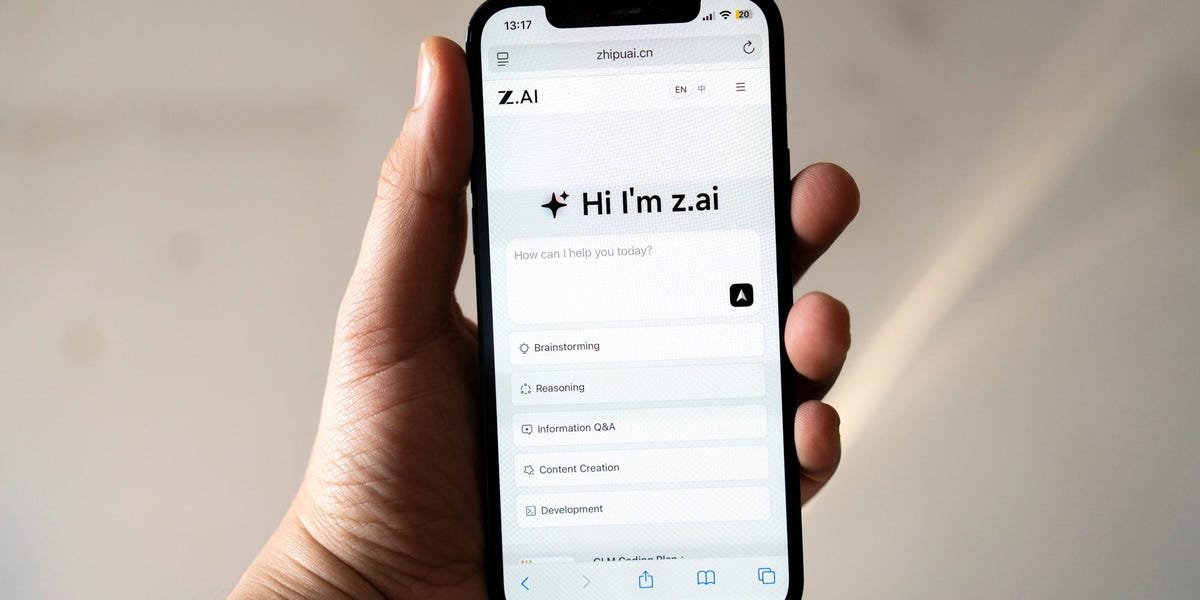


A new open-source AI model from China is drawing comparisons to DeepSeek, the LLM that shook Silicon Valley.
Developers, investors, and AI executives have spent the past week praising GLM-5.2, an open-source model built by Beijing-based Z.ai, for coding and agentic AI tasks. The company says it supports a 1 million-token context window — enough to process hundreds of thousands of words at once — putting it in the same league as OpenAI’s GPT-5.5 and Anthropic’s Claude Opus 4.8. Unlike those models, GLM-5.2 is free.
I decided to test it across a range of tasks.
Here’s how GLM 5.2 performed at writing an email, serving as a shopping assistant, planning a trip, and creating a poster.
Starting simple: an email
My first impression was that GLM-5.2 is noticeably slower than premium AI models and frequently runs into capacity issues. Whether it’s worth using depends largely on how patient you are.
After waiting several minutes, I asked it to write an outreach email for Business Insider seeking interviews with career coaches.
The result covered all the essentials and closely matched the style of email I would typically write myself. There was little to criticize beyond the wait time.
Choosing a product
Next, I gave GLM-5.2 a task I actually care about: recommending wet cat food for a cat with a sensitive stomach.
Once I got past another capacity delay, the AI suggested several well-known commercial brands, a prescription option, and general advice for choosing food for sensitive cats.
Again, it took a few tries to get past the model’s capacity issue. The AI eventually provided a generic list of commercial food brands for sensitive and picky cats, a prescription option, and a general set of rules for choosing cat food, all of which are great tips for first-time pet owners.
GLM, however, does not provide direct shopping links yet for the products it recommends.
As a lifelong caretaker of cats, I found the recommendations closely aligned with what my veterinarian has told me over the years. While GLM doesn’t provide direct shopping links, I didn’t find that to be a major drawback — finding the products on Google takes only a few seconds.
For informational advice, I didn’t notice much difference between GLM and more expensive AI models.
Planning a trip
I also asked GLM to plan a weekend trip for two from Oakland to Monterey, California, including hiking, scenic photography spots, antique shopping, restaurants, and a budget hotel.
The itinerary was thoughtful and detailed, recommending destinations such as Carmel and Moss Landing while accounting for traffic and reservations.
The weak spot was lodging. Although I specifically requested a budget hotel, the model initially skipped that part. After I asked again, it suggested several motels, but the prices weren’t realistic. One recommendation, Super 8 by Wyndham Monterey, was listed at roughly $100-$150 per night, while current rates are well above $300.
Generating a design
The design test proved to be the most revealing.
I uploaded a photo of an Art Deco-style amethyst ring and asked GLM to create an advertisement for a fictional jewelry business.
The latest 5.2 model spent more than 15 minutes stuck at capacity, so I switched to the older 4.7 version. It unexpectedly processed my English prompt in Chinese, producing both its reasoning and the finished poster in Chinese.
I know how to read Chinese, but a user who doesn’t would be very confused at this point, because this thinking process resulted in a poster that’s in Chinese too, which I did not ask for.
To make matters worse, the outcome does not come with a PDF or JPEG version I could download. When I asked it to regenerate the design in English, the image disappeared, and the underlying HTML broke entirely.
Eventually, capacity opened up on GLM-5.2. The newer model took a different approach, guiding me through an interactive design process with style and color options before generating the final poster. The design itself wasn’t especially polished — it looked more like a bar menu than a luxury jewelry advertisement — but it functioned properly and allowed me to download the result.
A small business willing to spend time iterating could probably produce something usable.
The bottom line: it’s worth trying
GLM-5.2 doesn’t yet match the polish or reliability of the best paid AI models. Capacity limits are frustrating, responses can be slow, and some features — particularly live pricing and design generation — still have obvious flaws.
Still, for a free, open-source model, it’s surprisingly capable. On everyday tasks like writing, research, shopping advice, and trip planning, it often delivers information that’s comparable to what you’d get from much more expensive competitors.
If Z.ai can improve reliability and reduce wait times, GLM-5.2 could become a compelling alternative for users who don’t want to pay for premium AI subscriptions.
Read the full article here