










Housing affordability is at a crisis low. You’ve read that headline a hundred times. Incomes have to rise or home prices have to crash to return to the housing affordability levels pre-COVID.
It’s true if you measure a home in dollars earned. It is not true at all if you measure a home in stock shares owned.
That distinction matters more than almost anything else written about housing in the past five years. Because the people writing those headlines are measuring the wrong thing for a large chunk of their audience.
The Inexpensive San Francisco Housing Market
Here’s a great illustration. Below is a chart showing the cost of a median San Francisco home priced in QQQ shares, the NASDAQ ETF. San Francisco is supposedly one of the most expensive housing markets in the country. But is it really?
Back in 2016, it took 12,800 QQQ shares to buy the median SF home. Ten years later in 2026, it takes about 2,634 shares. An 80% decline.
Now, obviously not everybody owned 12,800 shares of QQQ in 2016. If you did, congratulations, you were already rich and this post is just a victory lap.
But you don’t need to own stocks equal to the full median home price to feel this. You need 20% of it, because 20% is the typical down payment. That’s a far more achievable number, and it’s where the wealth effect actually shows up in your life.
Since we don’t all live in San Francisco, let’s run the same exercise for the country.
Below is a chart I built using St. Louis FRED data on the median U.S. home price going back to 2006, priced in shares of SPY, one of the largest S&P 500 ETFs.

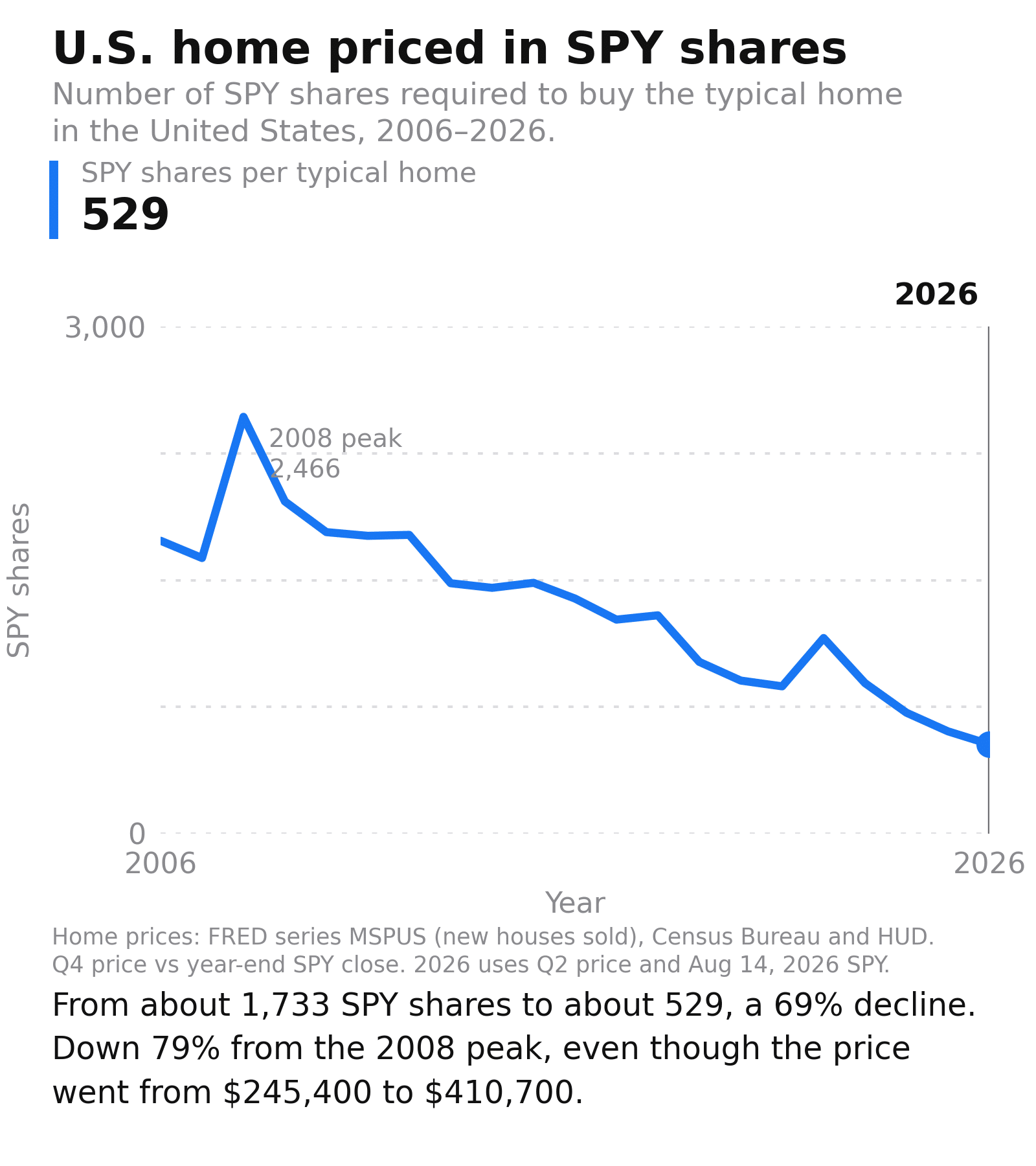
In 2006, it took about 1,733 shares of SPY to buy the median American home. Twenty years later, it takes roughly 529 shares. That’s 69% fewer shares.
The 20-year window also catches something the 10-year version misses. The peak wasn’t 2006. It was 2008, when the S&P 500 fell 38% in a year and home prices declined about 15% nationwide. Anyone who kept buying index funds through that stretch has been quietly getting a discount on housing ever since.
So for American stock investors as a group, the real cost of buying a median-priced home has collapsed. Not moderated. Collapsed like the cost of a big-screen TV.
One caveat worth stating plainly, because someone in the comments will find it otherwise. The FRED series here tracks new home sales, and homebuilders have spent the last four years shrinking houses to hit affordable price points. Some of this flattening is smaller homes, not cheaper housing. The trend holds regardless, but I’d rather tell you that than have you discover it yourself.
What This Means for Your Stock Portfolio Goal
The S&P 500 has returned roughly 11% a year versus about 4% for the national real estate market over the past several decades. So consistently investing in the S&P 500 over the long term is a good idea.
But add leverage and forced mortgage payments, and the typical homeowner still builds far more wealth than the typical renter. It’s simply too hard for the average person to save and invest the difference year after year. The mortgage is a savings plan you can’t talk yourself out of at 11pm.
What this stock-to-home conversion really tells us is this. Build a taxable portfolio equal to the price of the house you want to buy.
Looking at an $800,000 house? Make it your goal to build an $800,000 taxable portfolio, on top of your 401(k), IRA, and other tax-advantaged accounts.
Of course, that’s not practical for most people when buying their first couple of homes. Therefore, at least aim for 20% of your target home price. Do either one, and buying a home tends to get cheaper over time given how stocks have outperformed real estate.
You Want The Optionality to Pay Cash
Once your taxable portfolio equals the house you want, plus a cushion for capital gains taxes, you have options.
You can pay all cash. You can put down less. It depends on how much you want tied up in your home, your view of the market, and how big the rest of your net worth is.
Paying cash often gets you a discount. No financing contingency, short close. At minimum, in a bidding war, your offer stands out against everyone who needs a mortgage.
When I was touring those semi-mansions in Honolulu this past summer, I ran the numbers on paying cash if I sold my San Francisco primary residence for a great price.
I concluded I’m simply not wealthy enough to comfortably afford one. Paying cash at that price point would have swallowed too large a percentage of my net worth. It would have also felt like a waste of money.
My rule: don’t buy a dream home that costs more than 30% of your net worth. Not your starter home, your dream home. Cross that line and you’ll be stressed and more easily agitated, and you’ll resent the thing you worked for.
Ideally, build enough wealth that your dream home is 20% of your net worth or less. Then you can actually enjoy it.
Readers, Do you count your taxable stock portfolio as progress toward a home purchase, or do you think of the two as completely separate goals? Have you found buying a home to be more affordable since your taxable brokerage portfolio has increased?
The Risk Of Building Your House Fund Entirely In Stocks
The plan above has a hole in it, and I’d rather point it out myself.
If you’re building an $800,000 portfolio to buy an $800,000 house, you’re racing a target that moves. Stocks have won that race for 20 years. That’s the whole chart.
But look at 2022.
Stocks fell 18% while home prices kept climbing. The median American home went from 872 SPY shares to 1,157. A 33% jump in twelve months. If your house fund sat entirely in the S&P 500, your down payment shrank while your target got more expensive.
One year like that pushes the purchase out by three good ones.
That’s the case for owning real estate while you save to own real estate. Not instead of stocks. Alongside them, so when the two diverge you’re on both sides of it.
Then there’s income. Stocks pay you almost nothing while you wait. Real estate pays rent every month, up market or down.
Fundrise is how I own it without tenants, a second mortgage, or a call about a water heater at 11pm. I’m an investor, and they’ve sponsored this site for years.
Read the full article here