






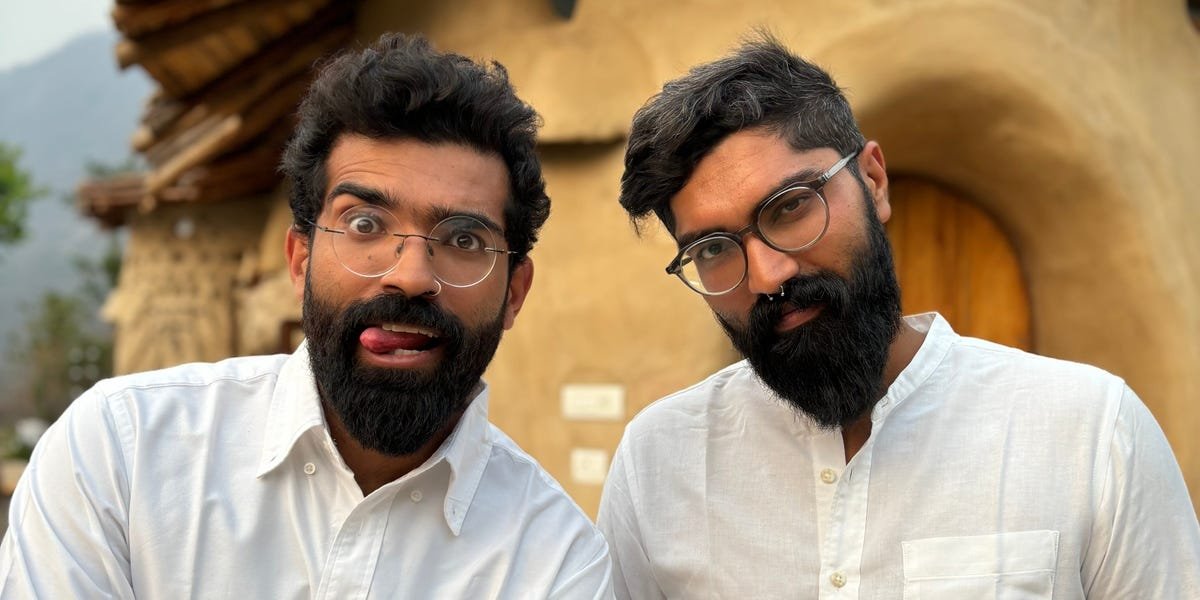


Perched on the side of a hill near the Himalayas is a whimsical house made of mud, stone, and straw that two brothers built by hand.
Ansh and Raghav Kumar, a pair of architect siblings from New Delhi, moved to a remote town in India to escape the noise and chaos of corporate city life and built the house that they now list on Airbnb.
“Someone sees it as a Harry Potter house, someone sees it as a hobbit house, someone sees it as a fairytale house,” Raghav, 32, said.
“For us, it’s a labor of love, and every curve tells the story of all the beautiful people who had come and put in the effort.”
Corporate burnout
Raghav interned with a German architectural company after architecture school and transitioned into a full-time role at another German company based in Ahmedabad. He said he loved the work culture, the people, and the company’s flat hierarchy — but he struggled with working long hours.
“When you’re in a corporate setup, the environment makes you believe that the longer you work, you can wear that as a badge of honor,” he said. “There were days when I ended up working 48 hours at a stretch trying to cope with all the side deadlines.”
Raghav also said there was a disconnect between the architect and the laborer.
Every time Aditi publishes a story, you’ll get an alert straight to your inbox!
Stay connected to Aditi and get more of their work as it publishes.
“The architect sits in this air-conditioned office, designing and dreaming visionary things, whereas the laborer who builds the project doesn’t get any credit,” Raghav said. “As architects, we’re not able to comprehend or appreciate that labor that goes into a project.”
During his three-year stint at the German company, he started traveling more to destress, going to remote mountainous parts of India.
“I realized I was living for the weekends,” he said. “That’s when I realized I didn’t want to climb the corporate ladder.”
His younger brother Ansh, 29, also interned in Germany, then freelanced on sustainable architecture projects in mountainous and rural areas of India, where he got a taste for mountain life.
During the pandemic, while quarantining at home in New Delhi, the duo began experimenting with making their own building materials. They tested mycelium from homegrown mushrooms and learned about making cob, a natural material made from soil, straw, and water.
That’s where the idea to move away from the chaos of the city and build a house in the mountains took root.
“Covid showed us life is short,” Raghav said. “We agreed that we needed to take a leap of faith.”
Moving and adapting to Rishikesh
The pair decided on Rishikesh, a town located in the foothills of the Himalayas, known as India’s yoga capital. It is about 150 miles northeast of New Delhi.
It’s historically been a pilgrimage destination, built on the banks of the Ganges River, but has recently become a hot spot for digital nomads, cafés, and corporate and wellness retreats.
The pair leased land in Rishikesh from a family friend, promising to build a sustainable building on it. And in March 2021, they packed their bags and moved into a house in a small village near Rishikesh.
“From where the car drops you off, you have to cross a tributary of the Ganga on foot via a wooden bridge,” Ansh said, “Then you hike for more than a mile to reach the village. So that was another challenge altogether.”
Building a house with their hands
In their past architectural work, the brothers used software to do concept drawings. But here, they used sticks and stones around the plot of land to mark out the house plan.
Then came the building phase. They carried thousands of rocks to the building site, trekked in sand on mules, and sourced most of the other materials from around the house.
They put out a call for volunteers on Workaway — a platform that connects travelers with hosts who provide food and accommodation in exchange for work.
The brothers estimated that, over the three years it took to build the house, more than 100 volunteers from 18 countries were involved in construction, along with about 20 local laborers they employed.
They spent about $30,000 on the project, from their savings and their parents’ investment.
“You can see the progress every day; the house was getting taller daily, by about six inches to a foot,” Ansh said. “So that is quite rewarding compared to eight hours of work in front of the laptop in the corporate world, where you feel exhausted but also like you didn’t get anything done.”
Finally, in 2024, they finished the house.
Raghav called the final project a “living sculpture.”
It’s full of organic shapes, with a whimsical thatched roof, and spiral patterns running around its walls.
They listed the two-bedroom, one-bathroom home on Airbnb in April 2024 for around $140 per night.
“Proceed to book only if you are comfortable hiking for 1.5 kilometers in a forest with a backpack, as the property is not accessible by car,” says the Airbnb listing. “There’s no WiFi in the forest, but you’ll get a stronger connection with yourself, your loved ones, and your passions.”
They said it’s booked out about 60% of the time.
Fittest they have ever been
Now, the duo has built an architecture and design studio in Rishikesh and is working on other natural building projects across India.
Running the studio from Rishikesh has its challenges. They deal with a choppy network — they’re eagerly awaiting Starlink — and must deal with safety concerns because the house is near a forest with wild elephants.
But mountain life has changed them.
“We’ve become the fittest version of ourselves, living here,” Raghav said. On the first day of their chapter in Rishikesh, just the hike up to the site winded them both, but they can now do four trips up and down.
“You don’t even know when you clock 10,000 steps. You have nature all around you, better air, and you feel your anxiety melt away,” Raghav said.
Read the full article here