





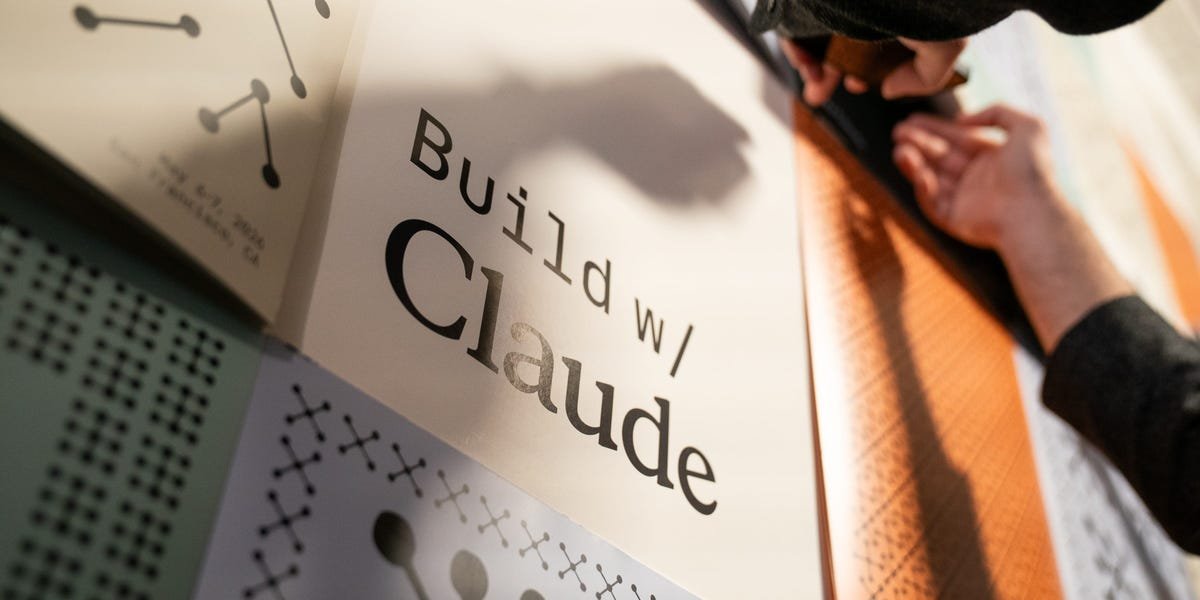
Anthropic is trying to calm everyone down over its new watermark.
The company sparked a wave of discourse this week when it updated a support page for its Claude model to reveal its plans to mark AI-generated text as AI-generated. Now, after concerns from Claude users, Anthropic has published a blog post on Friday that defends and explains the technology. It also outlines the tool’s limitations.
The AI lab’s post first makes one point clear: it is watermarking its text to comply with the European Union’s AI Act, and its AI provider peers — a likely nod toward OpenAI — will have to do the same.
Like other EU tech regulations, the AI Act’s effects ripple beyond the continent. Anthropic said in its post that it’s “applying watermarking globally at launch because we don’t yet have a durable way to scope it by region.” Watermarks will first be applied to new Anthropic models, and then to older ones in the coming months, the post said.
Previously, some customers told Business Insider they canceled Claude subscriptions because of the new watermark. Anthropic told Business Insider that it hasn’t seen a trend of an uptick in cancellations since it announced the watermark.
OpenAI did not immediately respond to a request for comment from Business Insider. A support page updated two weeks ago says that the company also plans to add watermarks to text.
How does Anthropic’s new watermarking tool actually work?
Anthropic spends hundreds of words of its post answering a basic question that emerged when the company first revealed its plan to watermark text: How do you embed proof of AI in a series of words without ruining a chatbot’s human-like tone?
The company cites a 2024 Google DeepMind paper that established the watermarking technique Anthropic will now apply to its Claude product’s outputs.
Here’s how it works. When Anthropic’s AI models churn out sentences, they make a series of decisions about which words to include. A lot of this is settled randomly — a grinning child can be either “joyful” or “cheerful,” so one of the words gets picked by a random number generator. Anthropic describes its watermark as essentially a different type of random number generator — if you have a “key,” you can detect whether the text follows Claude’s subtle patterns of choice.
Anthropic hasn’t released the “key” yet, though it says it will offer a tool called an application programming interface, or API, that will allow users and third parties to check text for Claude’s watermark themselves.
The watermark doesn’t include any hidden characters, weird fonts, or secret text. It’s just the word choice. Anthropic says the difference won’t be distinguishable to readers.
Is this the end of confusing AI-generated text with human writing?
No. Anthropic’s blog post repeatedly points out the limitations of the watermarking tech. Anthropic’s “key” will point back to Claude’s involvement, not AI’s in general. The post says, “Using our key, one can only answer the question ‘What is the likelihood this was partly written by Claude?'”
Longer passages will be easier for the “key” to recognize as Claude-generated because the model will have made more word choice decisions. The post also says that “factual passages,” in which the wrong choices might jeopardize accuracy, will receive fewer marks.
That same issue holds for AI-generated code. Anthropic writes that a watermark wouldn’t be applied as often in code because it’s so exact — the wrong term might mean the software can’t run correctly.
Some customers previously told Business Insider that they were concerned that the watermark would imply they weren’t the author of the text or code. Anthropic says that the watermark appearing indicates that Claude processed the content or file and doesn’t change a user’s rights or ownership of the text under its terms.
It’s an open question how often people will check for AI-generated text, and whether the new watermarks prompt a different relationship with Claude’s outputs.
“Light editing probably won’t remove the watermark completely; a complete rewrite where every word is replaced will,” the post says. “In the latter case, of course, it’s arguable whether the text can any longer be described as AI-generated.”
Have a tip? Contact this reporter via email at scouncil@businessinsider.com, or over text, Signal, Telegram, or WhatsApp at 415-757-8198. Use a personal email address, a nonwork WiFi network, and a nonwork device; here’s our guide to sharing information securely.
Read the full article here