








Burnout stalks even the most accomplished operators.
On Tuesday, Lilian Weng, a cofounder of Thinking Machines Lab and former OpenAI safety executive, announced her resignation from her role.
In a note to colleagues, later shared on X, she wrote that seven months of recurring illness, made worse by the relentless pace of startup life, had left her unable to give the job the full effort she felt it demanded.
“After thinking about it for several months, I ultimately have to admit that the amount of consistent stress and workload have pushed me beyond what my health can sustain physically,” Weng wrote. She said she hopes to return in a more scoped role at a calmer workplace.
Here’s how ten other business leaders have said they keep burnout at bay.
Evan Spiegel, Michael Dell, and Jamie Siminoff: build guardrails into the grind
Some leaders keep grinding but fence off pieces of their lives.
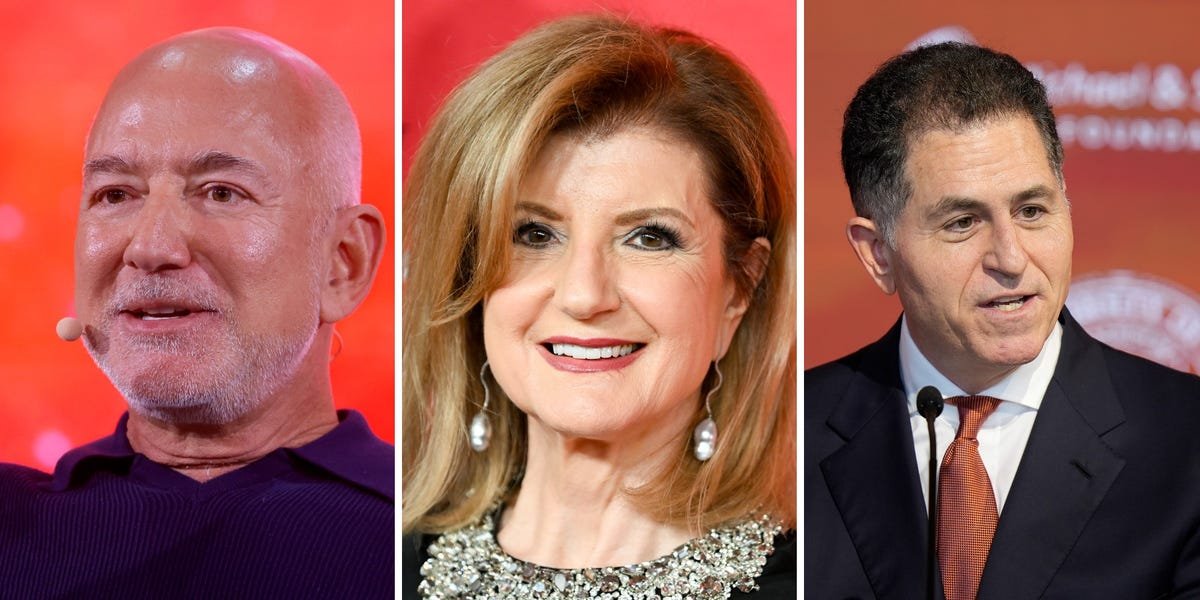
Snap CEO Evan Spiegel, who calls his seven-day-a-week schedule “completely insane,” says Sundays are non-negotiable: church, brunch, and an afternoon with his four kids.
Michael Dell’s guardrail is levity. The Dell Technologies founder has said there’s a diminishing return on hours worked in a day, and anyone in it for the long haul needs a mix of working, playing, and relaxing.
Ring founder Jamie Siminoff opts for what he calls “work-life fusion,” folding family into the job, for example, by bringing them along on business trips.
Arianna Huffington and Jeff Bezos: Treat rest as an asset
Others treat rest itself as the strategy.
Two years after founding The Huffington Post, Arianna Huffington collapsed from exhaustion at her desk, breaking her cheekbone. She said in a LinkedIn post in 2014 that the fall convinced her that equating success with burnout is a “collective delusion.” She later set up a company, Thrive Global, focused on well-being.
Jeff Bezos frames rest as a fiduciary duty. “Eight hours of sleep makes a big difference for me,” the Amazon founder told Huffington’s Thrive Global, arguing that an executive is paid to make a few high-quality decisions, and shortchanging sleep just yields more tired, lower-quality ones.
Indra Nooyi and Sheryl Sandberg: accept the trade-offs
Some leaders sidestep burnout by abandoning an impossible standard.
“I don’t think women can have it all. We pretend we can have it all,” Indra Nooyi, then the CEO of PepsiCo, said in 2014. Her answer was to stop pretending: to treat each day as a series of explicit trade-offs among CEO, wife, and mother, and to co-opt family and colleagues to fill the gaps.
Former Meta COO Sheryl Sandberg made a similar case in “Lean In,” calling “having it all” perhaps the greatest trap ever set for women. She has also defended leaving the office at 5:30 p.m. for family dinner.
Warren Buffett, Charlie Munger, and Lloyd Blankfein: life’s too short
A few notable business leaders have said they refuse to let work swallow everything else.
At Berkshire Hathaway’s 2023 annual meeting, Warren Buffett and his late partner, Charlie Munger, contrasted themselves with Elon Musk, whom Munger said succeeds by insisting on unreasonably extreme goals. “Warren and I are looking for the easy job,” Munger said. “We don’t want that much failure.”
Munger warned graduates away from grinding careers, too, saying that winning a pie-eating contest just means eating more pie, and “life is too short to just do nothing but eat pie.”
Buffett’s advice was to work backward from the end: “write your obituary and try and figure out how to live up to it.” He kept the job he loved until handing Berkshire’s reins to Greg Abel this past January, at age 95.
Former Goldman Sachs CEO Lloyd Blankfein got similar advice decades ago: In his memoir “Streetwise,” he recalled that when he made partner, he was told that if his obituary ran nine paragraphs, no more than three should be about Goldman. He retired in 2018 and has leaned into the other six: philanthropy, family, and, by his own account, thoroughly enjoying not having to travel for work.
Read the full article here