







Airlines are still willing to bet on Boeing.
The American planemaker showed signs of rebuilding airlines’ trust at the Farnborough Airshow — the latest indication that CEO Kelly Ortberg’s turnaround efforts are helping Boeing recover from years of safety concerns, quality issues, and delivery delays that damaged its reputation.
Ortberg was highly visible at the leading show. He took a front-row seat for an order signing and spoke at a media reception — a reflection of the leadership approach he adopted when he took the helm two years ago, including moving to Seattle to be closer to the factory floors and take a more hands-on approach than prior chiefs.
Augusto Viansson Ponte, a director at Alton Aviation Consultancy, told Business Insider that Ortberg’s visibility in Farnborough was “a good sign.”
“I think what was very interesting was quite a bit of Boeing [orders], which means people have faith,” he added. “They were in a pretty bad spot a while ago, and I think that there is confidence from the operators in the fact that they will resolve that.”
Boeing edged out Airbus in the orders tally at Farnborough, its first time taking the crown at a major air show in four years. It announced deals for 173 aircraft, compared to 154 from its European rival.
Airbus has dominated the Farnborough and Paris airshows in recent years as Boeing has contended with the fallout of the 2024 Max crisis and production issues with its 787 and yet-to-be-certified 777X.
In Paris last year, Boeing chose not to announce any orders in the wake of the fatal crash of Air India Flight 171, while Airbus announced 142.
“As I continue meeting with our customers, suppliers, and partners, they all say the same thing: a different, better Boeing is showing up,” Ortberg said in a memo to employees on Tuesday.
“Thank you for doing your part to get us back to the Boeing we all know we can be — let’s keep it going,” he added, saying that there’s more work to do and that “two quarters don’t make a year.”
Boeing isn’t out of the woods yet.
It’s still losing money: the company reported a $428 million loss in the second quarter, as its 24.6 billion in revenue was weighed down by a $280 million charge tied to the Air Force One replacement program.
The company’s share price is down about 8% over the past year. Still, there are signs of recovery, with revenue rising and commercial deliveries increasing. Its stock rose about 5% on Tuesday.
“We believe investors appreciate the steady stair-step progress that Boeing is making on deliveries, production increases, and [free cash flow] generation,” Ken Herbert, aerospace and defense analyst at RBC Capital Markets, wrote in a note.
And Deutsche Bank analysts, who rated the stock a hold, said, “Boeing is continuing to demonstrate improvement in executing against the strong demand environment.”
The order book lacked big-name airlines
This year’s show lacked the excitement seen at previous editions.
Qatar Airways canceled its presence after the country’s former Emir died earlier this month, and Etihad Airways’ CEO withdrew from planned engagements.
While the aircraft order tally was similar to the most recent Farnborough Airshow in 2024, the order book lacked big names.
Instead, the largest order came from a lessor, SMBC Aviation, which ordered 100 airplanes from both Boeing and Airbus.
“Probably because the airlines have ordered a lot and swallowed a lot in the past,” Viansson Ponte said. “They put their growth plans and their orders in terms of, this is what we want to do, we know when those deliveries are. Now it’s the turn of the lessors to come in with the flexibility,” he added.
Riyadh Air, the Saudi startup, announced deals for 28 Boeing 787s and six Airbus A350-1000s, but has already ordered much of what it needs in the past two years.
The Iran War has led to a decline in passenger demand for Middle Eastern airlines and may make them wary about buying new airplanes right now.
The order book is a sign of Boeing’s comeback from dire problems.
In early 2024, a door plug blew out of an Alaska Airlines 737 Max mid-flight. Investigators found the airplane had left Boeing’s factory missing key bolts designed to keep it in place. This led to an overhaul of its production processes and quality-control checks, as airline customers criticized the planemaker. Kelly Ortberg became CEO as his predecessor stepped down in the wake of the crisis.
Planemakers are also still contending with supply-chain constraints and have enormous backlogs to work through.
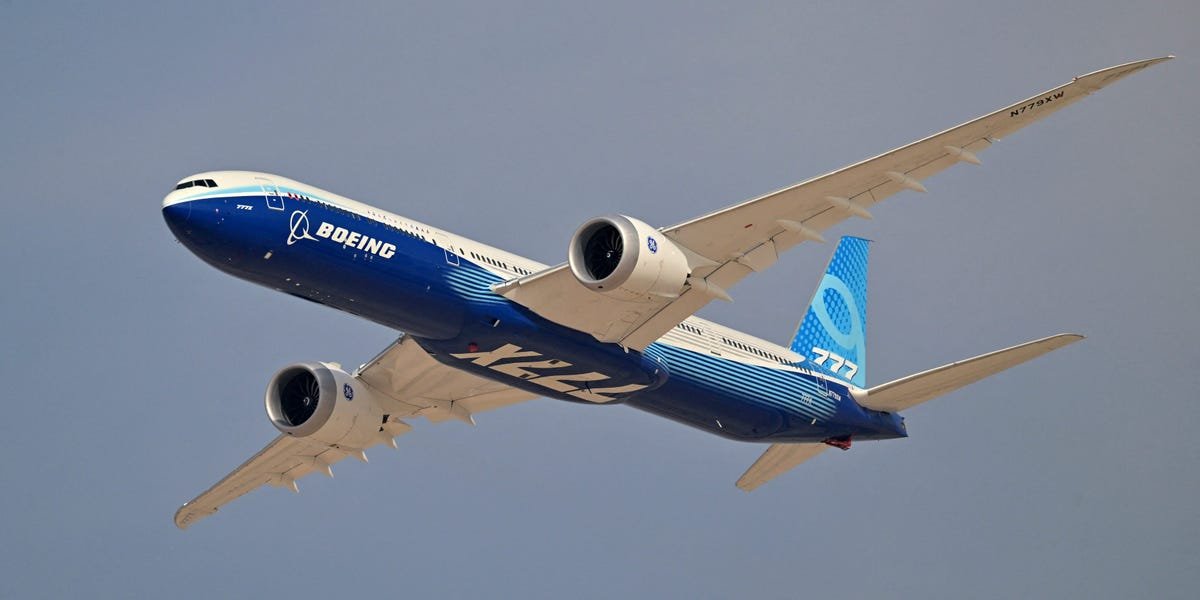
Perhaps the biggest headline of Farnborough came from the 777X’s biggest customer. Emirates President Tim Clark told The Telegraph that the airline is rejecting the first 10 777X jets built for it.
The airplane type was supposed to enter service in 2020, but now the first is expected to be delivered in 2027.
Its long path to certification has led to some design changes, so Clark believes the first batch of 777X planes would require too much work to bring them up to an acceptable standard.
“As far as we’re concerned, what they do with them is up to them,” Clark said. “Heinz would be interested — baked bean cans.”
During its second-quarter earnings call on Tuesday, Ortberg said he wouldn’t discuss contract changes publicly.
Read the full article here