








The freakout over AI that started in Silicon Valley and led to growing American calls to pause development has swept Western countries.
A new POLITICO Poll finds that pluralities of adults in the US, Canada, and Europe want to pause AI development regardless of their political leanings — and most believe there’s a real risk the technology could destroy humanity.
Pluralities of respondents in several countries say it’s okay for their country to fall behind others in the development of AI if it means being more responsible and secure when advancing it. And they’re more likely to expect AI will destroy jobs rather than create them.
The results from the poll, conducted by independent polling firm Public First, illustrate the sheer magnitude of how AI fears are spreading as some industry leaders warn the technology’s advancement could have potentially grave consequences. They show people’s preference for caution, even at the risk of forfeiting what could be revolutionary advancements or their country falling behind in the broader AI race.
And for governments, the results offer a stark warning of the political backlash they may face if they don’t take steps to rein in the technology, as leaders from US President Donald Trump to UK Prime Minister Andy Burnham scramble their responses.
Across six countries — the US, Canada, the United Kingdom, France, Spain, and Germany — roughly half of adults surveyed said AI is good enough now, so they supported a pause on further development to reduce risks, rather than continuing development for added benefits. That sentiment was highest in the UK at 51% and lowest in Germany at 45%.
Meanwhile, just 30% to 40% of adults in each country favored continued development to bring about “significant benefits.”
An even greater share of adults — more than half in every country surveyed and up to almost two-thirds in the US, France, the UK, and Canada — said there was at least a “moderate” risk that the technology could “destroy humanity.”
The skepticism around AI could impact Europe’s ability to keep up in the global competition: The European Union, which has taken a cautionary approach by adopting the world’s first AI regulation in 2024, hosts almost no providers of frontier AI models, with French Mistral as the most worthy contender.
The bloc’s highest official, European Commission President Ursula von der Leyen, leaned into the calls for a pause, saying during her yearly address last week that “if the people developing the technology are clear, then we should be too.” She’s invited the main AI labs to talk about how the EU could “support” industry efforts to pace the frontier.
But the recent AI warnings have put European policymakers in a tough spot, as the EU spent most of last year focusing on catching up in the race by preparing to invest billions in compute capacity and trying to boost low AI adoption rates.
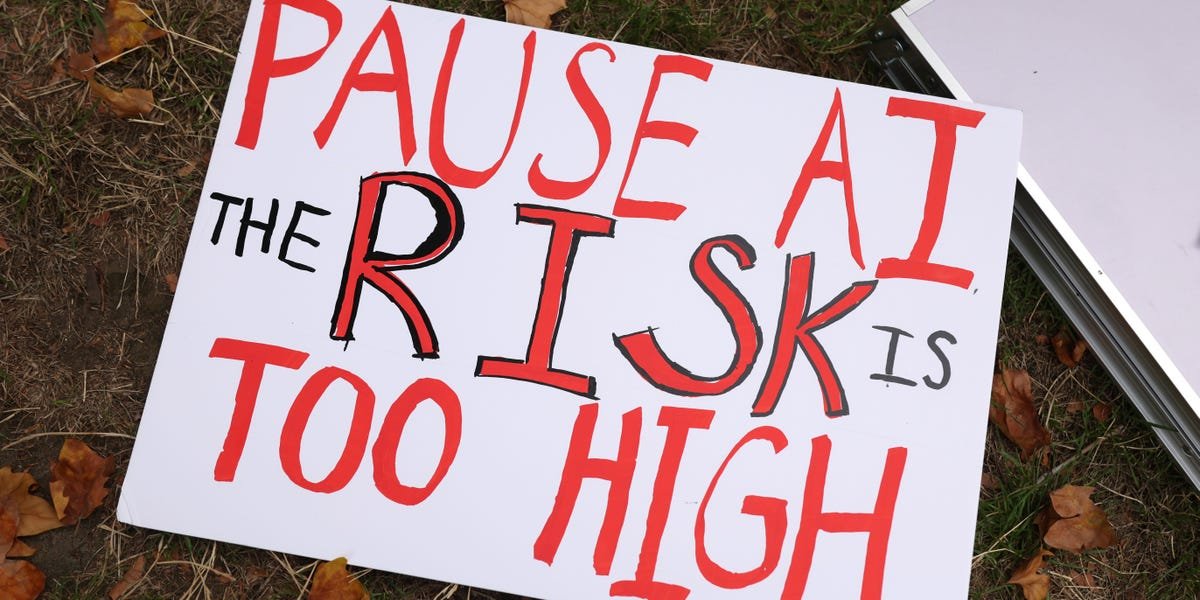
European policymakers faced additional pressure from activists on Monday, when the Pause AI movement demonstrated in front of the European Parliament buildings in Brussels.
“We would not board a plane with a one-in-ten-chance of exploding mid-air,” said Didier Coeurnelle, the coordinator of PauseAI Belgium, referring to the recent assessment from an Anthropic employee that there’s a higher than 10% chance AI could wipe out humanity. “That is what we are tolerating with AI today.”
Calls for slowing AI development have gone mainstream after AI titans including Anthropic CEO Dario Amodei, OpenAI CEO Sam Altman and Elon Musk raised the idea in recent days.
Consensus on the issue quickly fell apart in America after Trump blasted the AI warnings as a “HOAX,” sinking the likelihood of an immediate bipartisan deal to regulate AI. Since then, other industry leaders including Nvidia CEO Jensen Huang and former White House adviser David Sacks have similarly downplayed the technology’s dangers and resisted calls for new government regulations, blaming alarmists for overinflating AI risks.
“This poll fits the classic techno-panic pattern: few harms today, plenty of fear about tomorrow,” said Neil Chilson, head of AI policy at the U.S.-based Abundance Institute.
Chilson pointed to the POLITICO Poll finding that in every country but Spain, a third of respondents — or more — had rarely or never used AI.
“Most people haven’t felt AI’s benefits but they’ve heard many scary stories about its future,” he added. “For now, fear is outrunning experience. But experience will catch up.”
Still, many Republican and Democratic state leaders have scrambled to push for stronger controls, defying Trump’s and the federal government’s hands-off approach.
Want more Business Insider in your news feed?
Add BI in Google so our reporting is easier to find when you’re searching for what matters.
In California, the global epicenter of the AI industry, politicians are also tightening regulations as voters there sour on the technology. On Friday, Democratic Gov. Gavin Newsom — a likely 2028 presidential candidate — signed an executive order accelerating the implementation of new AI oversight standards and tasked state agencies with exploring whether a mandatory “kill switch” is needed for the most advanced AI models.
As politicians in America and beyond heed the warnings, so too, do voters.
According to the poll, people across North America and Europe view industry researchers’ warnings as legitimate. When asked whether AI lab staff really believed their own fears that “AI will kill us all” or if they were making a “marketing move” to hype their products, adults from all six countries tended to view the warnings as genuine.
That’s despite a suggestion among some industry observers that frontier AI companies may have sought to benefit from the publicity around their models. “I think a lot of it is marketing, to overemphasize the proposed capabilities,” Max Junestrand, co-founder and CEO of Legora, an American-Swedish AI firm valued at over $5 billion, said in an interview when asked about this summer’s AI hacking incidents.
Wariness of rapid AI development and its risks to society mostly crossed party lines in Europe and Canada. In the US, it was slightly more partisan: Americans who had voted for Trump in 2024 split almost evenly when asked whether to pause advanced AI development (44%) or press forward (40%), and they were more inclined than those who voted for former Vice President Kamala Harris in 2024 to say that AI employees’ alarmist talk was a marketing stunt.
Nearly half of Trump voters also said the US shouldn’t allow itself to fall behind other countries in the AI development race, even if it means taking risks to stay ahead.
In comparison, majorities in Canada and the UK (53%) opted for falling behind on AI advancement to prioritize security, even if it meant potentially ceding a technological edge to other countries.
Tyler Katzenberger reported from Sacramento, California, and Pieter Haeck reported from Brussels.
This edition of The POLITICO Poll was conducted by Public First from Sept. 13 to 15, surveying more than 2,000 respondents each from the U.S., Canada, U.K., France, Spain and Germany, and has an overall margin of error of ±2.2 percentage points. Smaller subgroups have higher margins of error.
This story originally appeared on POLITICO and is courtesy of the Axel Springer Global Reporters Network, which harnesses the resources of the company’s newsrooms to publish ambitious scoops, investigations, interviews, opinion pieces, and analysis. It allows journalists — including those from POLITICO, Business Insider, WELT, BILD, Onet, and Fakt — to collaborate on major stories for an international audience of hundreds of millions across platforms.
Read the full article here