








When Kevin Elliott’s job in Qatar ended, he and his wife, Camille, had to decide quickly where to retire.
The couple had spent nearly eight years in Doha after moving from South Carolina in 2018 for Kevin’s job. Life in the Middle East took some getting used to, especially the heat and the language barrier when dealing with bureaucracy. But once they settled in, they built a social life and traveled extensively.
“It was fun,” Kevin, now 63, told Business Insider.
Staying long-term in Doha was never their plan, nor did they want to return to the US, given the political divide and the high cost of living.
They had traveled to Malaysia and Thailand over the years and later visited Costa Rica and Panama to explore them as retirement options.
“One of the things we always tried to look at was, ‘Where could we live off of our Social Security alone?'” Kevin said.
In the end, Thailand won, with its lower cost of living and relatively accessible retirement visas.
After Kevin’s contract ended, the couple traveled to Hua Hin, a coastal town about 90 miles southwest of Bangkok, in November to see if it could check all the boxes in their long-term plan.
With about a month before their visas in Qatar expired, they were on a tight timeline. “It was a compressed schedule because my goal was, at least, by the time we flew back to Doha, we had to sign a lease,” Kevin said.
“And we did,” he added.
Thailand, their next chapter
Back in Qatar, they teed up their Thailand retirement visas and pet relocation plans. Bringing their two dogs — a Pomeranian and a Mauzer — to Thailand cost about $750 between paperwork and airline fees.
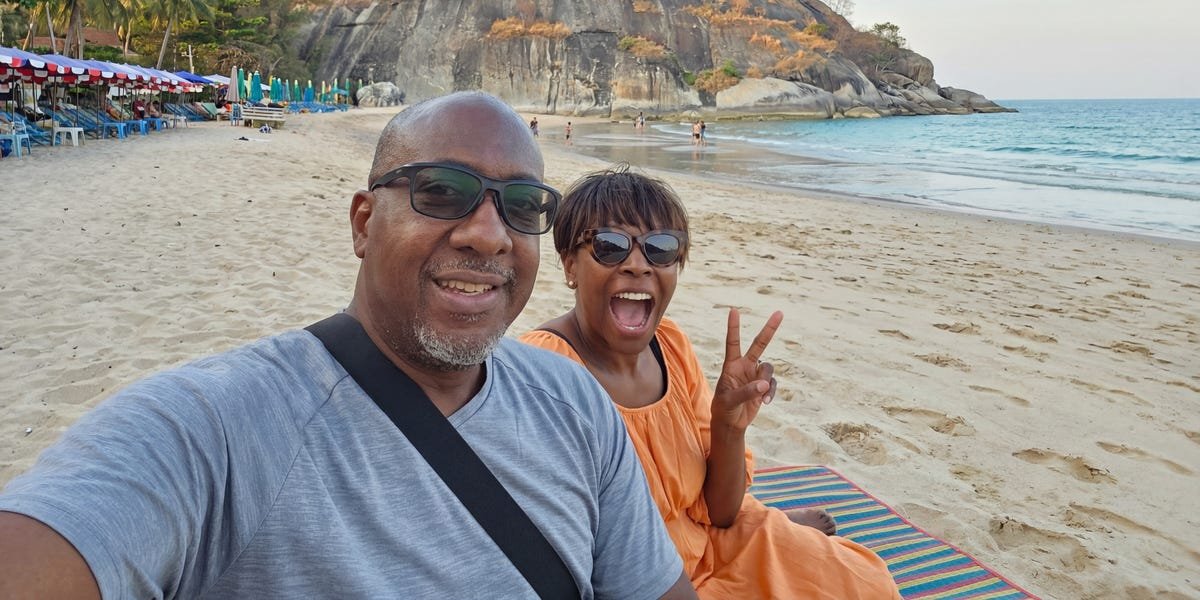
The couple moved to Hua Hin on January 1, settling into their two-story home in a gated community. Rent is 28,000 Thai baht, or about $870, each month.
After paying 8,000 Qatari riyal, or about $2,100, for a one-bedroom apartment in Doha, their new three-bedroom house with a yard felt like a major upgrade. The neighborhood’s greenery and space also reminded Camille of Jamaica, where she grew up.
“We knew it needed work, but I loved what I saw,” Camille, 62, told Business Insider.
Their neighborhood has its quirks, too, including monkeys that occasionally show up in their yard.
“Right now, it seems like a bonus, but I don’t know. At some point, it might not. But we kind of like watching the monkeys because we’re not used to them,” Kevin said.
For a while, the couple relied on a ride-hailing app for food, groceries, and transportation. After they borrowed a friend’s car, they plan to buy their own.
Their goal is to keep their monthly expenses under $2,500, though they’re still getting a clear sense of their spending. “We’re just starting to get out of that phase of buying stuff for the house,” Kevin said.
They’re still waiting to file their Social Security, but estimate they’ll get about $4,000 a month.
While most things in Thailand are inexpensive by US standards, they say costs can add up quickly if they don’t pay attention.
“If you’re always comparing to Doha or the US, you forget that at some point it needs to be Thai affordable. I’m in Thailand. Is this affordable? Not compared to the US and Doha, because you’ll overspend,” he said.
Even with that, they said the move has given them a quality of life they don’t think they could replicate in the US. “It’s not possible,” Camille said.
They can eat better for less, Kevin said. “We’re eating a lot of seafood, fresh vegetables, and fruits here. If we tried to do that in the US on a regular basis, it would probably be cost-prohibitive, especially in retirement.”
Thailand also has a robust healthcare system. More importantly, they said they’ve never felt unsafe living there, unlike in the US, where gun violence is “a concern,” he said.
A new country, a new rhythm
Though it’s difficult to determine exactly how many American retirees live in Thailand, at least 7,178 retirees there received Social Security benefits as of December 2024, according to the most recent US government data.
Unlike in Doha, where social life often revolved around surface-level interactions, Kevin says that it’s easier to form stronger social connections in Thailand among the established expat scene.
“If we’re out somewhere to eat, it’s nothing for us to say, ‘What is your WhatsApp number? Let’s stay in touch,'” he said.
Even so, they said they haven’t fully tapped into that social scene yet, as they’ve been focused on settling in — and looking after two more puppies they recently adopted.
“I’m probably going to plug into some of the golfing groups because golf is big here. I hadn’t played in years, but I enjoy the game,” Kevin added.
Life in their new home has taken some getting used to.
The couple said adapting to Thailand’s heat and humidity has been a challenge, especially compared to the more air-conditioned lifestyle they had in Doha.
“We are still trying to adjust to the language barrier,” Kevin said.
Even though Google Translate has been a great starting point, it’s not a long-term solution. “Having to pull out your phone, open the app, and go back and forth sometimes wears on you,” he said.
The couple said they sometimes miss the efficiency of getting things done in Qatar and the US, but have learned to adjust to a slower pace.
If anything, the cultural differences have been a positive, especially the friendliness and openness of the people they’ve met.
Kevin says he tries to live by two pieces of advice he once received.
“One, it’s their culture. You don’t have to forget your culture, but plug into theirs. And then two, try to make most of your life an adventure,” he said. “And if you do those two things, you should be OK.”
Do you have a story to share about relocating to a new city or country? Contact this reporter at agoh@businessinsider.com.
Read the full article here