





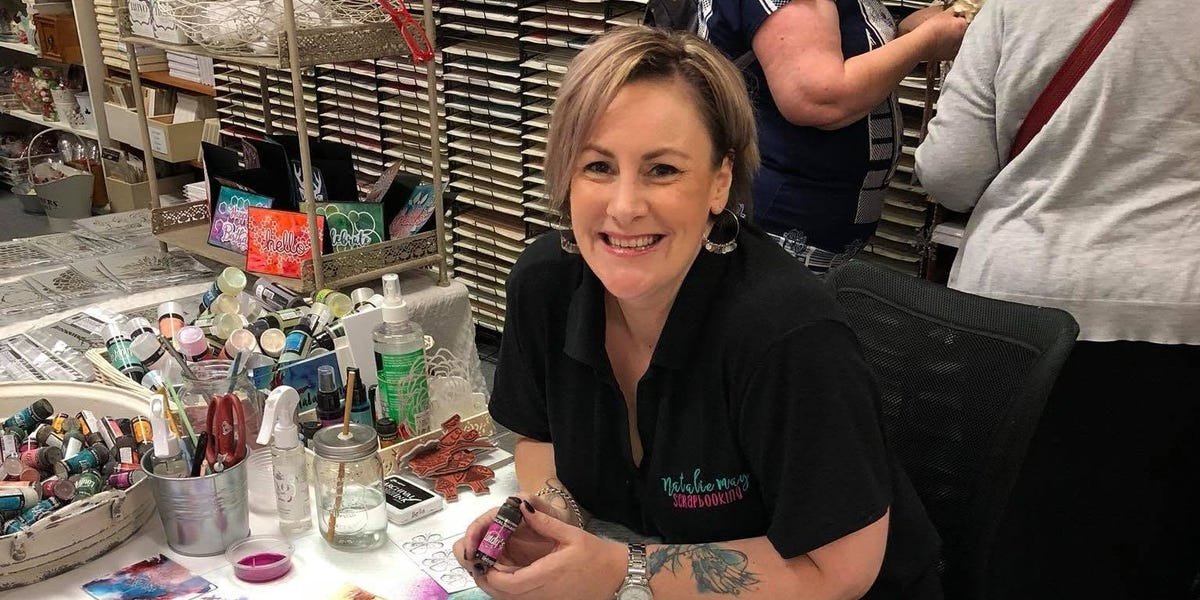


In front of a crowd of about a thousand people, Natalie May stepped onstage to talk about something she’d barely even spoken to close friends about — her vagina.
Her husband was mortified.
But by 2018, May had gotten used to being known as “the vagina lady” to audiences ranging from 12 to 200, sharing her own experience to help others recognize the early warning signs of ovarian cancer.
“It’s not just something that happens to someone else. It can happen to us,” she told Business Insider.
May, who lives in Adelaide, Australia, was 37 years old when she was diagnosed with stage 1 ovarian cancer.
Now in her 50s and one of Australia’s leading papercraft experts, May uses her scrapbooking classes and workshops to raise awareness that cancer can often develop for months if symptoms go unnoticed.
Cancer has become a growing concern for younger people, as more patients in their 20s and 30s are diagnosed with ovarian cancer, colon cancer, and breast cancer.
“There are so many different things put down to ‘just being a woman.’ That’s bullshit,” May said. “You really need to know what’s normal for your own body.”
Subtle signs of ovarian cancer
Around 2013, May noticed bright red spotting that escalated to full bleeding, which was unusual because she had recently finished her normal menstrual cycle.
Want more Business Insider in your news feed?
Add BI in Google so our reporting is easier to find when you’re searching for what matters.
“It was out of the blue,” May said. “Within two days, I was going through a pad an hour.”
She booked an appointment with her primary care doctor, who referred her for follow-up scans after initial testing revealed she had lost a lot of blood.
May was so confident that the follow-up appointment would be mundane, she brought her husband and daughter, 10 years old at the time, along with her. She had no family history of cancer, and a diagnosis never crossed her mind.
Then the doctor came in to discuss the results. When the nurse first took her daughter out of the room, May knew something was seriously wrong.
Imaging had found a six-centimeter cyst on her left ovary, which they suspected was cancerous. The initial diagnosis felt like “a complete and total blur” of panic and shock, she recalled.
Leading up to the diagnosis, May said she had felt she was in the best shape of her life, working with a personal trainer and exercising regularly. She had been losing weight: in retrospect, an early symptom of cancer.
With no other common signs of ovarian cancer, like bloating or abdominal pain, it would have been easy to ignore. May said trusting her gut and seeking help likely saved her life.
In the two weeks between the initial scan and her first surgery, the mass on her ovary had developed aggressively, nearly doubling in size.
“By listening to my body and acting straightaway rather than just pushing it aside, I prevented it from turning into stage two, three, or even four,” May said.
Early treatment is key to surviving ovarian cancer
May didn’t know much about ovarian cancer. She had to Google it when she got home from the doctor’s appointment. She learned that stage 1 diagnoses are rare because the cancer often spreads before patients seek help.
While May said she was lucky to have an early diagnosis, her treatment plan was far from simple. She underwent an initial surgery to remove the cyst, followed by a radical hysterectomy.
Recovery involved two weeks in the hospital, unable to sit up or do much else, and the healing process was delayed by months of chemotherapy to help reduce the risk of any lingering cancer cells.
Ovarian cancer is highly prone to coming back after remission; some studies estimate that up to 70% of patients experience recurrence on average, and it’s more likely to increase with later-stage cancers.
“It took probably four months for me to be able to walk, to drive unassisted, to get back to living,” May said. “All of a sudden, I had to go completely dark and cancel a heap of jobs and stop what I was doing to go through all of this treatment.”
Cancer is on the rise in younger people
For six months, May went to her chemotherapy appointment every Friday. It was there she first realized she was an outlier — more than a decade younger than the typical ovarian cancer patient in their early 60s.
“The only time I realized I was quite young was when I was sitting in the chemo ward, and I was the youngest person in the room,” May added.
That was in 2013. Over the past decade, early-onset cases of multiple types of cancer have been increasingly common in the US.
May said advocacy has helped her work through the lasting mental health toll of her diagnosis, which led to anxiety and depression in the years after her treatment.
At her crafting workshops — predominantly attended by women — she takes comfort in being open and blunt about her cancer experience, urging women of all ages to know the signs.
“As women, we tend to put everybody else before ourselves, and we ignore symptoms,” May said. “The thing we forget is that we can’t look after other people unless we look after ourselves first.”
Read the full article here