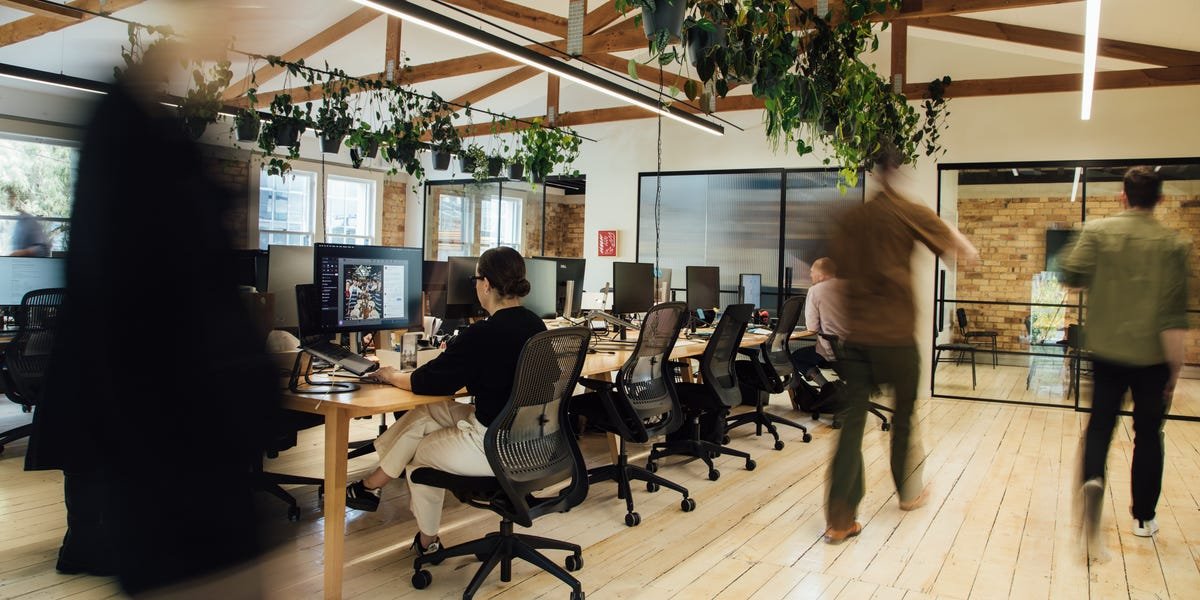
At a time when many organizations are convincing — or requiring — workers to return to the office, James Hurman is taking a different approach: creating an environment people actually want to work in.
Hurman, the founder and chair of Previously Unavailable, an innovation studio and venture firm in New Zealand, has designed his company’s Auckland office around an idea he calls a “Michelin-star workspace”: a space built with intention and care to make his team of 18 excited about showing up, in person, every day.
“How do you keep great people together for a long time, make sure that every day they’re feeling fantastic and completely taken care of, so they can focus all of their energies on doing the work that they love?” Hurman said in an interview with Business Insider.
It’s not about pampering, he said, “but how do we think thoughtfully about what they need to thrive and to be at their best and do their best work?”
In practice, that means a workspace filled with natural light, curated plants, organic materials, and thoughtful services, such as twice-monthly massages.
Hurman estimated the company has spent between NZ$300,000 and NZ$400,000 ($170,000 to $230,000) designing the main office space.
“If you look at it only from a cost perspective, which most companies do, they just go, ‘Oh, that’s too much,'” he said.
But he sees it as an investment.
“I really do think if we hadn’t invested in our people — not only in terms of the space, but in terms of all the stuff that we do for our people — we wouldn’t be this successful,” he said.
Take a look inside the company’s workspace in Auckland.
James Hurman’s goal was to create a workspace people wanted to come to that would support outstanding work.
Previously Unavailable, which invests in startups, creates new companies, and works with organizations on new ventures, was founded in 2014 and moved into its current building in Auckland’s Grey Lynn neighborhood five years ago.
In 2025, the company bought the building, which has two floors: a venture studio on the lower floor and the main workspace on the upper floor.
A company with big goals — creating million-dollar companies out of New Zealand — needs a team operating at the peak of its powers, Hurman said.
That involves thinking about “ingredients that we need to create a team that’s capable of pulling off stuff that other teams just are not capable of,” he said.
His team developed the idea of a “Michelin-star workspace.”
Inspired by the way Michelin-star restaurants weave together thoughtful details to shape the dining experience, several Previously Unavailable staffers formed a working group to ask: “What might make a Michelin-star office experience feel like for us?”
They ultimately developed a “three-star framework” inspired by three Māori concepts, drawing on the culture of New Zealand’s Indigenous Polynesian people:
- Āhua pai, or good form, which the company associates with comfort and functionality;
- Mauri tau, or a state of peace and equilibrium, which refers to energizing the team and supporting their well-being;
- Te Taumata, or the summit, which refers to “the transcendent space that elevates potential and fosters deep connection,” according to the company.
“They tend to think really long term,” Hurman said of his interpretation of the Māori wisdom culture. “They tend to have a profound connection to place and nature. They tend to kind of collectivize the value, the creation of value, and the sharing in that value.”
When employees rated the workplace against the framework, it scored 2.17 out of 3.
Hurman said he saw the score as an opportunity to be more thoughtful about the space.
The team’s feedback led the company to create more “focus-friendly zones,” improve acoustics, air, and temperature controls, and reduce clutter, among other things, he said.
At first, they focused on executing quick wins before looking ahead to longer-term improvements that honor the three concepts.
The team shares two long desks in the office’s 2,100-square-foot main space.
The large, open space features two long desks, enabling face-to-face collaboration and ample room to move.
Previously Unavailable is “studio first,” Hurman said, meaning employees are encouraged to spend most of their time together while still having flexibility when needed.
It’s particularly helpful to have people in one place at a creative organization, Hurman said. “If we were dispersed, it would be really, really hard,” he said.
The layout is also part of a broader goal: removing what Hurman calls “unnecessary stress” from the work environment.
There’s necessary stress at work, he said, such as deadlines or pushing each other to deliver strong results. But bad lighting, uncomfortable temperatures, and spaces that make it harder to focus can all add avoidable friction.
The office is filled with plants to support the team’s well-being.
The office has around 40 different plants, including two dozen hanging baskets. Hurman said they were selected partly because of their air-purifying properties.
The company said the snake plant, for example, converts carbon dioxide and produces pure oxygen, even at night, while the English ivy has been shown in studies to absorb pollutants and carcinogens such as benzene and formaldehyde from the air.
While a 1989 NASA study found houseplants could remove air pollutants in sealed spaces, more recent research suggests hundreds of plants would be required to meaningfully improve indoor air quality.
Still, Hurman said the plants serve another purpose.
“It’s not only the work that the plants are doing, but it’s the visual,” he said. “Almost like forest bathing inside.”
Natural surfaces, such as wood, were also key to the design.
The office also features wooden tables, natural materials, and large windows.
Many of those elements fall under the umbrella of biophilic design, an approach that incorporates nature into built spaces. Research suggests these features can help reduce stress, promote relaxation, and, in some cases, improve attention and productivity.
A 2021 review published in Indoor and Built Environment, for example, concluded that seeing wood indoors was associated with improved mood and some indicators of reduced stress, although the authors noted evidence was limited.
“When you work at a natural surface, it’s much better for your well-being than if you work at a non-natural surface,” Hurman said.
Beyond the shared desk space, there are corners for contemplation or collaboration.
In addition to smaller meeting rooms, a boardroom, a kitchen, and eating areas, the office has a large, light-filled lounge.
“We have a beautiful lounge area with a huge window, and the sun just pours into it,” Hurman said.
Research has also linked daylight and office views to cognitive benefits, such as working memory, satisfaction with the surrounding environment, and improved sleep.
Hurman’s team also created a special scent for the office space.
Previously Unavailable worked with a company called Aroma, which works with hotels and retail spaces, to create a scent, “Sandalwood Gold,” especially for the office. Using an air diffusion system, it fills the space.
“If you walked in here, it’s like if you walked into a high-end day spa,” Hurman said. “It just smells lovely and calming.”
Some studies have also shown that pleasant odors can positively influence mood, comfort, and well-being in built spaces, although the effects depend on factors such as the type of scent, its strength, and individual preference.
The space is also filled with local art that reflects the company’s values.
Previously Unavailable supports local Māori and Pasifika artists by commissioning special prints or visiting annual art fairs, then featuring their work throughout the office.
Last August, for the company’s 10th anniversary, it commissioned a painting, pictured above, by Tongan-Sāmoan artist Salome Tanuvasa for its invitations.
The company said it wanted to “create something memorable and unique, truly reflecting PU’s spirit.”
Twice a month, a massage therapist comes to the office.
A Slack message reminds employees to sign up for a free 15-minute massage time slot.
While it’s a nice reward for his team, Hurman said there’s more to it than that.
“All of this stuff is in the service of reducing unnecessary stress,” he said. “That massage component, there is a real kind of health and wellness benefit to that.”
Snacks are available, but Hurman considers this area for improvement.
There are nutritious snacks available — as well as less nutritious ones — and a large fruit basket that’s replenished every week.
But Hurman said his dream would be to eventually have an in-house chef making lunch every day with a focus on nutrition.
“We’re not doing that yet, but that’s something that we’re working towards,” he said.
There’s more to do to improve the space based on employee feedback.
Beyond additional complimentary food items, there was a call for more quiet breakout spaces, Hurman said.
“It’s a work in progress, but everyone’s kind of engaged in how we get to that three-star space,” he said.
Still, he said, not many other companies would score a 2.17 on the scale, so he feels they’re “already a long way down the road.”
So far, Hurman said, the approach seems to be working.
Hurman appreciates that it’s hard to isolate and measure the impact of design aspects on his team, but he said the proof is in how his staff comes to the office every day — and rarely leaves the company.
“People love the space. They love coming to it. They do amazing work in it. That creates extraordinary value,” he said.