




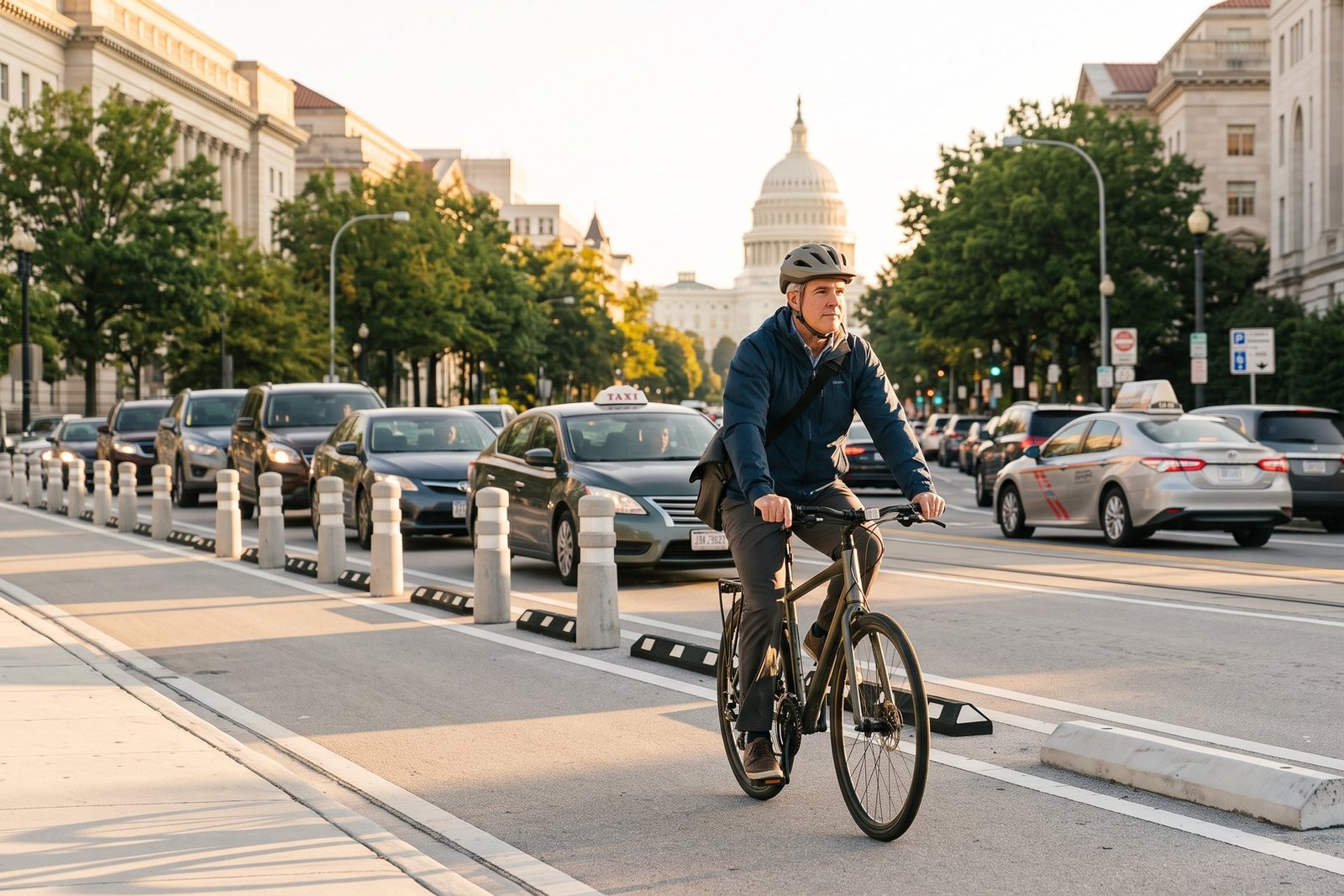


I rarely start my car. Most days I get where I’m going on two wheels and a little sweat.
I ride my bike primarily for fun and exercise, but it’s also the cheapest transportation I’ve ever owned. And after 35 years of writing about money, cheap gets my attention.
So does this: Washington is now moving to make my favorite money-saver harder to use.
In a July letter to Congress, Transportation Secretary Sean Duffy urged lawmakers to “restrict” federal funding for bike lanes and even back the “removal of existing bike lanes” that slow down cars. Days earlier, he said he was redirecting $1.73 billion away from what his department calls “DEI bike lanes.”
Here’s a direct quote from Duffy on X: “Remember when Biden and Boot-edge-edge used YOUR MONEY for DEI bike lanes and climate change? THAT’S OVER.”
DEI bike lanes? What the heck is this guy talking about?
Here’s the part that should bug you, whatever you drive. A bicycle is one of the most powerful money tools sitting in your garage. Let me show you the math.
1. You skip the biggest expense most families never question
That’s the car itself. AAA pegs the average cost of owning and operating a new vehicle at $11,577 a year as of 2025.
That’s not the sticker price. That’s every year — roughly a grand a month.
Ditch one car and you keep it. Even if you can’t go fully car-free, there are real ways to shrink what your car costs you.
2. The gas pump stops taking your money
A bike runs on breakfast. AAA figures fuel alone at about 13 cents a mile.
Personally, I ride about 4,000 miles a year, so that’s around $520 I never had to hand to an oil company — money that stings more every time gas jumps a dollar a gallon.
To be fair, I live in Fort Lauderdale, where the weather’s nearly always good for bike riding, so I can ride more often than many Americans.
3. Insurance drops off your budget
A bike doesn’t need its own policy. Car insurance averages $1,694 a year in AAA’s numbers, and it climbs every time your rate resets.
A bike carries no premium, no deductible and no teenage-driver surcharge.
4. Maintenance goes from a mechanic’s bill to a $10 chain
Cars need oil, brakes, tires, belts and the occasional four-figure surprise. A bike needs a chain, some air and a rag.
I do most of the maintenance myself in about 10 minutes.
Quick gut-check — if your money advice is coming from random online influencers, you’re playing a dangerous game. I’ve been a CPA since 1981 and writing about money since before the internet existed. Sign up for the free Money Talks Newsletter and get expert advice that’s been tested by time.
5. You stop paying to park
In a lot of cities, a parking spot costs more than lunch — every single day. Add permits, garages and the odd ticket, and it adds up fast.
A bike parks free at the rack.
6. Registration, taxes and tolls quietly vanish
AAA counts $813 a year just for license, registration and taxes on a typical car.
Bikes don’t get registered, don’t pay tolls and never trigger a renewal notice from the DMV.
7. Your gym membership becomes optional
Right now you might pay $40 or $60 a month to pedal a stationary bike that goes nowhere.
Ride a real one to work and the workout is free. Better yet, you actually arrive somewhere.
8. You may spend less at the doctor, too
A University of Glasgow study that tracked more than 250,000 people found that folks who biked to work had a 45% lower risk of cancer and a 46% lower risk of heart disease.
Lower risk tends to mean lower bills.
Where the money and the news collide
Every one of those savings depends on one thing: being able to ride safely. And safe riding depends on infrastructure with protected, painted lanes — the connected routes that let a normal person get to work without playing chicken with an SUV.
That’s exactly what’s on the chopping block. The Federal Highway Administration’s own research found that adding a bike lane can cut crashes by up to 49% on a four-lane road. This summer, the same agency dropped bike lanes from its official list of proven safety measures.
You don’t have to love bikes to see the problem. When the cheapest, healthiest way to get around gets harder and more dangerous, the car stops being a choice and becomes a requirement.
And a required $11,577-a-year expense isn’t freedom. It’s a bill.
The less you’re forced to spend, the freer you are. A bike is one of the last cheap doors left, and I hate watching Washington weld it shut.
If you want the nuts and bolts of turning two wheels into real money, we’ve laid out five more ways to make or save money with a bicycle.
Read the full article here