







Over the past few days, US forces launched high-risk missions into Iran to rescue a downed Air Force pilot and a weapon systems officer, underscoring one of the military’s most deeply held promises: if Americans are shot down behind enemy lines, the US will come for them.
Combat search-and-rescue (CSAR) missions like the ones that the US military carried out to bring home the crew of an F-15 Strike Eagle shot down over hostile territory are inherently dangerous, risking the lives of many for even just one or two service members.
The missions cost the US military a handful of aircraft, but the cost could have been much higher. As President Donald Trump said Monday, “we could have ended up with a hundred dead as opposed to one or two.” He said that “it’s a hard decision to make,” but in the US military, “we leave no American behind.”
In this instance, everyone made it home.
Such commitment, even when it means sending dozens of elite troops and aircraft into hostile territory, is about more than saving lives. It is central to the morale of the force, and it serves as a strategic safeguard against American service members falling into enemy hands.
‘We’re going to come after you’
“The belief that you will fight to the death for someone else on your team is so very powerful to give those folks the motivation to go forward and do what they need to do, and that’s reciprocal throughout,” said John Venable, a retired Air Force pilot and senior resident fellow at the Mitchell Institute for Aerospace Studies.
“‘Morale’ is a big word,” he continued, “but it misses this absolute lifeblood of the fighting force that says, ‘if you’re an American, you’re in distress, we’re going to come after you, and we’re going to do everything in our power to bring you back home.'”
Venable pointed to the black POW/MIA flags depicting the white silhouette of a captured American service member representative of prisoners of war and those missing in action.
Those service members — particularly those who were captured during the Vietnam War, who were tortured, and who, in many cases, never returned home — have been seared into the US military’s institutional and cultural memory.
During Vietnam, dedicated combat search and rescue efforts were professionalized as US forces launched hundreds of dangerous recovery missions under fire, developing the tactics, coordination, and specialized units that underpin CSAR today, even if not everyone could be easily rescued or recovered.
The US military’s modern approach to personnel recovery was further shaped in the aftermath of the calamitous 1980 mission, Operation Eagle Claw, to rescue American hostages in Iran.
The complex operation forced different services to operate jointly as they rarely had before, exposing serious communication failures and resulting in two destroyed American aircraft and eight dead US service members.
The failed mission became a catalyst for change, contributing to the eventual creation of US Special Operations Command and reinforcing the military’s focus on joint operations and personnel recovery.
Leaving no one behind
The US military’s ability and willingness to attempt high-risk rescues of downed airmen in combat has become an extraordinarily powerful strategic signal over the years, Venable said, and sends a warning message to other countries.
The message, he explained, is that “if you think it’s going to be easy to capture one of our airmen, you’re wrong. And if you think we won’t put up the fight of our lifetimes to prevent you from doing that, then you’re wrong.”
“That has its own level of weight,” he said.
Beyond the messaging, there’s intelligence. Pilots often possess more sensitive intelligence than other troops, making them especially valuable targets if captured.
That information falling into enemy hands is a serious concern for military leaders, said John Waters, an Air Force veteran who also flew with the service’s F-16 Viper Demonstration Team. It adds to the imperative to retrieve downed comrades.
A captured pilot may also become a powerful propaganda tool for the enemy, he said, raising the stakes for recovery operations.
There are also operational benefits in letting airmen know their lives are valued regardless of an enemy’s interest in propaganda or intelligence. It motivates service members, making them more willing to accept the risks of dangerous missions. Knowing their lives aren’t considered expendable can subtly steel resolve.
“You can ask more of me if I know you value me,” said Waters, who flew extensively, nearly 1,000 hours, during the wars in Iraq and Afghanistan. “You put me in my single-engine fighter over bad guy-land and the worst thing happens,” it’s reassuring to know “that you’re going to come get me, or try everything in your power to come get me,” he said.
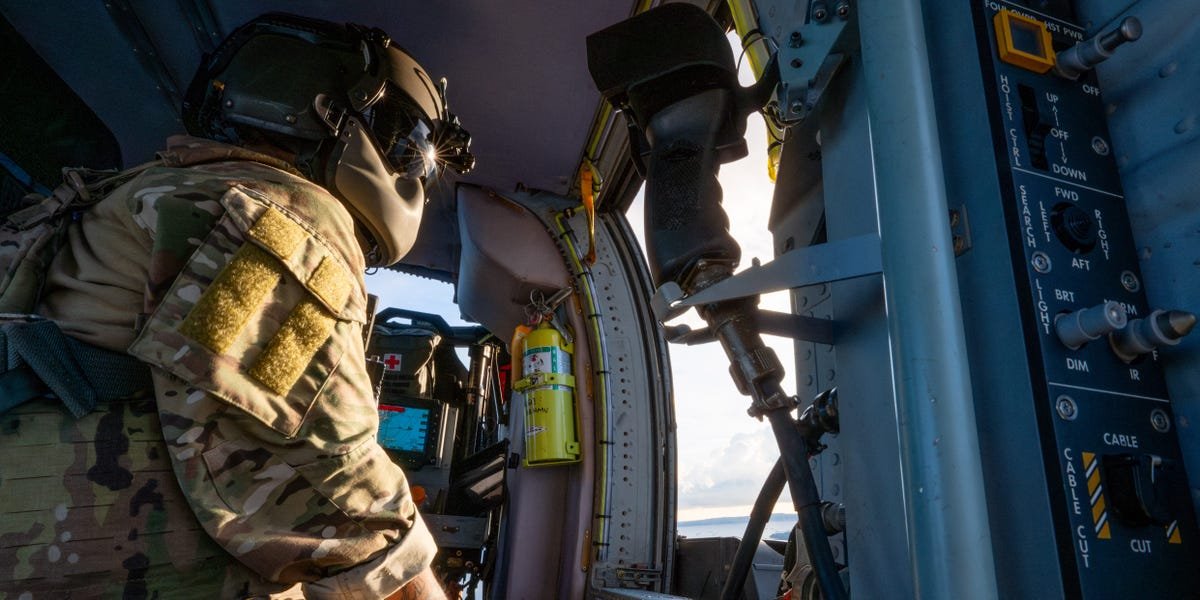
The future of the Air Force’s elite combat search-and-rescue teams, made up of helicopters, cargo and refueling aircraft, and pararescuemen, has come into question in recent years. As the wars in the Middle East wound down and the Pentagon shifted focus toward the Pacific, some leaders began to assume aircrew recovery missions would be too difficult in a conflict with a near-peer adversary, Venable said, leading to reduced investment in the units that carry them out.
Conflict analysts have warned that a war with China could result in casualties on a scale not seen by the US military in many decades, increasing the likelihood of downed aircrew in contested environments and perhaps more limited resources to rescue them.
As the Global War on Terror moved toward a close, the Pentagon began chipping away at CSAR resources, Venable said, cutting units and helicopters and redirecting funding to other priorities. Military news site Task & Purpose reported upheavals in resource allocations for the rescue force earlier this year.
One CSAR pilot Business Insider spoke with called the rescue efforts a “sacred duty,” acknowledging how expensive such a “niche capability” can be but arguing its strategic importance outweighs the cost.
Venable, likewise, argued that if airmen are in harm’s way, then “we’ve got to have the ability to go in and pick them up and take them home.”
Read the full article here