







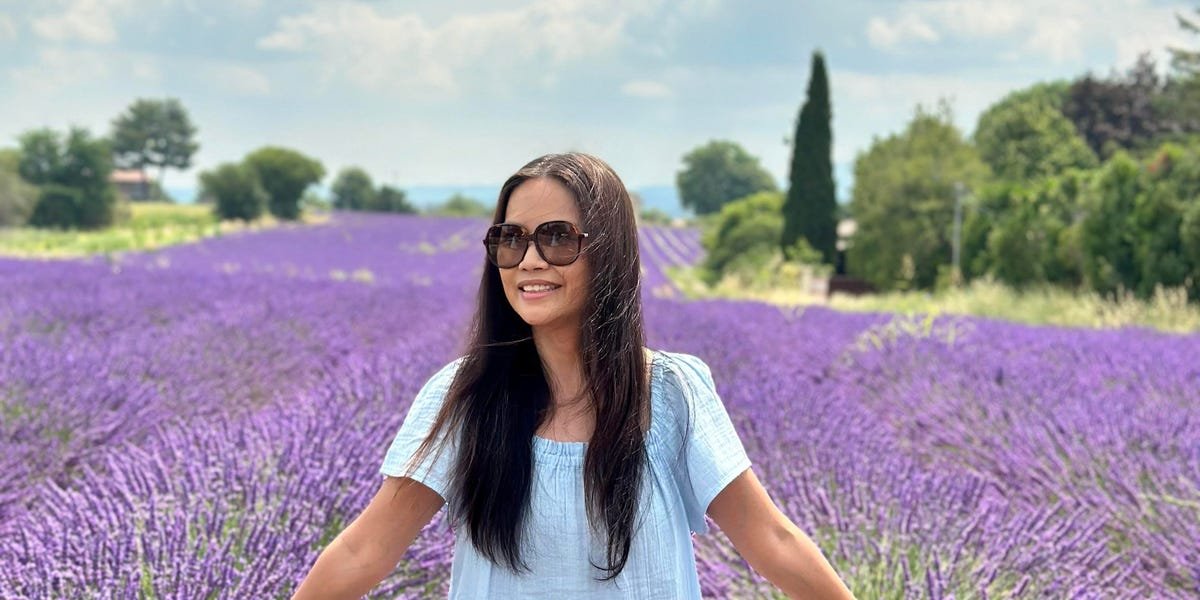


This as-told-to essay is based on a conversation with Lin Koh, 55, who relocated from California’s Bay Area to France in 2023 with her husband and two children to help care for her mother-in-law, who has Alzheimer’s. This conversation has been edited for length and clarity.
I was born in Singapore and moved to the US when I was young. I later settled in the Bay Area, where I met my husband, Adalbert, and had two children. Adalbert always worked in the tech industry, and before we moved to France, I spent time at Facebook and Adobe.
There are so many things to love about the Bay Area. The weather is beautiful, the food is very international, and the diversity is wonderful. But it’s notoriously expensive, especially down the Peninsula and farther south.
We lived in Santa Clara, which felt more affordable for us, and we built a community we loved. Still, life there could be hard — the cost of living was high, and we were working constantly.
In 2023, we decided to move to France. We had always known we’d end up there, but what pushed us to do it then was my mother-in-law. My husband’s parents live in France, and my mother-in-law has Alzheimer’s. We were observing her decline, and we made the call.
Our kids being young was another factor. At the time, they were five and seven, and we thought that if we delayed this any longer, it would get more difficult. I had moved around a lot when I was little, and it got tougher as I got older.
I think a really big part was that we were also ready for a change. Underneath it all, we were looking for a more balanced life, where our kids could truly enjoy themselves, and we wouldn’t be on our phones all the time and working.
The hardest part of leaving the US was saying goodbye to friends and family
When you’re the spouse of a French national, you’re entitled to a visa called a “vie privée et familiale” visa — basically a private and family life visa. In that sense, the application is fairly straightforward.
Before that, you need what France calls the “livret de famille” — the Family Book. It’s issued when you register your marriage with the French government, and any children are added to it. It’s important to have because, when you apply for the visa, they’ll ask to see it to prove your family status.
The vie privée et familiale visa allows me to stay in France initially for one year and also grants me the right to work in France. That’s why it’s easier as a spouse — you’re not subject to the restrictions you might face on a different route, like a visitor visa, where you typically wouldn’t be allowed to work.
We put a lot of our things in storage. We sold a car, did a lot of purging, and had to prepare our family dog for travel. We also put our house up for rent — it’s a single-family, four-bedroom home. In total, it took us six weeks to prepare everything. It was a very short timeline, because we had found a home to rent in France almost immediately.
The hardest part of leaving was saying goodbye to my family and friends — and that still stands.
We did worry about how the kids would adjust, but they’re really adaptable and resilient, and they were young. They were actually excited because we positioned it as, “Hey, this is going to be an adventure for you.”
I also think it’s beneficial for kids to see their parents doing something for the good of the family. We wanted them to understand, “Mommy and daddy are doing this because family is the most important thing.” We really wanted to instill that value in our kids.
The kids have adapted to life in France
We live in Fuveau, near Aix-en-Provence and Aix-Marseille University. After initially renting a five-bedroom house with a pool in the small village of Saint-Savournin for about €2,200 a month, we purchased a home in Fuveau.
Compared with the Bay Area, everything feels less expensive. But I will say the area we live in has a higher cost of living than a lot of other parts of France, aside from Paris.
Fuveau feels very Mediterranean: lots of pink hues — it’s easy to see why the Impressionists loved the region. There are many stucco homes with shutters, tile roofs, terracotta, and beautiful landscaping — succulents are everywhere. We’re close to the Riviera and the sea, which is just breathtaking.
Initially, the kids attended a private international school, but we decided to withdraw them because they were speaking too much English. We enrolled them in public school, and within six months, both of them were fairly fluent.
Kids are just sponges. They now speak French to each other, even, and we sometimes have to remind them to speak English at home so they retain it. But they’ve adapted really well. I’d say we’ve been really, really lucky.
We live in a multi-generational household
Since being in France, my husband has really stepped up. It hasn’t fundamentally changed our marriage, but there was initially more dependency on him because my French isn’t as good as his. He had to take on a bigger role in navigating day-to-day tasks.
My husband’s parents live with us. It’s not easy, because my husband and I don’t have as much privacy as we did before, so we really have to stay emotionally connected — expressing how we’re feeling and talking things through. In some ways, it has strengthened our marriage; in other ways, it has challenged it and added new stress. But it’s also brought a lot of opportunity to grow in a different direction.
With my in-laws living with us, there was a bit of an adjustment at the beginning, because we weren’t used to having so many people in the house. However, once we settled in, it has been fairly smooth. We still have enough space to spread out and do our own thing.
I was able to find a job here a year after we moved, and one of the wonderful things about this house is that I have my own office. My husband also has his own office space, which has been great for him.
I did have to adjust when it came to responsibilities, especially preparing meals for more people. The lifestyle in France is more centered on cooking at home, rather than takeout or DoorDash.
People visit the grocery store every other day, and fridges are often smaller. There’s more emphasis on fresh food, and the markets here are amazing, which is one of my favorite things about living here. I go almost every Sunday, and the prices are really affordable.
We all help care for my mother-in-law
The main goal of living with my husband’s parents is to support my father-in-law, because it’s really hard to support a spouse who has Alzheimer’s.
My husband is an entrepreneur who has been in the software industry for many years. To help keep my mother-in-law occupied, he created an app to support her. It’s called Argoli, an AI companion for the elderly. It helps occupy my mother-in-law with conversations about family and events when the rest of us aren’t available. It’s tough to share caregiving duties, so this helps us a lot.
She has late-stage Alzheimer’s, so she needs help with day-to-day things, and she can’t be left alone for too long. She shadows my father-in-law quite a bit because she recognizes him as her main caregiver.
We’ve also gotten help from an association in France called Petit-fils, which literally translates to “grandson.” Caregivers from that association come daily to spend a couple of hours with her, helping her get ready in the morning, grooming, showering, and doing other tasks. The rest of the time, we take turns as needed.
Over time, we’ve gotten into a groove of things and know what to do and how best to help her. Sometimes she gets lost in the house, so we have to keep an eye on her. However, in the grand scheme of things, based on my experience with caregiver groups on Facebook, I feel that she’s pretty manageable.
The hardest part of this move has been seeing a loved one who was so capable change over time. It’s also really tough for me because my kids don’t know their grandma the way she was before.
But the time together has been really good. I see how my son helps out, too — when he notices his grandma needs to drink more water, he’ll go get it for her. It’s really beautiful to see. It’s teaching my kids how to be nurturing, and it really emphasizes the importance of family.
Read the full article here