




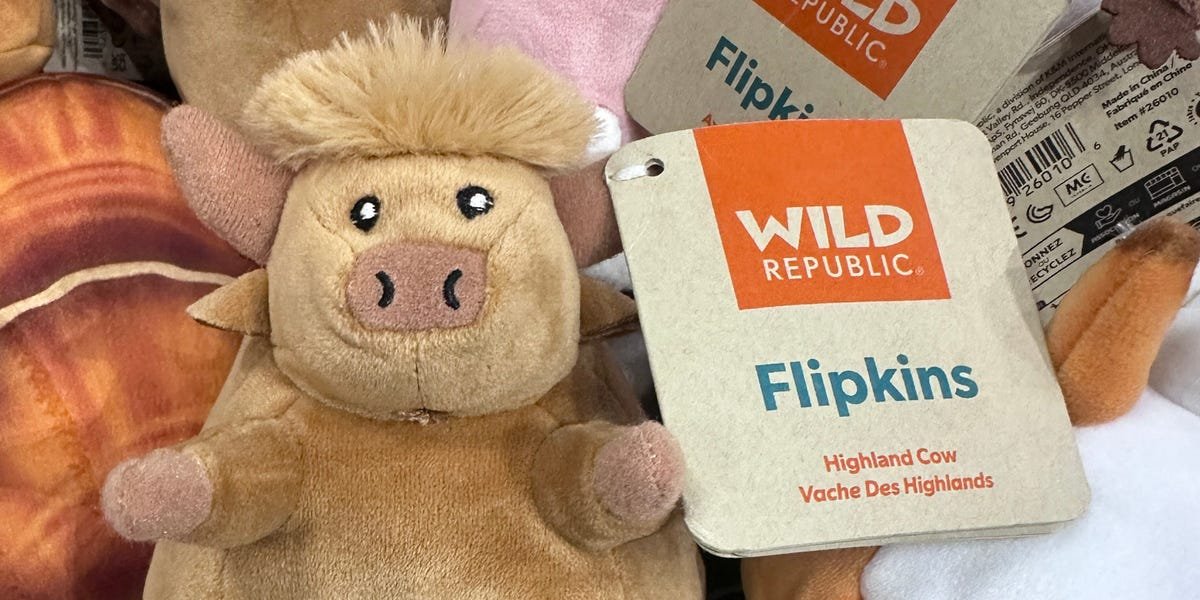


I’m calling it: If you haven’t already, you’re going to start seeing highland cows in toy aisles around the country.
After visiting one of the industry’s largest fairs earlier this week, I think I’m qualified to say: The shaggy cow is taking over as the hot new animal for plush toys.
If you’ve been paying attention to toys — or if you have kids — you probably already know capybaras are big, but they’ve been the hot thing for more than a year now. Same with axolotls, the eerily cute pink salamanders. Those trends are peaking, though.
Stuffed animals seem to go in trend cycles. In the mid-2010s, llamas and owls were all over baby and kids’ clothes and toys. Before that, hedgehogs and foxes.
Not everyone I talked to at the Toy Fair, the toy industry convention held in New York over Presidents Day weekend, agreed with my assessment. I got a few other surprising predictions:
pigeons.
frogs.
squirrels.
woolly mammoths.
But enough people I asked said the same thing — that the trending animal is the highland cow, with its caramel fur and tawny mop of hair — that I feel I can say there’s a modest consensus.
Like I said, not everyone agreed on the cow. But there was agreement, among everyone I talked to, about three things casting a long shadow over the toy business: tariffs, TikTok, and Labubus.
I chatted with several small to midsize toy companies who said that the tariffs that began when President Donald Trump declared “Liberation Day” have hurt their businesses. One plush toy maker said they’re paying $10,000 extra per container in tariff charges for their high-end plush animals made in the Philippines. They haven’t raised prices yet, and the new fees just eat into their profit. Another plush maker said that they raised prices once after tariffs, but are trying to avoid another hike.
Toy makers’ ears must’ve been burning when Trump made comments about how perhaps kids could learn to live with just a few dolls instead of many. But Trump was right about something — kids do often have more toys now than they did 30 years ago because toys are, in fact, cheaper than ever.
The rate of inflation for toys is well below the national average for all things, meaning a Barbie or Hot Wheel costs relatively less today than it did back in 1995. (If you’re a parent looking at a mess of toys spilling out of boxes and shelves, you’re not alone.) Part of the reason toys have gotten cheaper is overseas manufacturing, which the tariffs are now hitting.
The big toy brands like Barbie, Lego, and Pokémon all had new items to debut at the fair. Among the smaller toy brands, a few trends emerged — blind boxes were huge, and many brands and distributors had cute figurines packaged in blind boxes or adopted the aesthetic of twee characters sold alongside Labubus at the Hong Kong-based retailer Pop Mart.
Still, no one seemed to think there was a clear heir apparent to Labubus, which were a singular meteoric event in the toy world (yes, there have been viral toys before, like Beanie Babies or Tickle-Me-Elmos, but the rapid internet and celebrity-fueled Labubu phenomenon feels unique).
“Labubu is such a great example of something from nothing, but really built on the foundation of everything. Blind boxes have been massive. Plush has been massive. It was the amalgamation of a ton of the listening, and it then getting discovered,” said Eric Morse, VP of new business initiatives at Spirit Halloween said during a panel talk about Gen Alpha trends.
Morse went on to explain they used a similar strategy for rushing out “K-Pop Demon Hunters” costumes this October after the surprise hit debuted on Netflix over the summer. (Of course, even though they pushed through a licensed costume at a far faster speed than normal, they still sold out well before Halloween, much to the ire of 8-year-olds everywhere.) “How we view the business is listen first, execute second,” Morse said.
When toy and candy trends happen rapidly on TikTok, it can be hard to predict surges in demand. And with on-again, off-again tariffs, it’s even harder to plan, lots of industry insiders told me. That’s something I kept hearing from all the vendors I talked with: uncertainty.
But one thing I feel confident about is highland cows. You heard it here first, folks.
Read the full article here