









Copy link
X
Bluesky
Threads
Impact Link
Save
Saved
Read in app
subscribers. Become an Insider
and start reading now.
Have an account? .
- Hundreds of robotaxis are serviced each day at Waymo’s largest depot in San Francisco.
- Inside, robotaxis are cleaned and routinely serviced to be ready for riders.
- Business Insider took a tour — take a look inside.
The country’s largest operational robotaxi depot is surprisingly quiet.
In an inconspicuous corner of San Francisco, Waymo’s autonomous taxis hum and haw as they slowly pull into parking spots, patiently waiting for human coworkers to service them as needed.
This is a robotaxi rest stop: They park, recharge, and are routinely cleaned or maintained by human workers flowing in and out of the facility.
Business Insider took a tour of the Waymo depot on Toland Avenue on a late Thursday afternoon just before Super Bowl weekend.
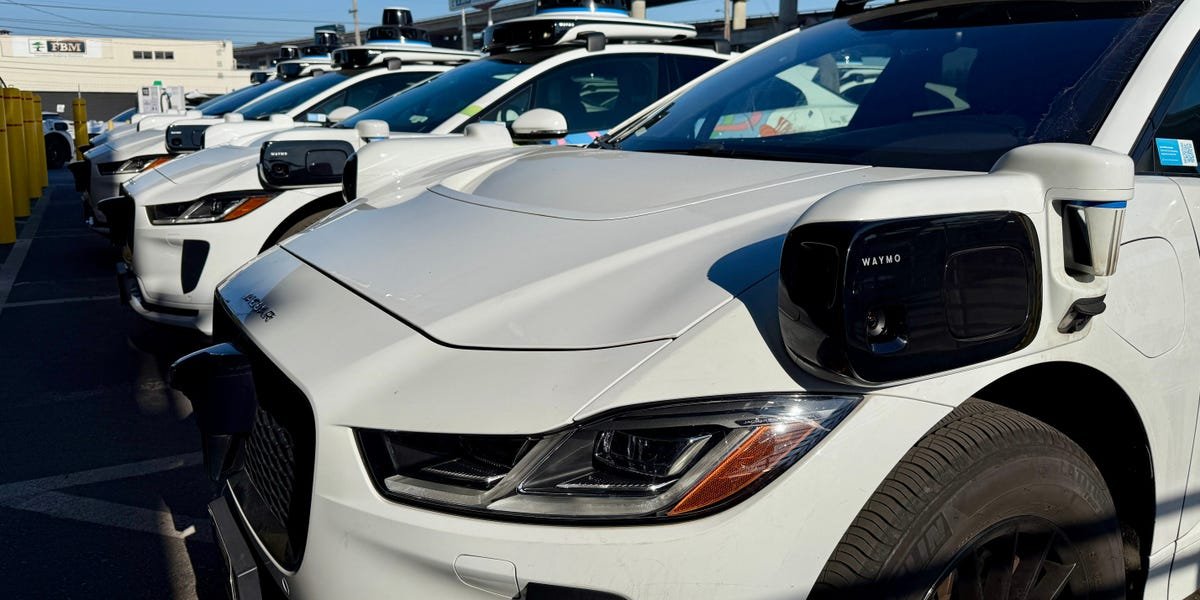
“It’s a busy time,” Sandy Karp, a Waymo spokesperson, told us, as we walked by rows of parked white Jaguars. The fleet vaguely resembled a crowd of wide-bodied stormtroopers.
As robotaxis scale, these depots will become a common sight in urban neighborhoods. Robotaxis need to be close to their customers, after all.
Take a look inside.
Waymo’s largest depot can service hundreds of robotaxis
Waymo has several unmarked depots throughout the Bay Area to service the nearly 1,000 robotaxis the company has deployed in the region.
Business Insider visited Waymo’s largest facility in Bayview, a neighborhood in southeast San Francisco. The building itself offers little indication that the facility is dedicated to autonomous cars. Small blue cones marked with the Waymo logo are lined up outside.
Most of the robotaxis remain on a large lot, waiting to be serviced or deployed to serve millions of riders in the San Francisco Bay Area.
A Waymo spokesperson said the depot can service hundreds of robotaxis and that the facility has been operational for about five to six years.
Some depots are entirely indoors. The Bayview depot is mostly outdoors, in part to comply with COVID restrictions at the time it was built, the spokesperson said.
The lot is quieter than you’d think
The Waymo depot in Bayview was busy but quiet. There was no honking, no beeping — mostly just the constant sound of cars zooming by on the nearby 280 highway.
Residents who live near other Waymo depots in California have complained that the robotaxis can make a lot of noise or emit too much light.
The city of Santa Monica has even sued the company to force the depot to stop operating past its curfew.
In any case, there were no residents to disturb at the Bayview depot — it’s located in the neighborhood’s industrial corridor.
Waymo robotaxis have to be regularly cleaned and charged by human employees
At the depot, employees contracted by Transdev and other third-party companies maintain Waymo’s robotaxis.
Employees perform a range of tasks, from plugging chargers into the cars to cleaning their interiors.
Inside the building is a break room for employees to take meetings or eat lunch. At least 40 people filled the room that afternoon.
Some employees donned bright yellow safety vests, since they’re dealing with multiple-ton cars that constantly move around the lot.
Business Insider was not allowed to photograph workers servicing the cars.
Each maintenance tool has its own section
Maintenance tools, from vacuums to cleaning supplies, are meticulously organized. One rack has towels organized by the day of use.
Depot workers carefully track the amount of time spent servicing vehicles. One whiteboard showed “productive times” with various times recorded.
There’s a business case for this: The more time Waymos are spent in the lot, the less time they’re being utilized and making money.
Some companies are building products or infrastructure entirely dedicated to automating the servicing process.
Waymos also use their domes to signal what they need
A standard iPhone camera can’t capture this, but the spinning lidar on the roof of the Waymos also flashes a symbol in a certain color to communicate what kind of servicing it needs, whether that’s charging or troubleshooting.
A yellow thunderbolt symbol will indicate that the car is charging, for example.
A Waymo spokesperson said the “dome communications” help workers find the right car in a sea of other robotaxis.
“Before, if you wanted to find a car, it felt like finding a needle in a haystack,” the spokesperson said.
This Waymo depot also services parts for the robotaxis
Inside the depot is a garage, where Waymos are also regularly serviced. That includes routine maintenance, such as replacing brakes and fluids, as well as services unique to Waymo’s robotaxis, such as replacing lidars and other sensors.
Outside, there are spare parts for Waymo’s retrofitted Jaguar I-PACE SUVs.
“Our team jokes that we have the most experience servicing Jaguars,” a Waymo spokesperson said.
Waymo is testing its new vehicle platforms
Most of the depot was filled with white Jaguars, but in one corner of the lot, the company’s new robotaxis are also being tested.
Waymo is currently testing the Hyundai IONIQ 5 and the Ojai, a retrofitted Chinese EV.
The company plans to launch the Ojai for public service later this year.
Read the full article here