







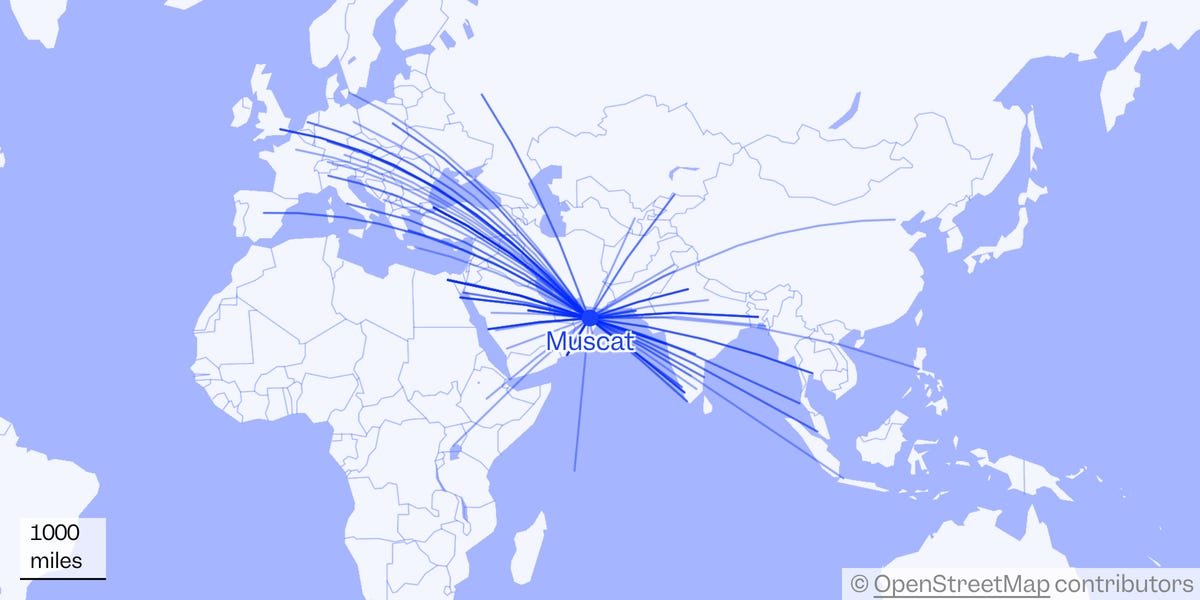


Muscat, Oman, has become the temporary center of Middle Eastern aviation after air travel was thrown into disarray by the US and Israel’s strikes on Iran last Saturday.
While most Gulf countries have closed their airspace, Oman’s has remained open. Airlines and governments have therefore been using it as a hub to help people get home.
Italy and Slovenia organised buses to help their citizens travel from the UAE to Muscat, about a five-hour drive.
However, demand is pushing some infrastructure to its limits. On Wednesday, Oman Air told passengers to arrive at the land-border crossing 12 hours before their flight’s departure.
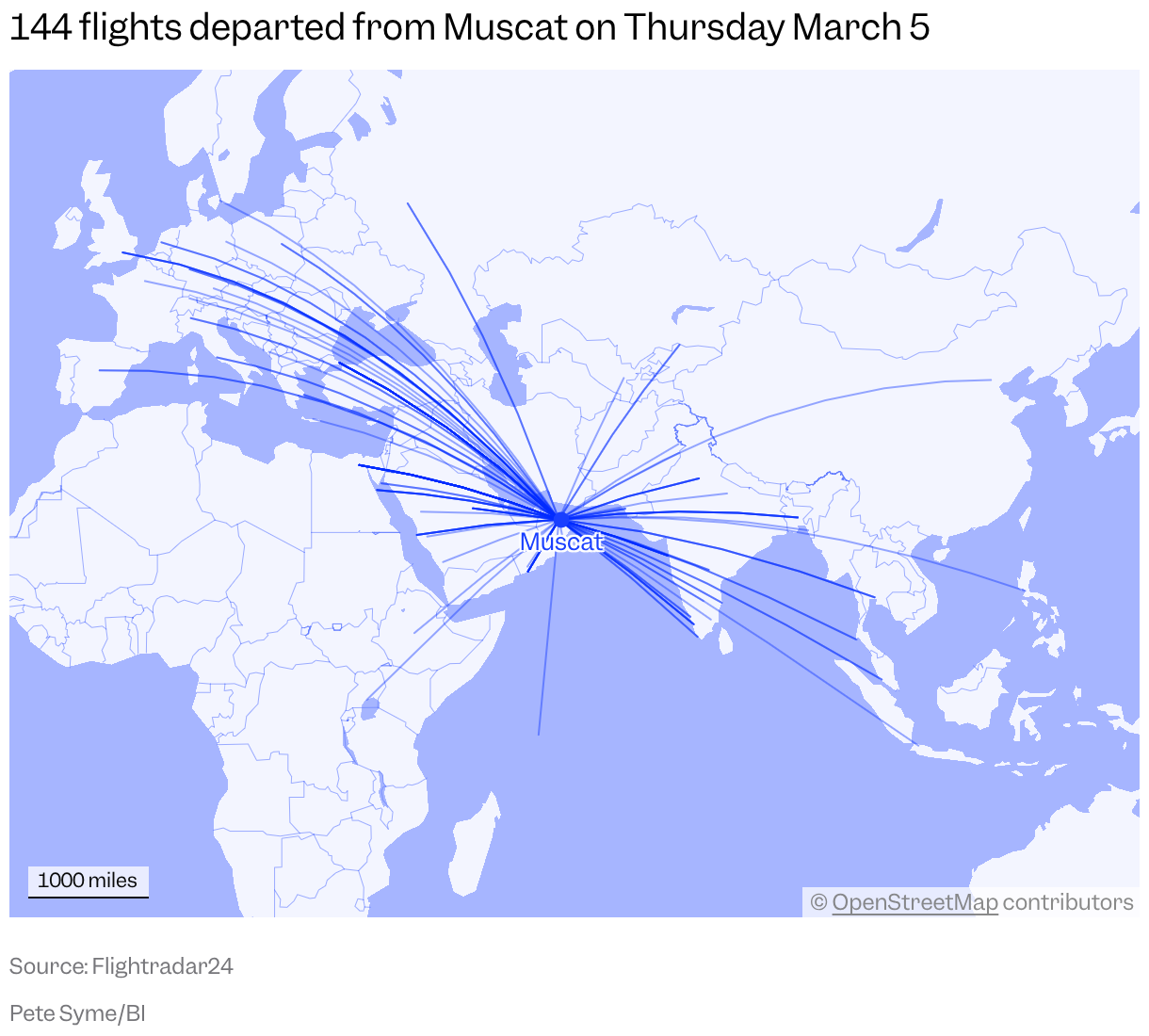
144 flights departed from Muscat on Thursday, compared to 125 a week earlier, according to data from Flightradar24.
The flight-tracking service also said that private aircraft account for nearly one-third of takeoffs and landings.
Business Insider created three maps that show how Muscat International Airport has grown in significance in the past seven days.
While the data listed another 10 takeoffs on February 26, these have been excluded because they returned directly to Muscat.
Flights from the Omani capital arrived in 20 new destinations on Thursday compared to a week earlier.

Previously, Dubai and Salalah, Oman, were the most popular destinations for flights departing Muscat. But on Thursday, it was Cairo and Istanbul. The Egyptian capital rose from four flights to 15, and the Turkish capital from two flights to 12.
From these cities, it is easier for passengers to find connections across the world.

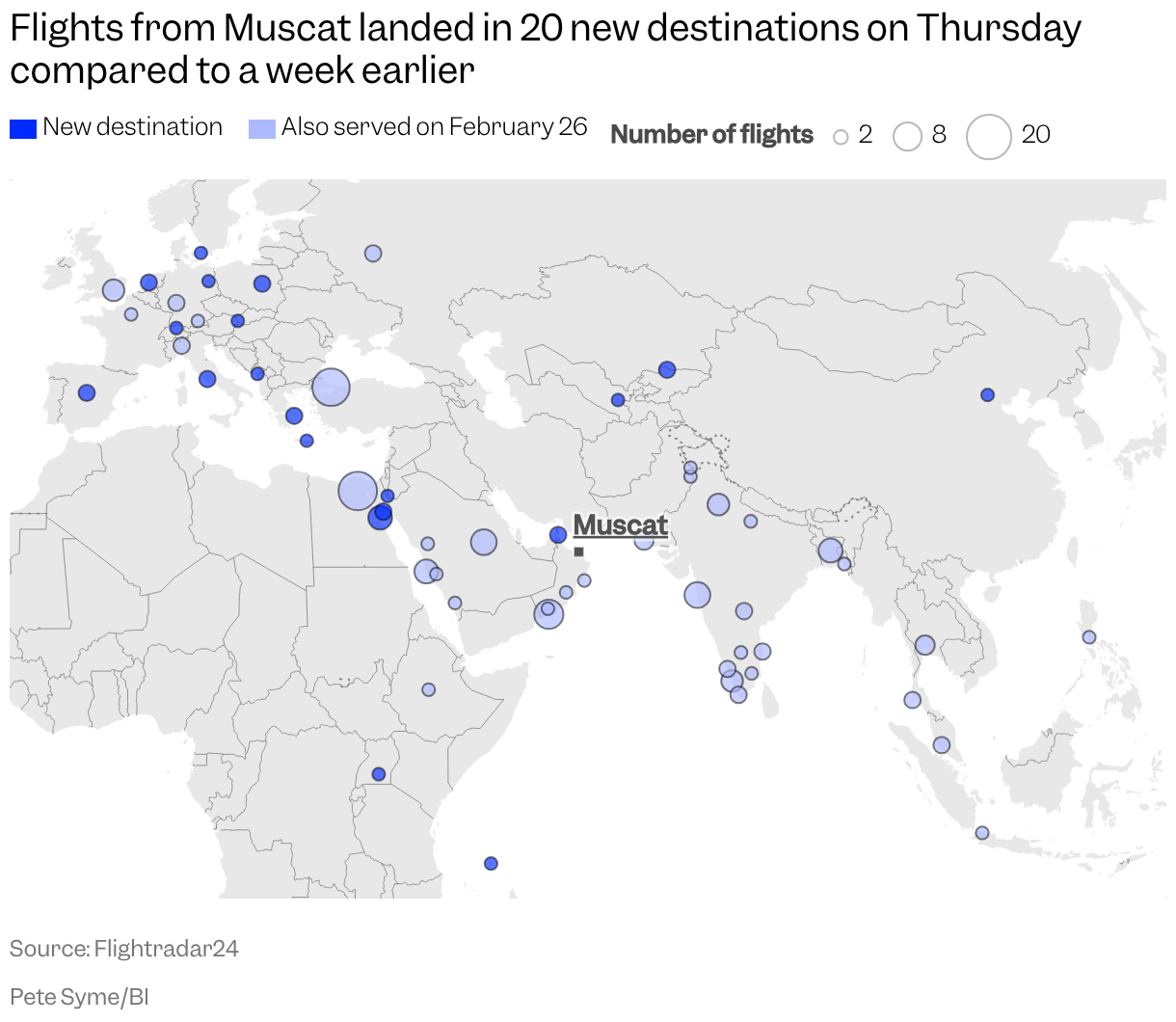
Indeed, 12 of the 144 flights made only brief stops before continuing to Europe.
For example, the maps only depict the first leg of Austrian Airlines’ special flight to Riyadh, before it later arrived in Vienna.
An Airbus A320 chartered by the British government stopped in Cairo before reaching London. Slovenia also chartered a plane, which went to Jordan, then continued to Ljubljana. And the Czech airline Smartwings operated three flights that stopped in Hurghada, Egypt, then went on to Oslo.
Airlines are also operating direct flights to support repatriation efforts.
British Airways, which doesn’t usually serve the country, has flown from Muscat to London three times this week. Qatar Airways is also operating flights from Muscat while its home airspace is closed. Six of its airplanes departed the Omani capital on Thursday, flying to Madrid, Rome, Copenhagen, Amsterdam, Berlin, and London.
Oman Airports said Thursday that it is “well-positioned” to support airlines because it operates 24 hours a day and has no constraints on the number of takeoffs and landings. It added that, for new airlines, it will help “facilitate and expedite regulatory approvals wherever possible.”
Thanks to its geography and wealth, the Middle East region is a major travel hub. Its main airlines — Qatar Airways, Abu Dhabi’s Etihad Airways, and Dubai’s Emirates — have helped boost tourism while connecting travelers from across the world.
With some 95 million passengers, Dubai International Airport was last year the world’s busiest for international traffic and the second-busiest overall, behind only Atlanta. By contrast, Muscat handled around 12 million passengers in 2025.
The UAE has partially reopened its airspace, but flights are still strictly limited. Dubai International is operating at about a fourth of its typical level, according to Flightradar24.
However, Emirates said Friday that it “anticipates a return to 100% of its network within the coming days.”
Like the other Gulf states, Oman is home to some US military bases. However, Oman maintains friendlier relations with Iran than its neighbors do. It has helped mediate talks between Iran and other countries.
While an Omani port was hit by Iranian drones on Tuesday, Iran’s foreign minister Abbas Araghchi said this “was not our choice” because military units are “independent and somewhat isolated.”
Read the full article here