






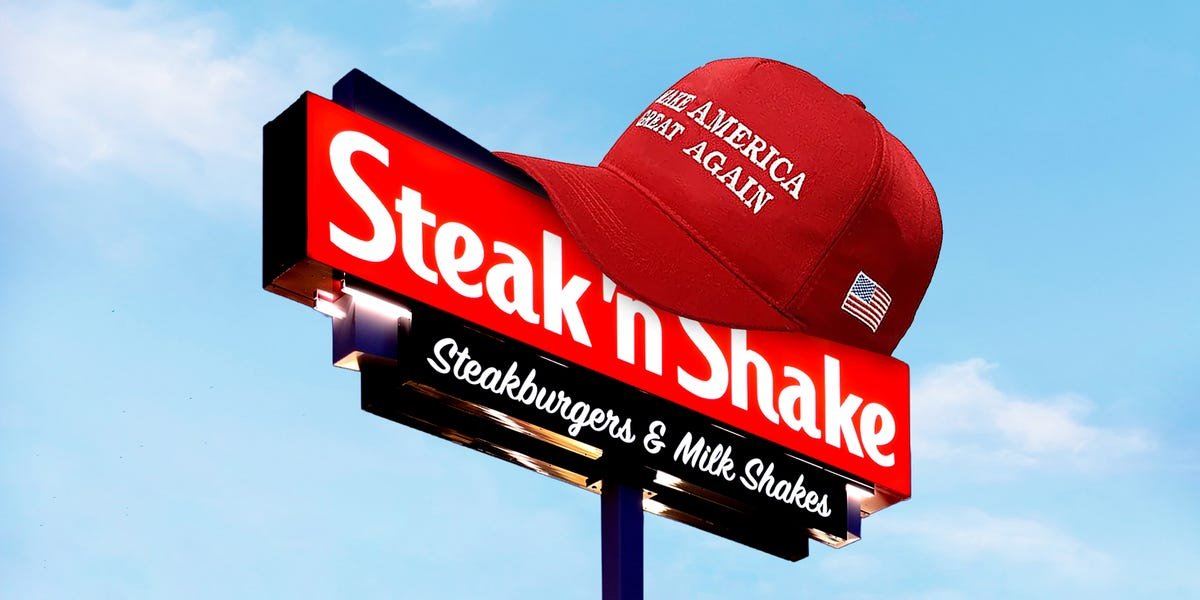


There’s something going on at Steak ‘n Shake lately. It’s put up giant American flags and axed microwaves. Its pinned tweet is a picture of Health and Human Services Secretary Robert F. Kennedy Jr. Judging by the fast-food chain’s social media, it’s really into beef tallow. It celebrates a special dubbed “Tesla Tallow Tuesday” from 2:22 pm to 4:20 pm each week and teases plans for tallow soap. It’s very excited about its tots fried in tallow.
Steak ‘n Shake is embracing the Make America Healthy Again agenda and making an outwardly Make America Great Again turn.
In an era where many brands are trying to steer clear of politics lest they poke any partisan bears, Steak ‘n Shake is diving in. The small — and struggling — regional chain is openly courting the Trump coalition in what appears to be more than a political stunt. The company says the strategy is working.
To understand where Steak ‘n Shake is headed, you have to understand where it’s been, which, over the past decade, is nowhere particularly good.
Iranian-American entrepreneur and activist investor Sardar Biglari took over the Midwestern restaurant chain after a proxy fight in 2008. At the time of the acquisition, Biglari often says, Steak ‘n Shake was losing $100,000 a day. The new owner quickly implemented an aggressive discounting strategy, including a “4 under $4” meal promotion, which Biglari says helped the company hit $100,000 in daily earnings by 2009. Courting the value-focused customer worked — until it didn’t. Sales started to drop in 2016. Steak ‘n Shake slashed the number of stores from a peak of over 600 in 2018 to around 400 today. It narrowly avoided bankruptcy in 2021.
“A lot of it was the pandemic, but they also were running into significant financial challenges at the restaurant level because they had this heavy discount focus,” says Jonathan Maze, the editor in chief of Restaurant Business Magazine.
A lot of what you’re seeing is the simple fact that they started marketing better.
Steak ‘n Shake had to go looking for other ideas. Some of these were operational: The chain replaced table service with a model focused on self-order kiosks and drive-thru, and reduced operating hours and menu items. It overhauled its franchise setup to look more like Chick-fil-A’s, prioritizing a super-selective approach that requires a low fee from franchisees but a high level of commitment.
Then, in the wake of Donald Trump’s election and the rise of RFK’s MAHA push, Steak ‘n Shake found another tactic: lean to the right. It announced it would switch to cooking with beef tallow at all its restaurants at the start of 2025, aligning itself with MAHA’s anti-seed-oil movement. In line with the HHS secretary’s preference for whole, unprocessed foods, Steak ‘n Shake changed the milk and butter it uses and began offering bottled Coca-Cola made with cane sugar on its menu.
Every time Emily publishes a story, you’ll get an alert straight to your inbox!
Stay connected to Emily and get more of their work as it publishes.
“America deserves the best!” the company said in an X post announcing the soda decision in July. “We continue on our MAHA journey…” Atop its X account is a pinned post from Kennedy’s visit to one of its restaurants.
“Having a strategy that is focused on quality, whether you agree with it or not, is a good thing,” Maze says. “A lot of what you’re seeing is the simple fact that they started marketing better.”
Steak ‘n Shake has also put itself in the news with some not-so-food-focused attempts to appeal to a Trump-y-ish base. The chain embraced bitcoin, accepting it for payments, giving it to customers as a reward for buying meal deals, and paying employees a 21-cent-per-hour “bitcoin bonus.” It’s tried to get the attention of Elon Musk fans by offering perks to Tesla owners, and it has pledged $1,000 contributions to the “Trump Accounts” of its employees.
Will Reeves, the founder and CEO of Fold, a bitcoin rewards app that’s worked with Steak ‘n Shake, tells me the push into crypto isn’t about adding a new payment method but about appealing to the community. “It’s more of a cultural zeitgeist that they’re tapping into, and this is why they’ve really embraced it comprehensively,” he says.
—
Steak ‘n Shake says that its strategy is paying off. Its same-store sales increased by 10.2% in 2025, per a regulatory filing from its parent company, Biglari Holdings. At the start of March, the company said on X that same-store sales are up 15% year to date in 2026, though it’s unclear exactly what time period they were comparing them to.
In an annual letter to Biglari Holdings shareholders, Biglari called Steak ‘n Shake’s performance “the biggest story of the year” for the company. “Many of the company’s goals, the foundation for which was laid in 2020, came to fruition in 2025,” he wrote, citing a reconstructed management team and new mission and energy. “By revitalizing Steak ‘n Shake, we made it relatable to a new generation that is itself faster paced, more mobile, and keenly interested in quality.”
On social media, Steak ‘n Shake thanked bitcoiners and MAHA for its performance.
Third-party evaluators of the company’s performance also paint a solid, if more complicated, picture. Data from location intelligence firm Placer.ai shows average per-location visits to Steak ‘n Shake were up by 3.6% in 2025 compared to the year before, outperforming much of the broader quick-service burger restaurant category. However, they’re still 25.4% below 2019 levels.
“We attribute this to the chain’s strategic shift toward smaller-format, capital-efficient spaces focused on self-service kiosks and drive-thru operations,” says RJ Hottovy, head of analytical research at Placer.ai. In other words, more people can visit because the restaurants’ layouts move customers through quickly.
When you break down what Steak ‘n Shake is doing, it’s relatively straightforward: It’s making a play for a quite specific group of people.
“That’s good marketing, OK? Go after a particular niche if you can,” says John Gordon, a restaurant analyst in San Diego.
Steak ‘n Shake is small enough that it can afford to pick a side. It’s geographically concentrated in the Midwest and South, where it may find a friendlier customer base for its politics. McDonald’s, for example, couldn’t replicate this type of strategy. With restaurants in Midtown Manhattan, rural Alabama, and dozens of countries around the globe, it has to be all things to all people.
It also helps that one man has a lot of influence over the chain, rather than a swath of investors or public shareholders. Biglari, who controls a majority stake in Steak ‘n Shake’s parent company, has donated to Trump in the past. Maxim magazine, which Biglari owns, endorsed the president’s reelection campaign in 2024. Biglari is clearly comfortable with an antagonistic stance, whether as part of his ongoing proxy campaign against Cracker Barrel or refusing to do earnings calls.
“It’s a weird company,” Maze says of Biglari Holdings. “It always has been.”
There are, of course, some complicating factors. Double-digit growth looks impressive when you’re digging out of a deep hole. Again, Steak ‘n Shake has closed a third of its stores over the past several years. It’s coming from a weak place, and it has less to lose if some consumers sour on its stances, as long as it can capture others.
Gordon warns that not everything about Steak ‘n Shake’s MAHA-heavy strategy is genius. It’s moving toward high-quality grass-fed beef at a moment when beef prices are through the roof.
“The beef market is at its absolute worst right now in probably 40 years, and that will take some time to work itself out,” he says.
Steak ‘n Shake is walking intentionally into politics, not stumbling.
While you can make the argument that many of Steak ‘n Shake’s food-related maneuvers are about quality, you can’t say the same about Tesla or bitcoin. There are about 3 million Teslas on the road in the US right now, compared to 40 million Fords, and Tesla vehicles are generally concentrated on the coasts. In making an overture to a small group of Musk fans and Tesla owners, Steak ‘n Shake risks turning off others. As for bitcoin … nobody should really be buying a burger with bitcoin. (Remember the guy who bought pizza with bitcoin in 2010 and came to regret it?) The price fluctuates so much that you may regret not holding onto the currency if it shoots back up again. And paying for goods and services with bitcoin is a taxable event — your Steak ‘n Shake milkshake purchase has to be reported to the IRS.
Instead, Tesla and bitcoin are about Steak ‘n Shake’s overall vibe shift. Any self-respecting bitcoin bro won’t actually pay for their meal with bitcoin, but maybe they’ll go to Steak ‘n Shake just because they’re into its overall schtick.
Steak ‘n Shake did not respond to requests for comment for this story.
As much as American businesses are often thrust into political debates, they would, as a general rule, prefer to avoid them. That’s become especially true in the Trump era, when companies risk not only alienating customers but also incurring the White House’s wrath.
Multiple brands have tripped into messy political controversies over the years, from Bud Light in 2023 to whatever happened last year with Cracker Barrel. For some brands, taking a stance pays off — look at Nike or Patagonia. But other times, it doesn’t. Starbucks has done all sorts of somersaults to undo some of its past progressive turns. Most people just want to shop where they shop without politics coming into play at all. Maybe you’re mad at Target because of how it does or doesn’t celebrate Pride Month, but are you really going to drive across town just to shop at Walmart instead? Products targeted at partisan audiences — from e-commerce platforms to beers to ETFs — generally stay small or fail.
Steak ‘n Shake is walking intentionally into politics, not stumbling. Most brands can’t follow suit, nor do customers want them to. And whether that works at scale or lasts beyond the current moment is unclear. But also, the word is that beef tallow fries are pretty delicious, whether they’re RFK-approved or not.
Emily Stewart is a senior correspondent at Business Insider, writing about business and the economy.
Business Insider’s Discourse stories provide perspectives on the day’s most pressing issues, informed by analysis, reporting, and expertise.
Read the full article here