







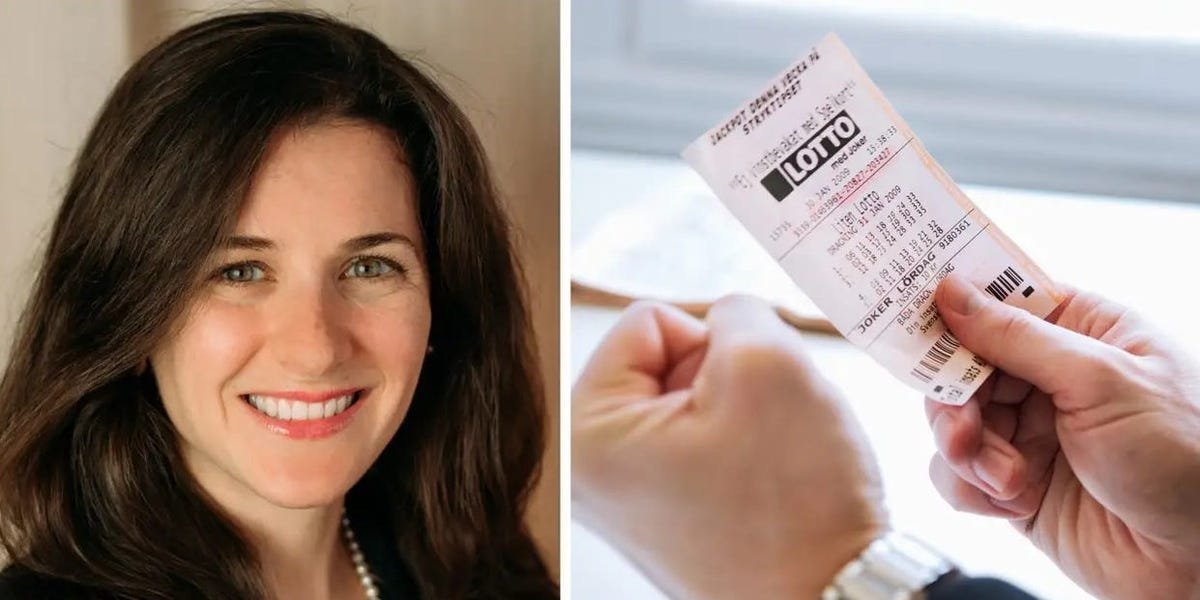


Households across the US will be awaiting Monday night’s Powerball drawing with fingers crossed, hoping it will deliver a life-changing windfall.
Players have a shot at the fifth-largest jackpot in US history — an estimated $1.6 billion.
Match all six numbers and the winner faces a huge decision from the offset: opting for an annuitized prize estimated at $1.6 billion paid out over 30 years, or taking a lump sum payment of about $735.3 million instead.
That choice is just one of many lottery winners must make, often with little to no support.
“Many people tend to overlook this, but after winning the lottery, you’re essentially on your own,” Emily Irwin, a Wells Fargo advisor who guides lottery winners on how to spend their money, told Business Insider in a 2023 interview.
Here’s what Irwin recommends if you beat the 1 in 292.2 million odds and end up holding Monday’s winning Powerball ticket.
Should you choose lump sum or an annuity?
Irwin told Business Insider that this decision should hinge on two factors: the financial implications, mostly around tax, and how you personally tend to handle money.
“If you consider the financial and tax side, taking the lump sum is often advantageous,” she said. “While you may face higher up-front income taxes, you gain greater long-term control over how your money is invested, and you have immediate access to your funds.”
Annuity payments, by contrast, tend to spread out over decades. In the case of Powerball, winners receive one immediate payment followed by 29 annual payments that increase by 5% each year.
“The advantage here is that it provides peace of mind,” Irwin said. “If you’re the sort of person who has a dollar in your pocket and you’re going to spend $1.50, having that annuity and the guarantee over three decades can be a reassuring safety net.”
For lottery winners, a team of advisors is key
Because lottery winners are often left to their own devices, Irwin recommends assembling a team of advisors as soon as possible. The team, she said, should include an attorney, an accountant, an investment advisor, and a philanthropic advisor.
“It’s not as straightforward as flipping through the yellow pages and randomly selecting somebody,” she said. “You must carefully consider experts specializing in high-net-worth and ultra-high-net-worth tax planning.”
Irwin also suggested interviewing several candidates for each role to make sure the relationship is a good fit, since winners will often be working with these advisors for years.
What should you do with lottery money?
“I think having a diversified portfolio and reviewing it with your financial and investment advisors is very important,” Irwin said.
“Typically, we see some mixture of short-term available assets immediately, such as cash or cash equivalents, along with more traditional investments in stocks and bonds,” she added.
Real estate is another common investment, Irwin said, but winners should fully understand the risk and costs that come with it.
She said buyers should think about whether they plan to pay for property in cash or by taking on financing, how much of their overall portfolio the purchase would take up, and whether they have the cash flow to support it.
“What I would say is to look at these decisions holistically because owning real estate brings carrying costs, including property taxes, maintenance costs, and potentially hiring property management companies — expenses you may not be used to having,” Irwin said.
Before lottery winners start spending, Irwin suggested that they should think about paying off any debt they might have, which includes paying off student loans and mortgages. “Most individuals find peace of mind and financial stability in having a clean balance sheet, as well as some financial uptick,” she said.
Who should you tell if you win the lottery?
“One of the things we think about with mega-lottery-winners is making sure that they can collect their winnings in a way that keeps them anonymous and can, in turn, provide safety,” Irwin said.
That can mean keeping spending low-key at first, rather than making highly visible purchases such as multimillion-dollar homes or private jets.
Irwin also warned that winners should think about how they communicate their win to family and friends. “Lottery winners frequently encounter requests from friends, family, and various organizations, and without proper guidance it can be challenging to navigate these conversations,” she said.
Learning how to say no gracefully is essential, she added, and in some cases winners may even benefit from working with a coach who specialises in family dynamics.
Avoid overspending, no matter how tempting
Irwin’s biggest piece of advice is for lottery winners to keep the urge to overspend in check.
“People see six zeros, nine zeros, or even 10 zeros in their bank account, and they think it’s not possible for them to spend all of that,” she said. “But it is certainly possible if you buy five $50 million homes, and buy a private jet.”
Once spending ramps up, so too do expenditures, and then balances can fall just fast, she said.
“It’s easy to spend your money quickly,” Irwin said, “so spend it wisely.”
Read the full article here