









Workers leave Big Tech for OpenAI. They fan out across a growing ecosystem of startups. Rinse and repeat.
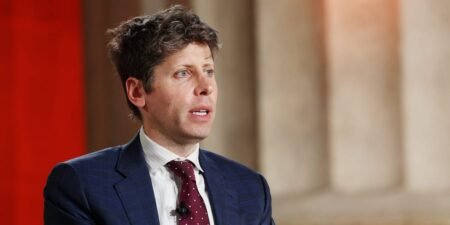
Since it launched ChatGPT, the Sam Altman-led company has quickly become a magnet for AI talent. It has pulled hundreds of researchers and engineers from competitors like Google, Meta, and Apple, according to data reviewed by Business Insider. After sticking around for a while, many of those employees go on to found or join rival startups of their own.
The company has nearly quadrupled in size since its chatbot took off in 2023, scaling from a small research lab of around 1,000 employees to a tech company with more than 4,000 workers.
To get a sense of how OpenAI is faring in the race for AI talent, Business Insider analyzed findings from workforce intelligence provider Live Data Technologies, which used LinkedIn to track the comings and goings of around 1,300 employees from January 2023 to March 2026.
Live Data Technologies analyzed publicly available professional profile data for OpenAI employees who had available information on previous employers. The roles analyzed ranged from engineering and research to product, human resources, and recruiting.
Representatives for OpenAI didn’t respond to a request for comment.
The company’s hiring pipeline is highly concentrated
OpenAI was originally founded by Altman and Elon Musk in 2015 to compete with Google’s DeepMind AI lab.
Now, Google is the No. 1 source of talent for OpenAI, accounting for roughly a quarter of hires, according to the data.
Nearly half of OpenAI hires in the last three years came from either Google, Meta, Apple, or Microsoft.
Apple’s Jony Ive joined OpenAI last summer to work on a new AI device. The project encompasses around 300 workers, many of whom came from Apple, The Information reported earlier this year.
The company has also made several high-profile hires over the past year, including Slack CEO Denise Dresser, OpenClaw founder Peter Steinberger, and Instacart CEO Fidji Simo.
Since 2023, OpenAI has added roughly four times as many engineers as it has lost, highlighting the company’s rapid expansion as the AI race intensifies.
The battle for AI talent has become one of Silicon Valley’s fiercest. Big Tech companies are aggressively competing for a relatively small pool of researchers capable of building advanced AI systems.
Meta CEO Mark Zuckerberg has reportedly taken a hands-on role in recruiting top AI employees, while Meta and other companies have reportedly offered massive compensation packages, sometimes valued in the tens and hundreds of millions of dollars in stock.
OpenAI is known for its high compensation packages. The Wall Street Journal reported last year that its employees receive an average of $1.5 million in stock-based compensation. Public salary data from H-1B visa applications shows that research scientists at the AI venture have salaries ranging from $245,000 to $685,000, while engineering roles are listed with a range of $165,000 to $290,000.
Where employees go after OpenAI tells a different story
Departures are fragmented, spreading across more than 150 different companies, including competitors like Meta, Anthropic, and emerging labs such as Thinking Machines Lab, according to the data. The majority of OpenAI employees left for smaller startups, venture capital firms, or academia, according to the data.
The data suggests OpenAI has become a centerpiece in the AI talent network, pulling researchers from Big Tech and sending alumni across the startup and VC ecosystem.
Only a handful of companies received more than 15 OpenAI alumni in the last three years: Anthropic, Meta, Google, and Thinking Machines Lab, the data shows.
Anthropic is perhaps the best-known example. It was founded by former OpenAI researchers, including siblings Dario and Daniela Amodei. VP of Research Max Schwarzer left OpenAI for Anthropic earlier this month.
Meanwhile, several OpenAI employees who left the company to help found Thinking Machine Labs in February, including Barret Zoph, rejoined OpenAI earlier this year.
Common roles at OpenAI include engineering and research, the data shows. The average tenure for US-based OpenAI employees is around 16 months.
Do you work for OpenAI or have a tip? Contact this reporter via email at gkay@businessinsider.com or Signal at 248-894-6012. Use a personal email address, a nonwork device, and nonwork WiFi; here’s our guide to sharing information securely.
Read the full article here