





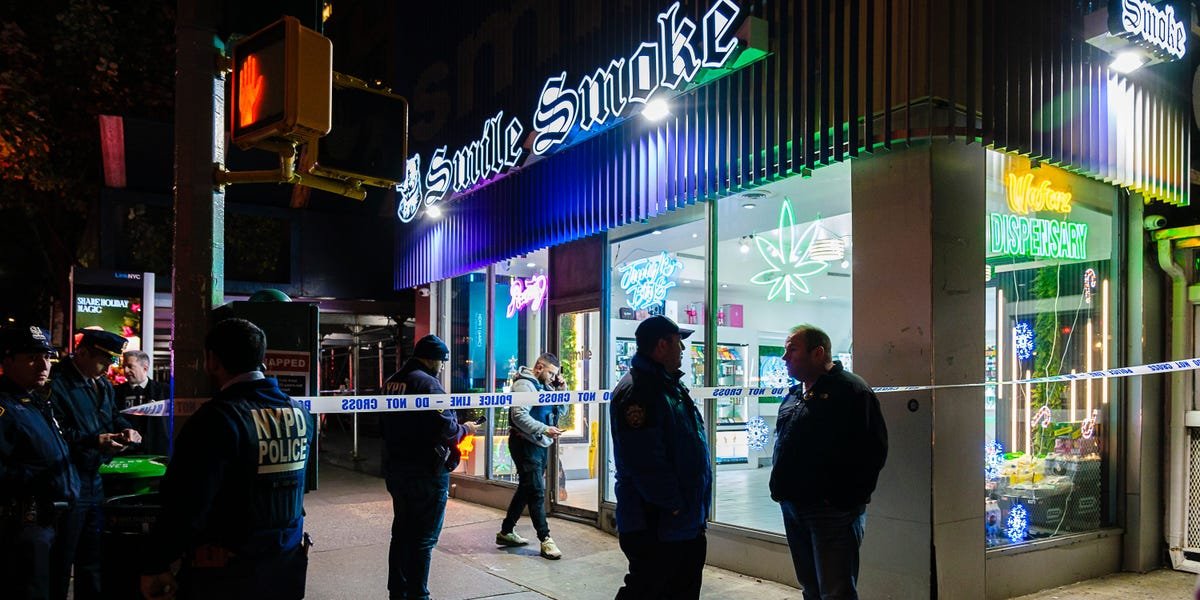


On May 28, 2024, Lenore Elfand, the owner of Empire Cannabis Club, an unlicensed dispensary in New York’s Chelsea neighborhood, received a frantic call from an employee. NYPD officers and deputies from the city’s Sheriff’s Office were lined up at the door, poised to raid the shop. Elfand said in an affidavit that when her security guard insisted on filming, officers placed him in handcuffs, killed the security cameras, and stormed in.
Elfand arrived 15 minutes later to find news crews interviewing New York City Sheriff Anthony Miranda, who was monitoring the raid. Inside, officers gathered products they suspected to contain THC and carried them away, Elfand said in a deposition. Her security guard was detained without charges for 30 hours. When she was given paperwork to sign, she wrote, the invoice “had no actual documentation of what they took.” More troubling was an omission: more than $10,000 in cash that she said officers removed from her store and that she never got back. Her claims were part of a larger suit on behalf of several cannabis merchants, in which a judge found that the Sheriff’s Office violated the shop owners’ constitutional rights.
Weed, now legal for medical use in 40 states and fully legal in 24, has become one of the most ascendant industries in America. Cannabis retail sales nationwide have tripled since 2019, to a projected $34 billion this year. Now Big Weed is poised to get even bigger. Last week, President Donald Trump signed an executive order to expedite reclassifying cannabis from a Schedule I drug (the same designation as heroin and LSD) to a less dangerous Schedule III drug (like ketamine or Tylenol with codeine). The order doesn’t legalize marijuana, but paves the way for further research into its potential benefits and for tax breaks for cannabis companies.
But building a successful business in a newly legal industry can be chaotic. And one place especially tumultuous has been in America’s largest city.
After New York State legalized marijuana in 2021, the state-approved industry was slow to materialize. As demand surged, hundreds of opportunistic merchants opened shop without licenses. At one point, The New York Times reported, they outnumbered Starbucks locations. Many were cash-only — making them prime targets for robberies. Teens loitered outside them, passing around medicinal-strength doobies they had purchased without any hassle. And the smell was everywhere: parks, playgrounds, even the steps of the Met — all wafted with dank clouds of ganja.
In 2024, after a public outcry, Gov. Kathy Hochul granted Mayor Eric Adams the authority to launch Operation Padlock to Protect. It was a sprawling deployment of K-9 units, SWAT vehicles, and officers in tactical gear to raid illegal weed stores, confiscate inventory, strap the merchants with debilitating fines, and potentially shutter them for as long as a year. The mayor heralded the dragnet as a rousing success. By City Hall’s estimate, $95 million worth of cannabis products from the unlicensed sellers were seized.
For Elfand and other operators of unlicensed shops throughout New York, Operation Padlock to Protect has been a nightmare, largely at the discretion of the sheriff. An ex-cop with a gleaming pate, a horseshoe mustache, and a love for TV cameras, Miranda has been the subject of a Department of Investigation probe, three pending federal lawsuits, and a raft of complaints by the union representing his deputies — dozens of whom have reportedly quit.
The mayor and his office have stood by Miranda and the operation. “Over the last four years, Mayor Adams has prioritized building a safe, well-regulated cannabis industry,” a City Hall spokesperson wrote in a statement to Business Insider in response to questions for this article. “To date, the team has sealed more than 1,600 illegal shops, marking a major step toward protecting communities from dangerous, unregulated products and strengthening a responsible legal market. This progress would not have been possible without Sheriff Miranda’s leadership and his commitment to a safer, more equitable, and business-positive city.” Miranda himself didn’t comment to Business Insider.
Miranda and Adams are both ex-cops who agitated for racial justice in the NYPD through organizations they founded: the National Latino Officers Association and 100 Blacks in Law Enforcement Who Care, respectively. Miranda’s group endorsed Adams in 2021 and he made Miranda sheriff when he was elected.
Unlicensed weed shops were already proliferating when Adams appointed Miranda to take over at the Sheriff’s Office, which falls under the city’s Department of Finance and enforces court orders, property seizures, and cigarette licensing and taxation.
When then-Gov. Andrew Cuomo — who once called marijuana a “gateway drug” — legalized the plant in 2021, he let New Yorkers smoke it wherever they were allowed to smoke cigarettes, a far more permissive provision than California, Colorado, and Massachusetts, which require smokers to be on private property. As people were getting their first COVID vaccines and venturing back into public life, suddenly it was legal to take a bong rip on Fifth Avenue.
Cuomo also launched a framework for allowing the licensed sale of weed. Critics say the rollout was slow and prohibitive; the state, for example, set aside the first licenses for people who had cannabis convictions. By June 2023, just 15 licensed dispensaries had opened in the city. By comparison, Colorado had 200 in the first six months of legalization. As the city of 8 million yearned to burn, delis and bodegas began slinging THC products from behind the counter. Seemingly overnight, it became possible to buy a joint along with an egg sandwich in the morning. Soon, stores opened for the sole purpose of selling cannabis without a license. They were neon-lit and decorated with posters of stoned cartoon characters. They had names like Best Budz, Cannabis Culture, Flame Zone, Puff & Pass, Zaza City, Zaza Land, and Zaza Waza Smoke Shop.
And with them came concerns: The inventory was unregulated and might not be safe, and the stores were magnets for crime. In 2022, there were 593 robberies of smoke shops, a fourfold increase from 2021.
As the greenrush overtook New York City, the Sheriff’s Office scrambled to convince the public that it had control of the situation. After Miranda’s office began inspections in September 2022, deputies reportedly found they were seizing more evidence than could fit in their six shipping containers. Their Queens headquarters had so much weed that employees reported breathing problems. The union, which said one deputy was coughing up blood, filed labor complaints.
Miranda’s employees also began to question whether they had legal authority to raid the merchants. Eleven deputies who raised concerns about the cannabis raids were suspended on allegations of stealing alcohol seized from bars raided during the pandemic. They were never criminally charged. Nine resigned, and two were found not guilty in an administrative trial.
The Sheriff’s Office’s Queens headquarters had so much weed that employees reported breathing problems.
In a federal lawsuit which is still in litigation, Deputy Sheriff Furney Canteen alleged that when he raised these concerns, the sheriff withheld his pay and transferred him to a punishing assignment. “You’re a soldier and your job is to follow orders,” Miranda told him, according to the complaint. When Canteen responded that his job was to follow legal orders, the lawsuit alleges, the sheriff responded sarcastically, “I’ll check on that and get back to you.”
Until 2024, the raids had little teeth. Even after deputies confiscated shops’ inventory, the unlicensed operators who received fines often ignored them and went right back to selling weed.
In April 2024, Gov. Kathy Hochul gave Adams and Miranda an assist: The city would have the right to fine landlords renting to unlicensed weed stores, and the sheriff could padlock any business selling unlicensed cannabis. “We waited far too long for this reckoning with all the illegal shops and your day has come,” Hochul declared at a press conference.
Three weeks later, Adams launched Operation Padlock to Protect with a fury. The Sheriff’s Office conducted hundreds of raids — which via Hochul’s initiative did not require warrants — in tandem with the NYPD. They opened safes and cash registers, and removed tens of thousands of dollars in cash from locations across the city. They filled giant garbage bags with weed, THC oils, and edibles. Ingrid Siminovic, spokesperson for the sheriff’s union, claims that Miranda “forced” deputies to take safes.
Nadia Kahnauth, an attorney for more than 100 store owners who have been caught in Miranda’s net, told Business Insider that a total of more than $1 million was seized from her clients. She says that as of December 2025, fewer than five of them had recovered their seized cash.
At a City Council hearing last year, the lawyer testified that “in each and every location there is significant cash being removed from registers.” She added, “I have other stores where there’s $25,000 being removed — absolutely no documentation … and no method to recover all this money.”
Kahnauth said that at least 10 of her clients had received calls or visits from unidentified men who demanded donations to “Latino organizations” in exchange for protection from raids. One agreed to pay monthly and was raided and shut down after missing an installment, she said. The merchants, who are immigrants, would not speak on the record out of fear of retaliation, she said.
Among those caught in Miranda’s dragnet was Tyler Lehmann. He was the president of the Breckenridge Cannabis Cafe in Williamsburg, which was licensed to sell hemp but not THC, when the Office of Cannabis Management (OCM) conducted a search in January 2024 and seized products its agents believed to contain cannabis, according to a lawsuit Lehman filed. The shop got an administrative hearing, and the violations were ultimately dismissed.
Eight months later, the Sheriff’s Office showed up.
A team of plain-clothed and uniformed officers in bulletproof vests barged in and searched behind the counter, security footage reviewed by Business Insider shows. Four officers found bottles of tinctures — a type of distillate that can contain THC, CBD, or a mixture of both — and poured them into a clear plastic cup. Once it was filled, an officer took the cup into the bathroom of the store and poured it down the toilet. After the raid, Lehmann received an Order to Cease Unlicensed Activity and a seizure notice that “THC Drinks” were removed from his store.
A deputy from Miranda’s Public Relations Bureau, Lt. Francesca Rosa claimed under oath in a state lawsuit against the Sheriff’s Office last year that “we are not required to test the product.” She said that during the raids, the teams decided if a product was illegal based on a review of its packaging and labeling. She also testified that she could smell which products contained THC — a feat that is not humanly possible.
Lehman’s attorney showed Rosa an order from a judge, who ruled after a hearing with the Office of Administrative Trials and Hearings (OATH) that the Sheriff’s Office “failed to establish the store posed an imminent threat” — allowing the store to reopen to sell non-cannabis products. But the Sheriff’s Office still decided that the store did pose an imminent threat, and kept it padlocked.
In October 2024, a Queens judge ruled that Operation Padlock to Protect was unconstitutional, and found Miranda’s enforcement to be “capricious and arbitrary.” City Hall appealed, and a decision from the state appeals court is pending. In a separate case, a federal judge ruled there was nothing unconstitutional about Miranda’s discretionary padlockings. The New York Post reviewed hundreds of pages of files from OATH hearings and found Miranda kept padlocks on nearly 30% of stores greenlit by a judge to reopen.
The manpower needed to orchestrate the raids required a drastic reorganization of the Sheriff’s Office. The office maxed out its overtime budget and billed the city millions more than it was allotted. Deputies were no longer able to fully attend to other responsibilities, according to a letter from New York City Comptroller Brad Lander to the City’s Department of Finance.
In June 2024, the union filed another complaint against Miranda with the Office of Collective Bargaining and punctuated it with a demand: The sheriff needed to resign.
In September 2024, the City Council summoned Miranda to a hearing on marijuana legalization and Operation Padlock to Protect.
In early December, Miranda sent an email imploring his employees to “address failures early and with clear direction.”
“In just a little over four months, the operation has conducted over 5,059 inspections,” Miranda testified. “The sheriff’s joint compliance task force has sealed 1,078 locations, seized over $67 million in illicit products, and issued $104 million in civil penalties.” Another statistic he dropped: Of the 1,124 padlock orders he issued, a judge threw out 208 of them, nearly 20%.
Days later, Miranda was back in the headlines with local media reporting a city Department of Investigation probe into the sheriff, reportedly into the claims of improper cash seizures and the alleged protection-money racket.
Reporters asked Adams if he still had confidence in Miranda. “He’s doing the job that New York is asking him to do,” the mayor said. “This guy has closed down 1,100 smoke shops. Got $78 million of illegal cannabis off of our streets, not in the hands of our children and families. And so, why would I not have confidence?” Hours later, Adams was hit with a federal indictment for alleged bribery — charges that would be dismissed after President Donald Trump took office.
On the same day of the indictment, the Department of Investigation was at the Sheriff’s Office — to collect tens of thousands of dollars that had been mysteriously discovered there. In a statement about this visit, City Hall said Miranda learned of “seemingly unvouchered cash held in safe boxes and self-reported the incident to his supervisors,” who called in investigators. The provenance of the money has not been revealed.
As the days passed, pressure on Miranda continued to mount. That October 2, DOI asked Kahnauth for the names of clients whose cash was seized during the sweeps. Two city councilmembers fired off a letter asking Miranda to square his testimony that his office did not seize cash with “subsequent public testimony and recent press coverage” suggesting it had. They asked for a reply by October 18.
“To the best of my knowledge, the Sheriff’s Office has not seized or vouchered any currency related to Operation Padlock to Protect; the NYPD is responsible for all seizures and vouchering of currency during the Operation,” Miranda wrote in a letter on November 1. A spokesperson for DOI declined to comment. Its probe is ongoing.
Following Zohran Mamdani’s historic election as mayor, the sheriff’s union took out a full-page ad in the New York Post featuring a picture of Miranda dressed as Woody from “Toy Story.”
“MAYOR-ELECT MAMDANI: YOUR NEW ADMINISTRATION NEEDS QUALIFIED LEADERS! SHADY SHERIFF ANTHONY MIRANDA IS NOT ONE OF THEM,” it blares above a mock resume listing: “No new contract negotiated with the union since 2022, 16 labor grievances, a hostile work environment, abuse of authority, tax liens and fines from the municipal government, lies to city council, retaliation against his employees, and civil rights violation lawsuits from approximately 40 smokes shops.”
It’s not clear whether the Mamdani transition team will keep Miranda on in his current role. In early December, the Sheriff sent a cryptic email that some deputies interpreted to mean his days might be numbered.
With the subject headline “Protect Your Standards,” Miranda implored his employees to “address failures early and with clear direction” and “set firm boundaries so no one pulls you into improper conduct.”
“One Final Thought,” Miranda wrote. “SILENCE AND TAKING NO ACTION IS ALSO A DECISION, AN ENABLING DECISION.”
Timmy Facciola reports on politics and striped bass at his Substack, The Judge Street Journal.
Business Insider’s Discourse stories provide perspectives on the day’s most pressing issues, informed by analysis, reporting, and expertise.
Read the full article here