







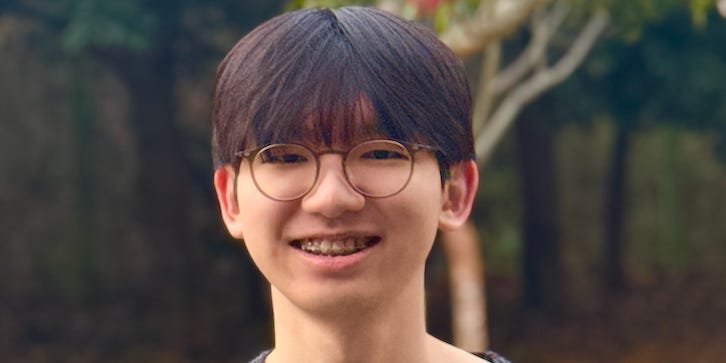


This as-told-to essay is based on a conversation with Alex Seungyong Yang, an 18-year-old high school senior, based in Seoul. The following has been edited for length and clarity.
As an incoming university freshman and the founder of an AI research startup, AI feels like a double-edged sword.
I started my AI research and development startup with other students around the world, and AI has been amazing for us. It’s allowed us to push further and think about achieving things we couldn’t have imagined. On the other hand, I’m pursuing a computer science major this fall, and I keep hearing that computer science jobs are being replaced by AI.
No one has explicitly told me that pursuing computer science is a complete waste of time, but many people around me have expressed concerns about the risks it entails. I think those concerns point to something valid.
Simply learning how to code no longer guarantees a stable or well-defined career path, but there are still many opportunities by staying within what I would call the “eye of the typhoon” and studying these machines, even if they are increasingly unpredictable.
A computer science degree will help me understand the changes in tech
From 2025 to 2026, the tech industry changed so much. Last year, there was still a broad sense of expansion and experimentation, startups, new tools, and huge model launches. Now, what feels dominant is resource concentration in capital, compute, and top talent, along with a narrowing focus on AI infrastructure.
This kind of acceleration makes it so that one year doesn’t feel like just a single year anymore. I think that computer science, engineering, and very technical majors are the only majors that can fully understand how this industry is changing and the direction of that change.
I think the important part of studying computer science isn’t about basic coding or programming; it’s understanding the logic behind it and the framework that can be applied anywhere, anytime, wherever we are with technology. It’s all about solving the problem, and I think that kind of talent is most relevant in the AI era.
Studying computer science will help me adapt more flexibly and with greater urgency in my career. I want to use the knowledge from my degree to develop a niche kind of talent rather than simply following a very conventional pathway and becoming another factory-made worker.
A computer science degree might help me become irreplaceable in the job market
Being unemployed or unable to find a job used to be the most obvious failure. Now, given how frequently unemployment is already happening around us, I don’t think it can even be considered the greatest failure anymore. To me, the biggest failure would be an inability to adapt, and if we become irrelevant as technology advances.
A small number of people or companies can now build and deploy things at a scale that used to require much larger organizations. Rather than only preparing for predefined roles, I spend time now and will continue to during my degree, building real systems, contributing to research, and working on projects where the constraints are unclear and the outcomes are uncertain.
I see my computer science degree as a way to build depth, judgment, and adaptability rather than just technical skills.
I don’t see this as a guaranteed strategy, and I’m still learning what truly matters, but I hope that developing this ability in specific domains matters the most. I’m in competition with AI, but it’s equally a competition with other people. I want to become an irreplaceable person, not just with AI, but also relative to other people.
The uncertainty motivates me more than scares me
Many peers around me who are pursuing computer science and working on startups believe this is actually the easiest era to start something and succeed. Some majors naturally keep people closer to the frontier of change. I believe studying computer science, engineering, or mathematics trains you to reason from first principles, work with abstraction, and stay comfortable with uncertainty.
Those habits matter more than any specific technical skills, which may quickly become outdated. Because the underlying skills are transferable, people in these fields may be better positioned to adapt when conditions change, even if the direction of change is unclear.
I’m excited to pursue computer science, even though it might be uncertain how it will turn out. Things may become more complex, demanding, and challenging than I can anticipate, but I still believe there will be abundant opportunities for those who are willing to adapt, go deep, and continuously redefine their value.
Do you have a story to share about higher education and AI? Contact this reporter, Agnes Applegate, at aapplegate@businessinsider.com.
Read the full article here