This story is available exclusively to Business Insider
subscribers. Become an Insider
and start reading now. Have an account? .
When your family asks why you didn’t find a new job this year, show them these charts.
It’s been a year full of milestones for the job market — but not the good kind.
Unemployment rates for 20-somethings hit their highest level in years.
Kanika Mohan lost count of her job applications.
With a new bachelor’s degree, a slate of summer tech internships, and years of networking at campus career fairs, she hadn’t expected getting a job to be this hard.
“I remember waking up every single day to at least a few rejection emails, and these emails have absolutely no personalization to them,” Mohan, 22, told Business Insider over the summer. “You can do three rounds of interviews, yet you’ll still get a very generic, ‘Sorry. You’re not a good fit.”‘
She eventually landed a role at a top tech company, but months of editing cover letters, prepping for interviews, and getting ghosted had been exhausting. And brutal job search experiences like hers aren’t an outlier — they’ve become the norm.
The job market in the US hit some major milestones this year. Unfortunately for the dozens of job seekers Business Insider has heard from, they weren’t the good kind. AI, economic uncertainty, and ashift toward employer power have been felt across the workforce.
Tyler Sorensonknows this all too well. The Gen Zer was so frustrated by limited job vacancies and slow replies to his online applications that he began leaving paper résumés at local businesses.
“I literally just had to walk into that store and hand them an actual résumé for them to even take a look at me,” he said in the summer. For him, that actually ended up yielding results: He was able to bypass the onslaught of AI applications and get directly to a human. It’s part of just how topsy-turvy the job hunt has become.
The economic situation has everyone feeling stuck: Companies are pulling back on hiring, while people with a steady paycheck are feeling too cautious to make a move. It’s culminating in a frozen job market — and Americans are feeling the chill.
The number of job openings for each unemployed person has tightened
Millions of people are struggling to get a job — the unemployment rate as of November is the highest since 2021. Meanwhile, job openings have cooled off 37% from their high point in 2022.
“This job market is terrifying,” Hilary Nordland, a Gen X job seeker told Business Insider over the summer. “It’s a black hole that makes you question everything — and I don’t see a clear path through.”
The number of job openings for each unemployed person has come way down over the past few years — from two openings per unemployed person in 2022 to one this past September. The number of people unemployed briefly surpassed job opportunities in July and August, which hasn’t happened since the economic disruptions caused by the pandemic in 2020 and 2021.
“Job growth has been very slow over the course of 2025, and it doesn’t seem like we’ve turned around quite yet to translate the pent-up demand for hiring and the recent increase in job openings into actual hires,” Nicole Bachaud, an economist at ZipRecruiter, said.
The ‘Big Stay’ intensified
In 2023, Business Insider wrote about how the Great Resignation, where many workers were switching into new roles amid robust options, was pivoting into the Big Stay, where more workers would keep their jobs, whether they wanted to or not.
That shift became clearer in 2024 and persisted in 2025. The quits rate fell to 1.8% this past October, the lowest since May 2020.
The quits rate provides a good indicator of how confident workers feel about being able to transition to a new employer. The low rate means workers likely don’t see many new opportunities.
“When we look at the fact that inflation is still strong, wage growth is cooling in respect to inflation, a lot of workers are maybe thinking a steady paycheck, whether it’s my ideal job or not, is better than the risk of me going for something else because there’s not a lot of something else out there,” Bachaud said.
The job switcher wage premium evaporated from Great Resignation highs
Over the past few years, wage growth for job switchers had far outpaced that of their colleagues holding tight; at the peak of the Great Resignation, job switchers’ paychecks were benefiting from major premiums.
But in 2025, the job switcher wage growth came down to earth, and then some. In the back half of the year, job stayers and job switchers have duked it out for who’s seeing larger wage growth — a marked contrast to the larger paychecks companies dangled over potential job hoppers just a few years ago.
That’s not necessarily great news for job stayers, though. On the whole, wage growth tempered for both groups, meaning less ample raises. And it’s another indicator that job market power has slipped back into the hands of employers.
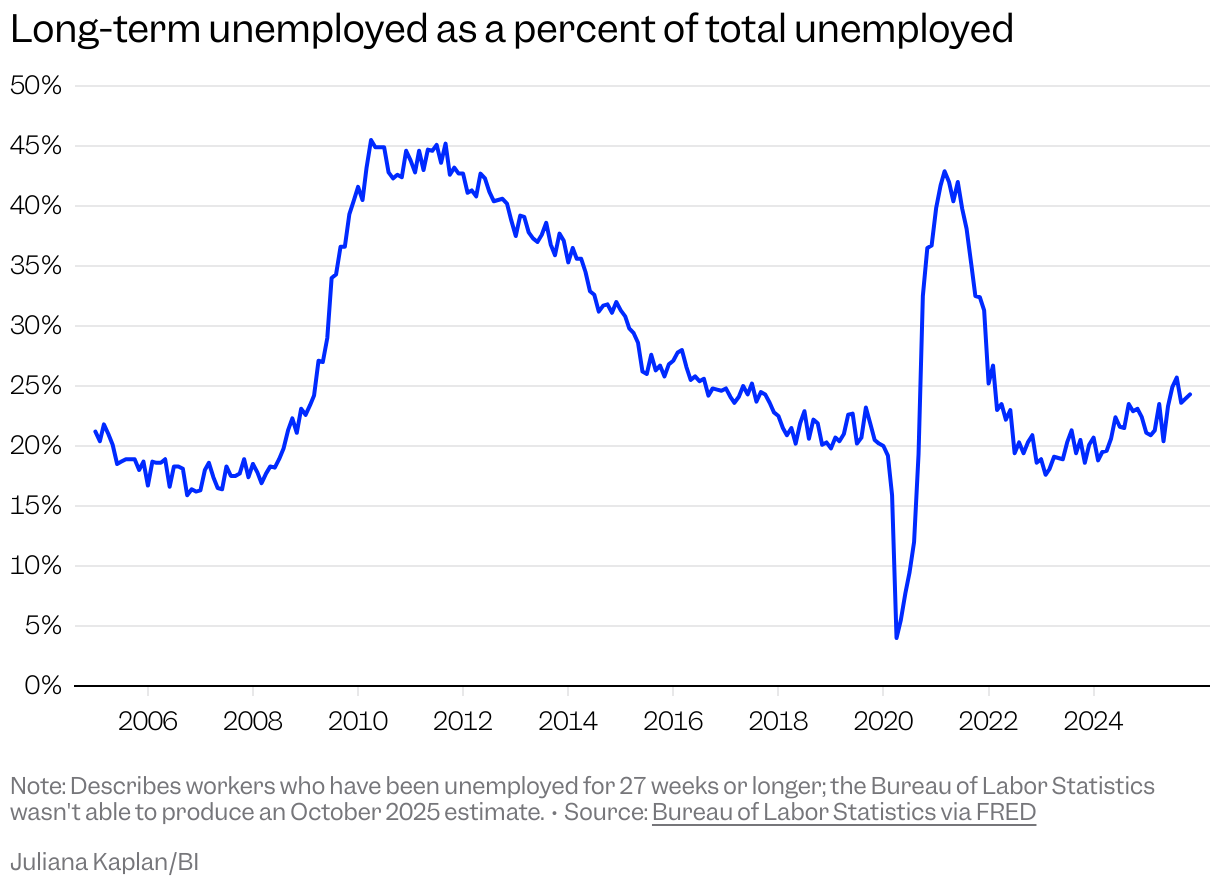
Long-term unemployment reached levels unseen since 2022
The share of workers who are deemed “long-term unemployed” — meaning they’ve been out of work for 27 weeksor more — has come to encompass a quarter of all unemployed Americans. That’s picked up in the back half of 2025, suggesting that many had spent a solid chunk of the year jobless.
For workers thrust out of their jobs, climbing back into the fold is an ever more daunting task.
Clair Todd, who was laid off two years ago, said constant job rejections can make you feel like you are not good enough.
“On top of that, you have to worry about paying the bills without money coming in,” she said. “I don’t want to say I’ve given up, but my search has been extremely discouraging.”
She stopped actively looking for a new position a few months ago and instead prioritized building a website development business.
Young adults haven’t been this unemployed since the early pandemic
The 2025 job market was brutal for every generation, but Gen Zers are in an especially tough spot. The unemployment rate for 20- to 24-year-olds reached 9.2% in August and September, the highest figure since the recovery from the pandemic recession.
“I was applying and I felt like, ‘This is so stupid because I know I’m going to get rejected,’ recent grad Bella Babbitt told Business Insider last spring.
For those with a college degree, the prospects have been especially grim. The educated 20-something unemployment rate has consistently surpassed the overall unemployment rate since 2021, and the gap haswidened. It’s not unusual for young people to be out of work at higher levels than the general population, but a degree has historically boosted young people’s chances of landing a job. Young men were more unemployed than young women this year, in part because women tend to dominate one of the few growing sectors of the job market: healthcare.
Business Insider has heard from dozens of Gen Zers this year. Some are pivoting from white-collar fields to more seemingly secure blue-collar work, while others said they’ve submitted hundreds of applications without any luck. Most felt their traditional paths to success disappeared in 2025: The Trump administration’s DOGE initiative slashed opportunities in the federal workforce, AI is snapping up entry-level tasks in fields like tech, and major companies aren’t hiring due to economic headwinds.
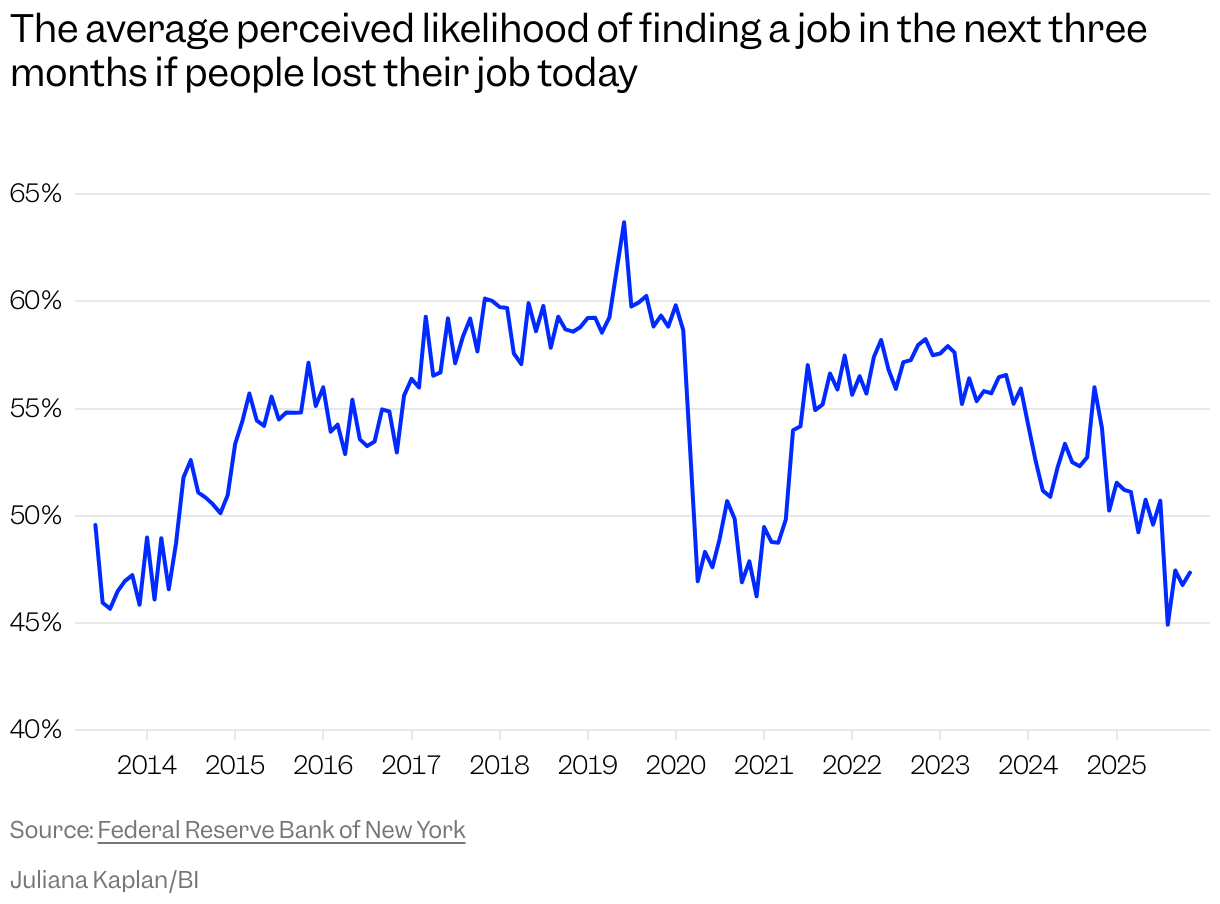
Workers aren’t confident about finding a job if they lost theirs
The US isn’t in an official downturn, but workers and consumers had an especially bleak outlook this year.
The New York Fed asks people about how likely they think they could find a new job in the next three months if they lost their role today. The average probability fell to its lowest point in August since the survey began in 2013. It’s only seen mild recovery since.
Weaker worker sentiment has been paired with fewer job opportunities than a few years ago, stubborn inflation, tariff chaos, and relatively high interest rates.
“I went through months of job searching — about four to five months — and it was really scary, it was really harsh, it was really painful,” Mohan, the recent college grad, said. “It took a really huge emotional toll and a big toll on my mental health, too.”
Jacob Zinkula contributed reporting for this story.