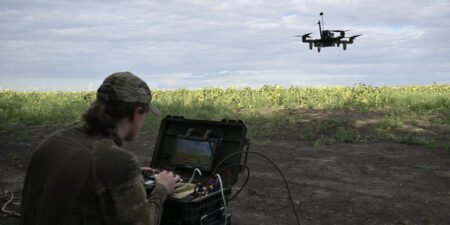









For the last two decades, investors favored “bits” businesses — software, apps, and online platforms. The logic was simple: software scales cheaply, distributes instantly, and can generate huge margins once built. By contrast, “atoms” businesses, involving physical assets like factories, logistics, or energy, were seen as slower, capital-intensive and less profitable.
That balance is starting to shift.
A growing number of investors and founders now argue the rise of AI is flipping the script, making atoms-based businesses relatively more attractive than their bits-based counterparts.
Travis Kalanick’s comeback underscores the point. The Uber cofounder relaunched his effort under a new umbrella called Atoms, focused on manufacturing, food logistics, mining, and robotics.
“Software has automated tasks of language and math, but the complete automation of the physical world — autonomy — remains largely untouched territory,” he wrote.
Supply dynamics
This change is happening because AI is upending supply dynamics across the tech industry and beyond.
AI is dramatically increasing the supply of digital goods — code, text, images, even video. Digital work that once required skilled workers can now be done faster and cheaper with help from AI machines. That’s great for productivity, but it also means software and other digital products are becoming more abundant, and therefore, according to the law of supply and demand, less valuable.
Joe Fath, a partner at Eclipse who invests in physical industries, describes this as a structural shift. Historically, he said, software businesses had a major advantage because they required far less capital to reach “escape velocity,” where they could sustain themselves. Asset-heavy companies, by contrast, needed more capital, faced uncertain timelines, and so were often higher risk.
“That’s changing quickly,” Fath said.
AI is not only automating digital work, it’s starting to make the physical world more programmable. Advances in robotics and systems that combine vision, language, and action are allowing companies to bring software-like efficiencies to industries such as manufacturing, logistics, and energy.
“For the first time, AI is making physical industries meaningfully programmable,” Fath said. “Opening the door for faster scaling with less capital and labor.”
Software commoditization
At the same time, AI is putting pressure on traditional software business models. If anyone can generate decent code or build an app with the help of AI, it becomes harder to maintain a competitive edge. That dynamic is already showing up in public markets, where software valuations are under pressure.
“If AI commoditizes software, what’s actually safe?” Michael Bloch, a partner at Quiet Capital, asked on X recently. His answers included:
- Regulated and liability-bearing businesses (someone has to be on the hook).
- Anything touching the physical world (hardware, manufacturing, energy).
- Operationally intense businesses (the “bad” businesses become the best ones).
Hard assets = moat
Even the companies building AI models face uncertainty, with open-source alternatives and competition from China, as venture capitalist Marc Andreessen recently noted. If the core technology becomes commoditized, value has to shift elsewhere.
One place it’s shifting is infrastructure — the physical backbone of AI.
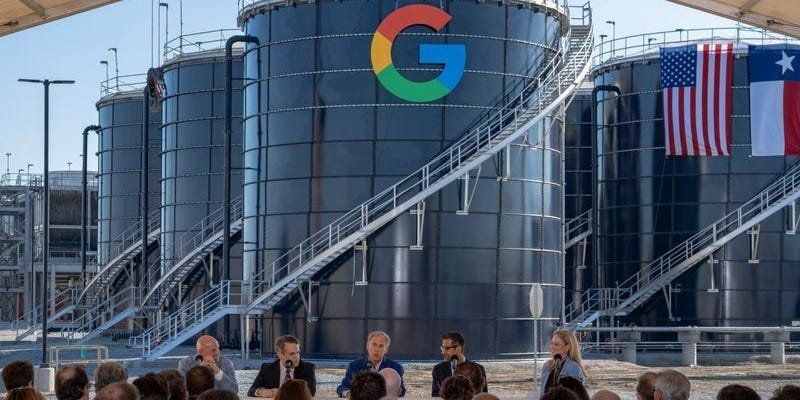
Big tech companies such as Microsoft, Google, Amazon, and Meta are pouring hundreds of billions of dollars into data centers, chips, networking gear, and energy. These are deeply physical, asset-heavy investments. In other words, even the biggest “bits” companies are becoming “atoms” businesses.
As a Googler famously wrote in an internal memo in 2023, “We have no moat, and neither does OpenAI.”
This reflects a broader realization: If AI models become roughly comparable, the winners may be those who can deliver them fastest, cheapest, and most reliably. That depends less on software alone and more on physical infrastructure.
Blending real and digital worlds
The same trend is playing out across industries. Companies like Tesla, SpaceX, and Amazon have long blended software with real-world operations. Now newer players — including Wayve, Anduril, and Redwood Materials — are doing the same, using AI to improve everything from defense systems to battery production. Importantly, AI complements these businesses rather than replacing them.
“In physical industries, you still must build and operate real things,” Fath said. “AI can’t fully replace that, in the way it can take over a call center or act as a coding agent.”
His bet is there are many more examples of companies like Redwood and Anduril coming. “Capital that once flowed primarily into software and consumer internet will increasingly shift in this direction over the coming years,” Fath added.
Job market impacts
This shift is also showing up in the job market. Roles tied to digital work — programming, customer service, data entry — are increasingly exposed to AI-powered automation. Meanwhile, demand for skilled, physical trades such as construction, electrical work, and maintenance is rising, partly driven by the buildout of AI infrastructure itself.
“AI is really still digital. Ultimately, AI can improve the productivity of humans who do things with their hands, like welding, electrical work, plumbing — anything that’s physically moving atoms like cooking food or farming or anything that’s physical,” Elon Musk said on a recent podcast. “Those jobs will exist for a much longer time. But anything that is digital, which is like just someone at a computer doing something, AI is going to take over those jobs like lightning.”
Scarcity = value
Still, the shift toward atoms isn’t without risk. Physical businesses remain hard to scale — what Musk has called “production hell.” They require significant capital, operational expertise, and strong execution.
Fath acknowledges that challenge. “You’re not just solving a technical problem — you then must scale it. And when you’re physically building things, scaling well is incredibly hard.”
Even so, the direction seems clear. As AI drives the cost and value of digital work down, scarcity — and therefore value — is moving back into the physical world.
“The future is physical,” said Rohan Pandey, a former researcher at OpenAI, wrote on X recently. “As AI drops the cost of computer work to ~0, the bottleneck (and thus capital) returns to the physical world.”
In that sense, the future of technology may look less like pure software, and more like a fusion of bits and atoms, with the latter increasingly taking center stage.
Sign up for BI’s Tech Memo newsletter here. Reach out to me via email at abarr@businessinsider.com.
Read the full article here