






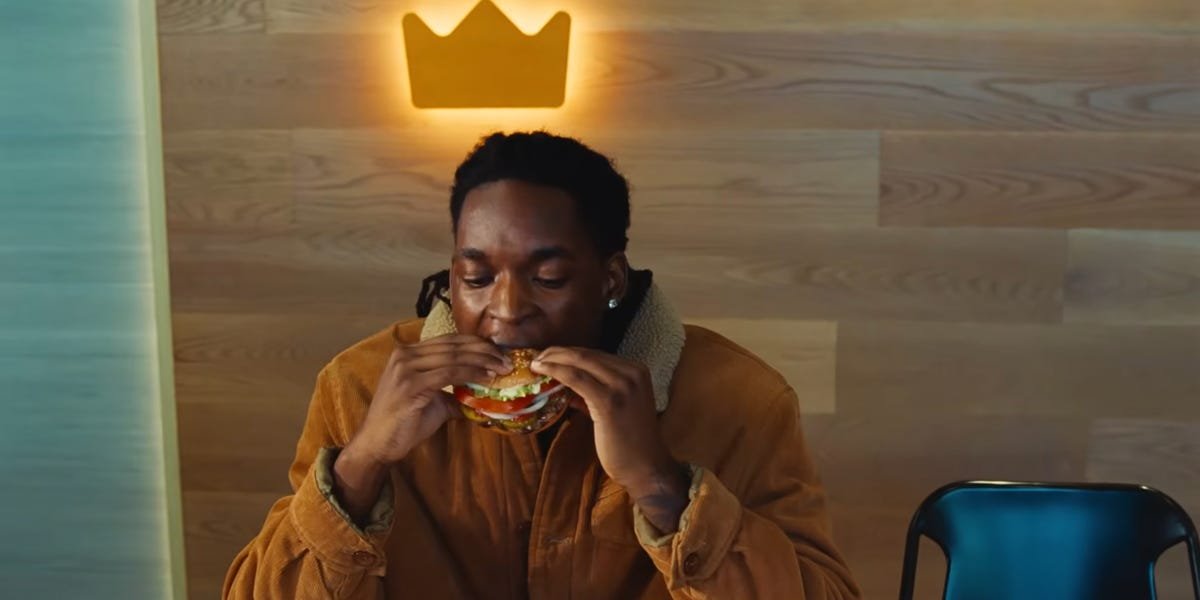


And the Oscar for splashiest ad campaign during the 2026 Academy Awards goes to… Burger King.
The fast-food giant went big to ensure its brand was all over the Oscars this year, airing a series of spots during the commercial breaks and on-air host mentions of its sponsorship at key moments throughout the ceremony. The standout ad was a 90-second mea culpa.
In the “There’s a New King, and It’s You” spot, Burger King owned up to past mistakes like slow service, burgers that got squished by substandard packaging, and fast food that “fell off.” The company said it had fired its King mascot, reinvested in its restaurants, and improved its decades-old Whopper burger recipe.
The Oscars blitz forms part of Burger King’s recent premiumization push.
Earlier this year, Burger King gave out a phone number for customers to call or text its US and Canada president, Tom Curtis, directly to give feedback about the business. Curtis told Business Insider’s Katherine Tangalakis-Lippert last month that he had received tens of thousands of voicemails and texts, with the Whopper “consistently one of the top topics.”
Another of Burger King’s Oscar’s ads that aired on Sunday night directly referenced how the company listened to customer feedback to improve the Whopper.
Burger King set the wheels in motion for its turnaround in 2022, with the launch of its $400 million “Reclaim the Flame” strategy. The program included the refurbishment of restaurants, the modernization of its equipment, and a significant investment in advertising.
Curtis has played a high-profile role in Burger King’s recent marketing efforts. He provided the voiceover for the “There’s a New King, and It’s You” ad. Earlier this month, Curtis also took a huge bite of a burger in a social media slapback to the viral clip of McDonald’s CEO Chris Kempczinski’s Big Arch “taste test.” The McDonald’s chief got roasted by social media users and rival fast-food chains over his wooden delivery and dainty mouthful, and for describing his own food as a “product” in a social media video.
Self-deprecation works — up to a point
Camilla Yates, managing partner at the creative agency Elvis, said Burger King’s Oscars push was likely to land well with viewers because the self-deprecating, authentic approach stands out from a broader trend of glitzy ad campaigns that lean heavily on A-list celebrities.
“They managed to bring together the operational optimization with this really interesting way of talking directly to the audience with their president,” Yates told Business Insider in an interview.
However, she added that Burger King shouldn’t lean on this type of functional marketing strategy for too long.
“It can quite easily become overly worthy, as soon as it’s not entertaining, people switch,” Yates said.
Brands often lean on the Oscars and the Super Bowl to make big statements as they’re one of the few remaining mass-market media events. The Oscars drew 19.7 million US viewers last year, according to Nielsen, the TV ratings provider.
Disney, which televised the Oscars on ABC and Hulu, said earlier this month that it had sold out its ad inventory for the telecast. Other advertisers included Rolex, Mazda, Pfizer, Verizon, and McDonald’s.
Vicky Bullen, CEO of the WPP branding agency Coley Porter Bell, said Burger King’s main ad conveyed confidence by acknowledging its missteps while also tapping nostalgia by including various cultural references to its history.
During volatile times, “people look to the past and the steadiness of times gone by for comfort,” Bullen told Business Insider in an interview.
Burger King can’t rest on its laurels. WPP’s BAV brand equity database, which assesses brand health, found that every fast-food brand in the US is falling from “leadership” roles into the “fatigued” category. Burger King is falling faster and further than others.
“If the brand is going to succeed again in the US, it really needs to communicate what makes it different,” Bullen said. “‘They may have to think quite radically about what their offer is and how they offer food that is relevant to a completely new generation with different attitudes toward food and health.”
Read the full article here